Istanbul Fishing Family’s 19-Hour Survival Story
When a trawler vanishes into Black Sea fog off Istanbul’s coast, one fisherman’s daughter refuses to leave the Karaköy pier until she knows the truth. What she learns about waiting, and about her father, changes the course of both their lives.
The smell hit Yusra Demir before the sound did: diesel, frying simit dough, and the particular mineral tang of the Bosphorus when a ferry churns too close to the seawall. She was standing on the Karaköy pier at six in the morning, holding a thermos of menengiç coffee that had gone lukewarm an hour ago, watching the water taxis line up like nervous horses.
You’re going to wear a hole in that dock, her uncle Tarık Demir said, coming up behind her with two simit rings threaded on his forearm like bracelets. Sit. Eat. The boat doesn’t come faster because you’re standing.
Trending Now!!:
She didn’t sit. She’d been a deckhand on her father’s fishing boat since she was eleven, and the one thing fifteen years of harbor work had taught her was that boats came when they came, and the waiting never got easier, it just got quieter.
The boat in question wasn’t her father’s. It was the Marmara Yıldızı, a forty-two-foot trawler that had gone out of Sarıyer two nights ago with six men aboard, including her father Halil Demir, and hadn’t answered radio calls since 4 a.m. the previous day. The Turkish Coast Guard had widened the search grid past Anadolu Kavağı, out toward the mouth of the Black Sea, where the currents got mean and the fog sat low enough to swallow a hull whole.
Tarık, she said, if they don’t find him by noon, I’m chartering a boat myself.
With what money?




The same money I don’t have for rent. I’ll find it.
He didn’t argue. He’d known her long enough to know arguing with a Demir woman was like arguing with weather. Instead he handed her a simit, and she ate it without tasting it, watching gulls fight over fish guts near the ferry terminal, the Galata Tower rising grey and patient behind them like it had seen this exact kind of morning a thousand times before.
By ten, three other families had gathered on the pier. Sevgi Aydın, whose husband was the boat’s engineer. The Polat brothers’ mother, who’d brought a thermos of salep nobody touched. They formed the kind of silence that doesn’t need translating, the silence of people who make their living off a sea that doesn’t owe them anything back.
At 11:40, a Coast Guard cutter rounded the point past Üsküdar, moving slow, and Yusra felt her stomach drop the way it does on a fast elevator. Slow boats meant one of two things. They were either towing something broken, or they were in no hurry because hurry wouldn’t change what they’d found.
Don’t, Tarık said, gripping her arm. Don’t run at it. Let them dock.
She ran at it anyway.
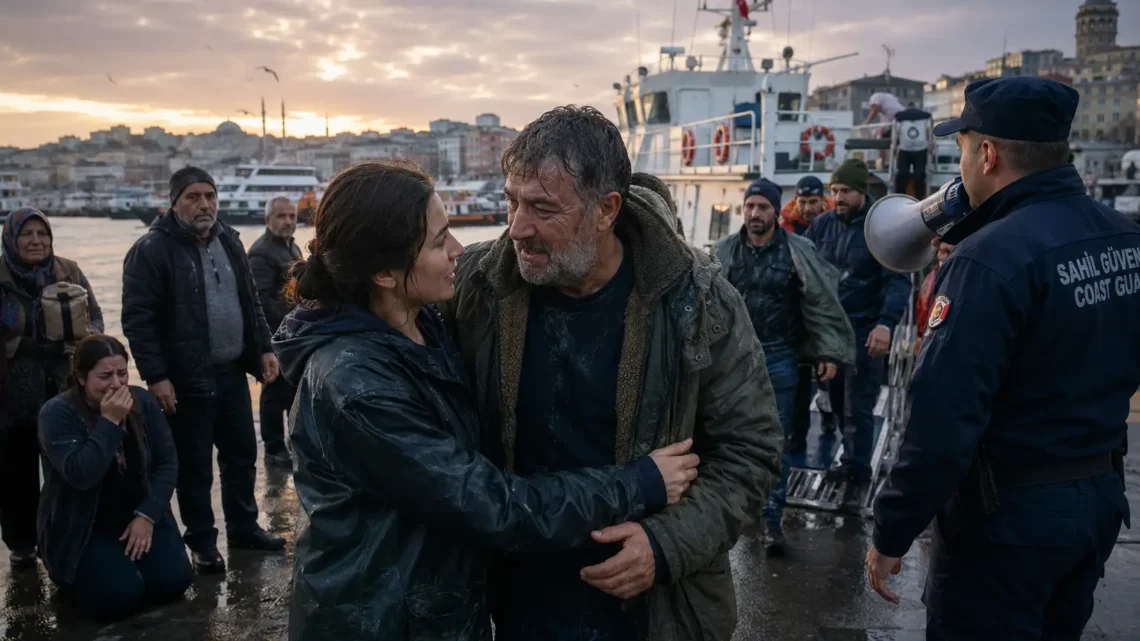
The cutter’s deck officer, a young man with a sunburn across his nose, was already lifting a megaphone before the boat finished docking. Family of the Marmara Yıldızı, he called, all six crew recovered. Alive.
The pier exploded into a noise Yusra had never heard a harbor make, something between a sob and a roar, and Sevgi Aydın dropped straight to her knees on the wet concrete and didn’t get up for a full minute. Yusra didn’t move. She watched the cutter come alongside, watched six men, salt-crusted and shaking, helped onto the gangway one by one, and the fifth one was her father, grey-faced, missing a boot, alive.
Baba, she said, and the word came out smaller than she meant it to.
Halil Demir looked at his daughter standing on the pier in her father’s old oilskin jacket, the one she’d worn since she was a teenager because it was the only thing of his that fit her, and he laughed, a cracked, exhausted sound. You waited on the dock the whole night?
Where else would I wait?
Your mother used to say that exact thing. Word for word.
She helped him down the gangway, her shoulder under his arm, and he told her later, once he’d slept fourteen hours and eaten three plates of his sister’s mücver, what had happened out past the strait. The engine had failed in fog so thick they couldn’t see the bow from the wheelhouse. They’d drifted for nineteen hours, rationing water, taking turns at the radio that wouldn’t transmit but might, just might, receive. He said the worst part wasn’t the cold or the thirst. It was not knowing if the silence on the other end meant no one was looking, or everyone was.
I kept thinking about your mother, he said. How she used to wait for me on this same pier before you were born. I thought, if I don’t come back, Yusra will be the one standing there now. And then I thought, no. She’ll be the one chartering a boat to come and get me herself.
I would have, Yusra said. I was already pricing it.
I know. He smiled, and for the first time since the cutter had appeared past Üsküdar, she let herself cry, not from fear anymore but from something looser, something that had been coiled in her chest since the first missed radio call.
Six months later, the Marmara Yıldızı went back out, engine rebuilt, radio replaced with a satellite unit that didn’t care about fog or distance. Yusra went with it this time, not as a passenger on the dock but as crew, her father’s first mate, because she’d decided somewhere in those nineteen hours of not knowing that she’d rather be the one on the water than the one watching it.
The Bosphorus didn’t get gentler. It never does. But the next time fog rolled in off the Black Sea, thick and grey and swallowing the horizon, Yusra was the one at the wheel, her father beside her, and neither of them needed to say what they were both thinking: that the sea takes what it takes, but this time, they were going through it together.