My Neighbour Emeka Introduced Me to Bitcoin and Ruined My Life
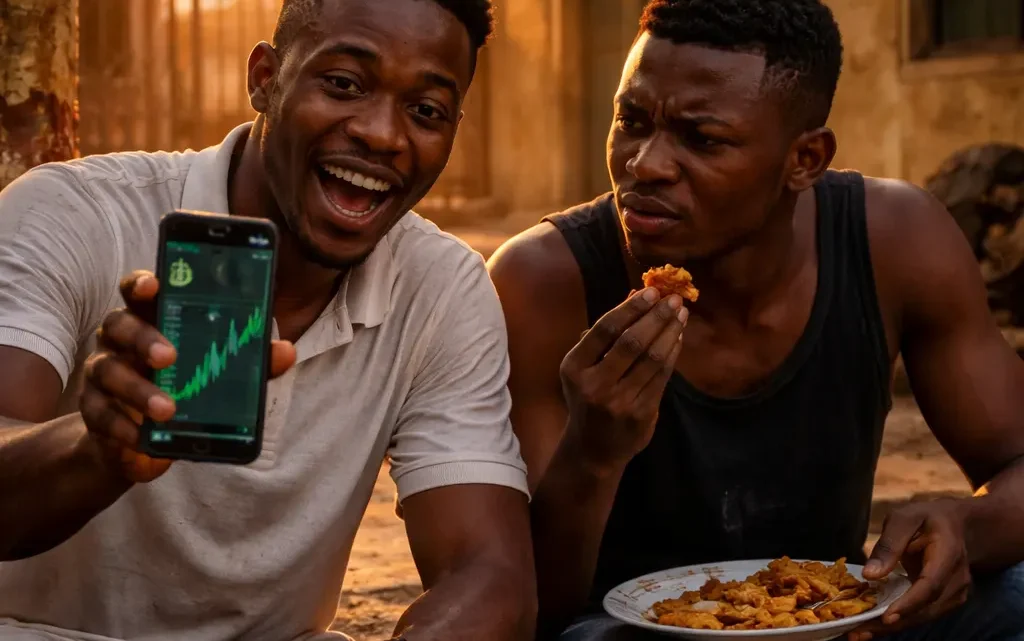
The first time I heard the word Bitcoin, I was eating fried plantain in a face-me-I-face-you compound in Yaba, Lagos, and my neighbour Emeka was sweating through his shirt like someone had just told him he won the lottery.
He had not won the lottery. It was worse.
Trending Now!!:
“Guy, this thing is going to make us millionaires,” he said, phone screen shoved so close to my face I could see my reflection in it. “One Bitcoin is already $400. By December, they are saying $1,000.”
I squinted at the green chart on his screen. It looked like a heartbeat monitor for someone who had just seen their ex at a wedding, jumping, dipping, then spiking back up dramatically.
“Where you wan keep the money?” I asked.
“Online wallet. It is called blockchain,” he said, very confidently, like he had not just learned that word three hours ago.
That was 2014. I was 26, broke, and dangerously optimistic.
Emeka convinced me to put in ₦50,000. That was every kobo I had saved from six months of freelance graphic design work. I remember sitting at the cyber cafe on Herbert Macaulay road, watching the guy behind the counter create my first cryptocurrency wallet.
The smell of cigarette and old cables. The fan that spun without actually cooling anything. The moment the wallet address appeared on the screen, a long string of letters and numbers that looked like someone sneezed on a keyboard, and the attendant said, “That is your address. Don’t lose it.”
I wrote it on the back of a GTBank deposit slip.
I lost it in three days.
Not the Bitcoin, just the paper. Which meant I also lost the Bitcoin. Because I had no recovery phrase, no backup, nothing. Just a memory of a wallet that sat somewhere on the Ethereum blockchain like an abandoned building in Ajegunle, full of someone’s hopes and never to be entered again.
Emeka had the nerve to laugh.
“You did not screenshot?” he said.
“I wrote it down!”
“On paper? Who keeps crypto seed phrase on paper in 2014?”
“Every serious crypto person does!” I shouted back.
He laughed harder. “You kept it on GTBank paper. That is the most Nigerian thing I have ever heard.”
That first mistake cost me ₦50,000 and about four months of pride. But it also gave me something I did not expect: obsession. I started reading everything. Bitcoin whitepaper by Satoshi Nakamoto, forum posts on BitcoinTalk, YouTube videos with terrible audio explaining what a decentralized ledger was. I fell asleep reading about proof of work. I dreamed about hash functions.
By 2015, I knew enough to be dangerous. By 2017, I was dangerous.
That year, the entire cryptocurrency market went insane. Bitcoin climbed from $1,000 in January to nearly $20,000 in December. Ethereum was doing things that made grown men cry in public. Every day, I was watching my portfolio on CoinMarketCap like a man watching a football match where his entire future is on the line.
I had invested smarter this time. Hardware wallet. Written seed phrases stored in two separate locations, one at home, one with my mother in Ibadan, who did not know what it was and called it “that useless book with alphabet.”
I was up 4,000% on my initial investment by November 2017. I felt like a genius. I started a WhatsApp group called “Crypto Millionaires in the Making” and added 47 people.
My cousin Bisi messaged me: “Ayo, is this safe? My pastor said crypto is gambling.”
I replied with the confidence of someone who had never actually experienced a full market crash: “Blockchain technology is the future of finance. Your pastor just doesn’t understand decentralized finance yet.”
Bisi put in ₦200,000.
Then January 2018 arrived.
The crash came like rain during harmattan, sudden, violent, and completely disorienting because nobody had predicted the timing. Bitcoin dropped from $19,500 to $6,000 in six weeks. Altcoins, those smaller cryptocurrencies I had piled money into, XRP, Litecoin, and a coin called TRON that I was absolutely certain was going to flip Ethereum, those dropped 80%, 90%, some 95%.
My WhatsApp group went from 47 active members to 12 people who were still replying. The others had gone quiet in the way that people go quiet when they are embarrassed and hurting at the same time.
Bisi called me.
“Ayo.”
“Bisi.”
“My money.”
“I know.”
Long silence.
“Should I sell?”
And here is where I made my second biggest mistake. I said, “Hold. This is just a market correction. DCA in. Buy more while it is cheap.”
Bisi bought more.
The market continued to fall for another 11 months.
I learned what HODL really meant that year. Not just hold. It means sitting with discomfort, watching green turn red, watching news headlines scream “Bitcoin is Dead” for the 400th time, and choosing not to panic sell. It means understanding that blockchain is not just a price, it is infrastructure.
The same way the internet crashed in 2000 and everyone said it was finished, and then ten years later Jeff Bezos and Mark Zuckerberg were running the world from their laptops.
By 2019, I had stopped checking prices daily. I started building instead.
I got into understanding smart contracts on Ethereum. I took an online course on Solidity, the programming language for writing smart contracts. I joined a small blockchain developer community in Lagos Island where about 15 of us would gather every Saturday in someone’s flat, eating chin-chin, arguing about gas fees and scalability like our lives depended on it.
One Saturday, a guy called Tunde walked in with a laptop and said, “I am building a DeFi protocol for informal savings groups. You know how people do ajo and esusu here? I want to put it on the blockchain.”
The room went quiet.
Then everyone started talking at once.
Because that, right there, was the most African, most practical, most beautiful use case for decentralized finance any of us had ever heard. Not for Wall Street. Not for Silicon Valley. For the woman in Onitsha who runs a rotating savings club and gets cheated by the organizer every third cycle.
I told Tunde, “I’m in. Whatever you need.”
We spent eight months building. There were nights I slept in the office, which was actually just Tunde’s living room with a whiteboard and three extension cables. We debugged smart contracts at 2am. We lost an entire week of work when someone pushed broken code to the main branch without testing. I personally introduced a bug that locked test funds in a contract for three days before we figured out what happened.
“You killed it,” Tunde said, not joking.
“I thought the function was correct!”
“The function was correct. The logic was not. That is the difference between a developer and a blockchain developer.”
That line hit me somewhere personal.
We launched a beta version in 2020. Small. Quiet. Only 200 users. But those 200 users saved and withdrew real money through a decentralized application built on Ethereum’s blockchain, with zero middlemen, zero bank charges, and complete transparency because every transaction was recorded on the public ledger.
One woman, a trader from Alaba Market, sent Tunde a voice note that he played for the whole group. Her voice was the voice of someone who had been cheated one too many times and had finally found something she could trust. She said, “This thing, I can see everything. Nobody can touch my money without my key. This is what we needed.”
We sat there in silence for a moment. Then Tunde said, “That is why we build.”
In 2021, the market exploded again. Bitcoin hit $60,000. NFTs were everywhere, digital art selling for millions on OpenSea, and people were making more money from JPEG profile pictures than from two years of employment. I watched it all with the eyes of someone who had already been burned once and learned to read the heat.
Bisi called again.
“Ayo, NFTs. Should I buy?”
“What do you know about NFTs?”
“That monkey one. Everyone is buying.”
I took a breath. “Bisi, let me explain. An NFT, a non-fungible token, is a unique digital asset recorded on the blockchain. It can be art, music, a game item, even a deed. The technology is legitimate. But right now, most of what you see is speculation, not value. If you cannot explain why a specific NFT has utility beyond being a profile picture, do not buy it with money you cannot afford to lose.”
Silence.
“So no monkey?”
“Only if you understand you might lose everything.”
Bisi did not buy the monkey. Six months later, that monkey NFT collection dropped 90% in value. She sent me a voice note that was just her laughing for 45 seconds.
I am writing this in 2025, and the blockchain space looks nothing like what Emeka and I were discussing over fried plantain in 2014. We now have layer 2 scaling solutions making Ethereum transactions faster and cheaper. We have Bitcoin ETFs approved in the United States. We have Web3 wallets that are as simple to use as a mobile banking app. We have real-world asset tokenization, where physical property and commodities are being put on-chain.
And we still have scams. Rug pulls. Fake projects. Celebrities promoting tokens they secretly dumped. That part has not changed.
What has changed is that I can now smell a bad project from the whitepaper. I can read tokenomics and tell you in ten minutes whether the team intends to build something or just exit with the liquidity. I can look at a crypto project’s GitHub repository and tell you if any real development is happening.
That knowledge cost me money. It cost me sleep. It cost me relationships with people who blamed me for their losses even when I had warned them.
But I would not trade a single lesson.
Because this industry, cryptocurrency, blockchain, decentralized finance, is still the most honest revolution I have ever witnessed. Honest not because it has no bad actors. It has plenty. Honest because the code is open. The transactions are transparent. The ledger is public. You can verify without trusting anyone.
In a world where trust has become the rarest currency, that means something.
Emeka still messages me every bull market season.
Last week he sent: “Guy, Solana is running. You think we should buy?”
I replied: “Have you read the whitepaper?”
He replied with a laughing emoji, then: “Guy, you don’t change.”
I smiled, closed the chat, and went back to reviewing the smart contract audit for a DeFi project I am consulting on.
Some of us stopped playing the market.
We started building the infrastructure.
And somewhere in Ibadan, my mother still has that little notebook she calls “that useless book with alphabet.”
She does not know it holds the key to the most important lesson of my financial life.
Never lose your seed phrase.
Never lose your patience.
And never, ever, let a man with a shaky chart and sweaty shirt talk you into anything without reading the whitepaper first.