She Was Being Evicted, But Every Thursday She Left Fresh Food Outside My Door
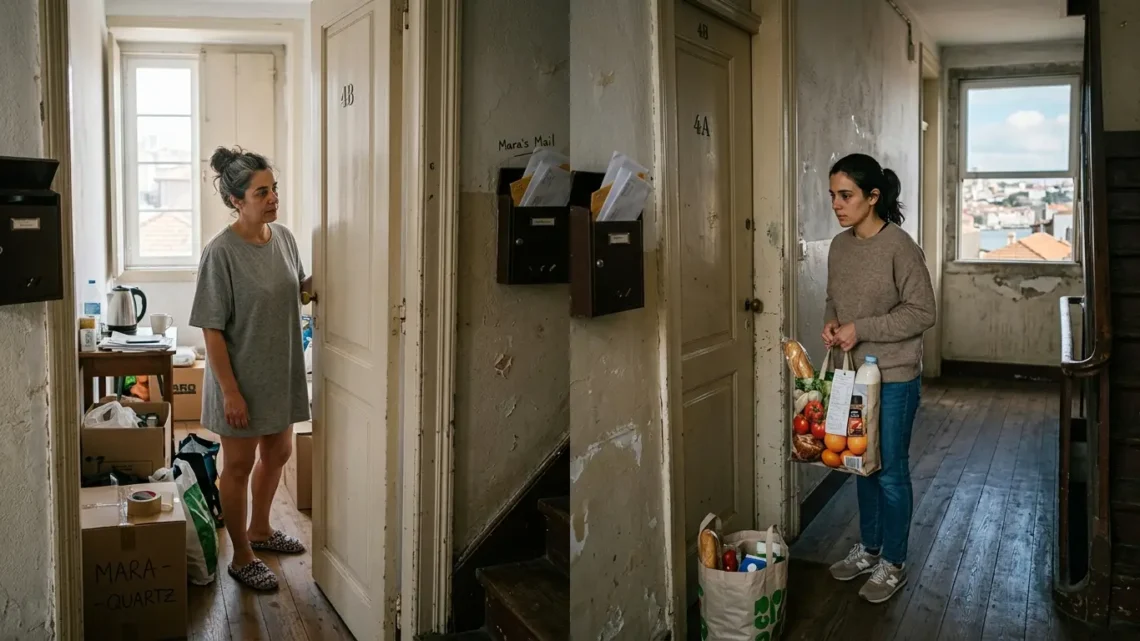
The third time I found a bag of groceries outside my apartment, I carried it upstairs and knocked on the door of the woman who had left it there. She opened the door wearing slippers, an oversized T-shirt, and the expression of someone who had been expecting a delivery she could no longer afford.
I think you left these outside my door, I said.
Trending Now!!:
She looked at the bag, then at me.
No, she replied. Those are yours.
I told her they were not. I had bought nothing that morning. The bag contained eggs, two tomatoes, a loaf of bread, a small bottle of cooking oil, and a packet of instant coffee. There was even a receipt folded neatly beneath the bread.
She looked genuinely confused.




You live alone, don’t you? she asked.
I said yes.
Then please keep them.
Before I could ask another question, she thanked me for bringing the bag upstairs and closed her door.
That was how I met Mara, my neighbour in apartment 4B, in a building on the outskirts of Porto, Portugal. At the time, I thought she was simply an unusual woman with strange ideas about sharing groceries. I had no idea that within a few weeks, I would be standing outside her apartment again, this time holding something that belonged to her and wondering whether returning it would be the right thing to do.
I had moved to Porto eight months earlier for a job at a small company that handled bookings for holiday apartments. My work involved answering emails, calling cleaners, updating reservation calendars, and apologising to tourists when the keys did not work.
It was not the kind of job I had imagined when I graduated, but it paid the rent. That was enough.
My apartment was small enough that I could stand in the kitchen and touch the bedroom door without taking a step. The heating was unreliable, the bathroom window never closed properly, and the washing machine made a noise like a motorbike struggling uphill.
Still, I liked the place.
Every morning, I bought a coffee from a bakery near the bus stop when my budget allowed it. On better days, I added a pastry. On worse days, I made instant coffee at home and pretended I preferred it.
Porto was beautiful in ways that sometimes made me feel guilty for being unhappy there. The old buildings, the narrow streets, the smell of bread coming from bakeries before sunrise, and the view of the Douro River could make an ordinary afternoon feel special.
None of that stopped the bills from arriving.
My salary had stayed the same while my rent increased. The supermarket seemed to charge a different price for everything every time I visited. I had started checking my bank balance before buying lunch, and I knew exactly how many days remained before payday without needing to look at a calendar.
I was twenty-nine and becoming very good at making a small amount of money look like enough.
Mara appeared to be about fifty. I rarely saw her outside the building, except when she carried a reusable shopping bag or collected parcels from the entrance.
She lived alone. I knew that because I had never seen anyone enter or leave her apartment with her.
She was polite but not especially friendly. If we met on the stairs, she greeted me with a small smile. If I held the door for her, she thanked me. We had never sat together, shared a meal, or discussed anything more personal than the weather.
The groceries changed that.
The following Thursday, another bag appeared outside my door.
This one contained rice, onions, a tin of sardines, and three oranges.
I knocked on Mara’s door again.
You really need to stop doing this, I told her when she answered.
She looked past me at the bag.
Why?
Because I can’t keep accepting food from someone I barely know.
She studied my face for a moment.
Are you embarrassed?
The question caught me off guard.
No. I just don’t understand why you’re buying groceries for me.
She leaned against the doorframe.
Maybe I buy too much. Maybe I don’t like seeing food wasted. Maybe I like knowing somebody will eat what I cannot finish.
Then why not give them to a food bank?
She smiled slightly.
Because I know where these are going.
I had no answer to that.
She insisted that I keep the groceries. I eventually agreed, partly because I was tired of arguing and partly because I could not ignore the fact that the bag contained things I had planned to buy that weekend.
I cooked the rice with the sardines that evening. I fried the onions, added a little tomato paste, and ate at my small kitchen table while watching a video on my phone.
For the first time in weeks, I did not calculate the cost of every ingredient while I ate.
That should have made me grateful.
Instead, I felt uncomfortable.
I did not know Mara well enough to understand her generosity, and I had no idea whether she could afford it. I was accepting food from someone who might have been struggling just as much as I was.
The next morning, I bought a small cake from the bakery and left it outside her door with a note thanking her.
When I returned from work, the cake was sitting outside my apartment.
The note was still attached.
She had written three words beneath my message.
Eat it yourself.
I laughed for the first time that day.
After that, we developed an arrangement neither of us officially acknowledged. Every week or so, groceries appeared outside my door. Sometimes there was bread and milk. Sometimes there were vegetables, pasta, or a bag of apples.
I tried returning the favour with small things. A loaf of bread. A container of soup. A packet of biscuits.
Mara returned nearly everything.
The only items she accepted were things I had cooked myself, and even then, she usually brought back the container filled with something else.
Eventually, I stopped fighting her.
I also started noticing things about her.
She never carried shopping bags that looked particularly heavy. She always checked the mailboxes before climbing the stairs. She had a habit of standing by the entrance after collecting her letters, sorting them into neat piles before going upstairs.
Some envelopes were opened immediately. Others disappeared into her handbag.
One afternoon, I saw her sitting on the steps near the entrance, holding an unopened letter.
She was not crying. She was simply staring at it.
I almost walked past.
Instead, I asked if everything was all right.
She folded the letter and placed it in her handbag.
Everything is expensive now, she said.
I nodded. It was the kind of sentence everyone in Porto seemed to say eventually.
Especially electricity, I replied.
She gave a short laugh.
Especially being alive.
I did not know what to say to that.
She stood up, adjusted her cardigan, and climbed the stairs.
For several days afterward, I thought about her answer. It had sounded like a joke, but she had not smiled when she said it.
I began wondering whether the groceries were her way of avoiding something else. Perhaps she had too much money. Perhaps she was lonely. Perhaps she simply enjoyed doing something useful for another person.
I never asked.
Then, one Monday evening, I came home and found no groceries outside my door.
That should not have mattered. I had never asked for the food, and Mara had never promised to bring it.
Still, I noticed the empty space.
On Tuesday, there was nothing.
On Wednesday, I passed her apartment and heard a television playing inside. I knocked to ask whether she needed anything from the supermarket.
There was no answer.
I assumed she was out.
On Thursday, I saw her in the entrance hall carrying a cardboard box. She looked smaller than I remembered, and her hair was tied back carelessly.
Are you moving? I asked.
She stopped.
Not yet.
The answer confused me.
What do you mean, not yet?
She shifted the box in her arms.
The landlord wants the apartment back. I have until the end of the month.
It was the middle of the month.
I asked whether she had found somewhere else.
I’m looking.
She said it casually, as if she were talking about finding a new pair of shoes.
I offered to help her search online. I knew how difficult it was to find an affordable apartment in the area, but I also knew some websites and local groups where people advertised rooms.
She thanked me and said she would think about it.
That evening, I searched anyway. I found a few rooms, but most were either too expensive or too far from public transport. I sent her two links by message after she gave me her number.
She replied with a simple thank-you.
The next day, I discovered why she had stopped bringing groceries.
I was collecting my mail when the building manager, Rui, approached me with a clipboard. He was a broad man who always wore a clean shirt and carried a ring of keys that jingled whenever he walked.
He asked whether I had spoken to Mara recently.
I said I had.
He glanced toward the stairs.
She has been having some trouble, he said. I hope she finds somewhere soon.
I asked what kind of trouble.
He hesitated, then lowered his voice.
She has not paid her electricity bill for two months. There are other things, too.
I felt a sudden embarrassment.
I had accepted groceries from a woman who could not keep up with her own bills.
For a moment, I was angry. Not because she had given me food, but because she had allowed me to believe that she had plenty to spare. I had complained about my salary to her without ever considering that she might be in a worse position.
Then I remembered her words.
I like knowing somebody will eat what I cannot finish.
I wondered how much of that had been true.
That evening, I knocked on her door.
This time, she opened it almost immediately.
Her apartment was half packed. Cardboard boxes stood against the walls, and the small table near the window held a mug, a phone charger, and a stack of papers.
I told her what Rui had said.
She looked annoyed.
That man talks too much.
I asked why she had never told me she was struggling.
She gave me a long look.
Would you have accepted the groceries if I had?
I opened my mouth, then closed it.
She nodded as if I had answered.
People are generous when they think you don’t need anything from them. The moment they know you need something, everything changes.
I told her that was not fair.
Perhaps not, she said. Still, it happens.
I asked whether she had enough food.
She looked at me for a long moment before answering.
I have some.
I offered to bring her groceries. She refused. I offered to help with the move. She said she could manage.
I left feeling useless.
For the first time since moving to Porto, I had enough money in my account to cover my rent, utilities, and groceries without borrowing anything. It was not a fortune. I had simply received a small performance bonus at work after covering several extra shifts.
I could have offered Mara some money.
I thought about it all evening.
The problem was that I did not know how much she needed, and I did not want to insult her by making assumptions. I also did not want to become responsible for a situation I barely understood.
In the end, I did nothing.
The following Saturday, I returned from the supermarket with a bag containing potatoes, carrots, chicken, bread, and a carton of milk. I had bought more than I needed because everything was on sale.
When I reached my floor, I found Mara sitting outside her apartment with a small suitcase beside her.
She looked exhausted.
I asked whether she was going somewhere.
To my sister’s place for a few days, she said. She lives outside the city.
I looked at the suitcase, then at the apartment door behind her.
What about the rest of your things?
I’ll come back for them.
She did not sound certain.
I offered to carry the suitcase downstairs. She accepted, which surprised me.
As we walked toward the entrance, she told me that her sister had offered her a room, but they had not spoken properly in almost six years. They had fallen out over their mother’s apartment after their mother died.
Her sister believed Mara had kept money that should have been shared. Mara believed she had paid debts and expenses nobody else wanted to handle.
Neither woman had changed her mind.
She called me last week, Mara said. I didn’t answer the first two times.
I asked what made her answer the third.
The landlord gave me a date.
She said it without bitterness.
At the entrance, I asked whether she wanted me to keep the groceries I had bought.
She looked at the bag.
Of course. Those are yours.
I almost laughed, but something in her face stopped me.
I asked if she had enough money for the journey.
She said yes.
I knew she was lying. The bus fare was small, but she had spent the past week packing her life into boxes and avoiding conversations about money.
I took a twenty-euro note from my wallet and held it out.
She stared at it.
No.
It’s not charity, I said. It’s for the groceries.
She frowned.
What groceries?
The ones you’ve been leaving outside my door.
She looked at the money for a long time.
Then she pushed my hand back toward me.
I didn’t give you those things because I wanted something in return.
I told her I knew.
Do you?
I had no answer.
She picked up her suitcase and walked toward the pavement. I watched her until she reached the bus stop, then returned upstairs.
The empty space outside my apartment looked larger than it should have.
For the next two weeks, I did not hear from her.
I occasionally wondered whether she had made peace with her sister. I wondered whether she had found a new apartment or whether she was sleeping in the spare room while two people tried to forget six years of anger.
I also wondered whether I should have insisted on helping her.
My own life returned to its ordinary rhythm. I went to work, checked my bank balance, cooked simple meals, and complained about the cost of heating.
The groceries stopped arriving, but I had become accustomed to buying my own food again.
Then, one evening, I received a message from an unknown number.
It was Mara.
She asked whether I was home.
I said yes.
Ten minutes later, someone knocked on my door.
When I opened it, she stood in the hallway holding a small envelope.
She looked better. Her hair was neatly combed, and she wore a coat I had never seen before.
I wanted to give you this before I forgot, she said.
Inside the envelope was a handwritten list of recipes. There were simple instructions for lentil soup, roasted vegetables, chicken stew, and a potato dish with onions and paprika.
At the bottom, she had written the name of a small grocery shop near the building where she had lived.
I looked up.
What is this?
She smiled.
Things you can cook when you don’t have much money.
I laughed, then felt my throat tighten unexpectedly.
I asked whether she had found somewhere to live.
She said she was staying with her sister for now. They had not settled their old argument, but her sister had given her a key and told her she could stay until she found a place.
We are not friends again, Mara said. Not yet.
She seemed comfortable admitting it.
I asked whether she wanted to come inside for tea.
She looked at her watch and said she had to catch a bus. Before leaving, she touched the envelope in my hand.
There is one thing I want you to understand.
I waited.
When I started bringing you food, I had enough. Not plenty, but enough. I was cooking for one person and buying things in sizes meant for two or three. I hated watching food go bad.
She paused.
Later, things became difficult. I kept bringing the food because I had already started, and I didn’t know how to stop without explaining myself.
I stared at her.
You could have told me.
Yes, she said. I could have.
She did not apologise, and I did not ask her to.
After she left, I sat at my kitchen table and read the recipes. Some were written in careful handwriting, while others had corrections squeezed into the margins. Beside the lentil soup, she had written that it tasted better the next day. Beside the potato dish, she had noted that it could feed three people for less than the cost of a restaurant lunch.
I made the soup that weekend.
It was good.
A month later, I heard from Rui that Mara had found a small room near her sister’s home. She had started working part-time at a neighbourhood shop, and she was saving money toward a place of her own.
I was relieved, though I knew very little about what had happened after she left.
Sometimes I still think about the groceries. I think about how easily I accepted them when I believed they cost her nothing, and how quickly I became uncomfortable when I discovered that they might have cost her something important.
I also think about the twenty-euro note she refused.
Perhaps I had offered it because I wanted to help. Perhaps I had offered it because I wanted to feel less guilty about accepting so much from her. Those two things can look almost identical from the outside.
I have not seen Mara in person since that evening. We exchange messages occasionally, usually about ordinary things. She once sent me a photograph of a pot of soup she had made. I sent her a picture of mine, and she replied that I had cut the carrots too large.
Last week, I bought a bag of groceries that was more than I needed. I carried it upstairs and stood outside my neighbour’s door for nearly a minute.
I could hear someone moving around inside.
For a moment, I considered leaving the bag on the floor and walking away.
Instead, I knocked.
When the door opened, I held out the groceries and asked whether they would be useful.
The neighbour looked surprised, then smiled and accepted them.
I went inside my apartment feeling lighter than I expected.
I still do not know whether Mara was right to hide her difficulties or whether I should have done more when I learned about them. I suspect the answer changes depending on which of us you ask.
The envelope of recipes remains in my kitchen drawer. I have used nearly every one of them.
I have never returned the envelope.
Some things are easier to repay when you stop trying to calculate what they were worth.
And sometimes the person who feeds you is not asking you to save them. They are simply trying to make sure that, for one more evening, nobody has to eat alone.