The Akara Seller Who Smelled the Scam Before It Introduced Itself
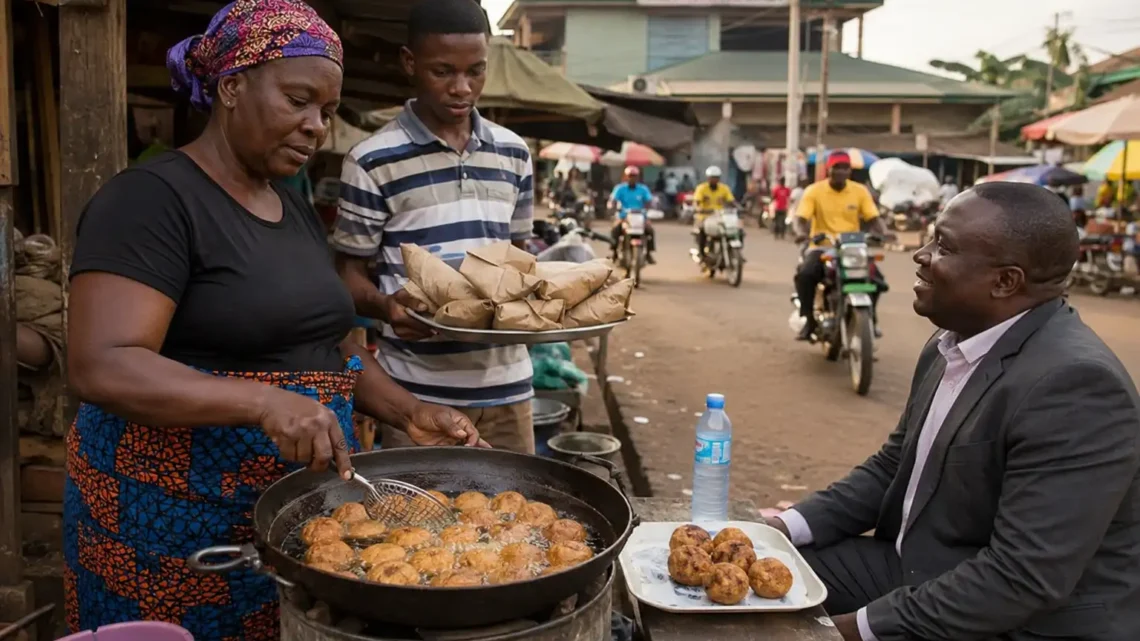
The smell hit Ogui Road before the sun did, that hot mix of palm oil and blended pepper rising off Mama Ngozi’s cast iron pot at exactly five forty in the morning, six days a week, for eleven years.
By the time the first okada riders were revving past Kenyatta Market in Enugu, she already had four hundred akara balls frying gold in three batches, her wrapper tied high above her ankles so the oil splashes wouldn’t catch her skin.
Trending Now!!:
Her son, Chibuike, was the reason the alarm went off that early. He was writing his final JAMB the following week, and Mama Ngozi had one plan and one plan only: sell enough akara and moimoi to keep him in the extra lesson classes at Federal Government College until the results came out, then push him toward university, then push him toward whatever came after that, because in her head the ladder only went up if you kept feeding it.
Mama, you go rest small, Chibuike told her that Tuesday morning, balancing a tray of moimoi wraps on his head the way she’d taught him since he was nine. Every day na the same five forty.
Rest go pay your school fees? she shot back, not even looking up from the pot. Abeg, go arrange the bench for me.
He laughed and did as he was told, because arguing with Mama Ngozi before six a.m. was a battle nobody in Uwani had ever won, not her husband before he passed, not her landlord, not even the LAWMA officials who once tried to fine her for the smoke.




That morning, a stranger sat on the bench nobody used, the one closest to the gutter, wearing a suit too heavy for Enugu heat and shoes that had clearly never touched red laterite dust before. He ordered four akara and a bottle of water, ate slowly, and watched Mama Ngozi work like he was studying something.
You don dey sell here long time? he asked eventually.
Eleven years, my brother. Since Chibuike still dey crawl.
The man introduced himself as Mr. Eze, said he worked with a microfinance outfit called Sterling Roots Cooperative, and that he’d been sent to the area to identify hardworking traders for a new loan scheme, small collateral, low interest, quick disbursement.
He said her name had come up already, that a woman two streets away had mentioned the akara seller who never missed a morning even during the fuel scarcity in January when everybody else’s stalls stood empty.
Mama Ngozi wiped her hands on her wrapper and considered him properly for the first time. She had heard versions of this story before: the man from the church who promised seed money and vanished with the offering, the cousin’s friend who collected contributions for a cooperative that turned out to exist only in WhatsApp screenshots. Enugu traders traded these stories the way other people traded gossip about celebrities.
How much be the collateral? she asked, arms folded.
Fifteen thousand naira processing fee, and we release two hundred thousand within one week, Mr. Eze said, already sliding a form across the bench. Small thing for a woman like you. Expand the business, maybe open a proper shop for your son’s sake.
Mama Ngozi didn’t answer immediately. She turned back to her pot, flipped six balls of akara with the flat of her ladle, and let the silence stretch until it turned uncomfortable for him and not for her.
Oga, she finally said, fifteen thousand naira be three days’ profit for me. If I give you and nothing come back, na my son’s lesson fee I don burn.
Madam, I no be scam, he insisted, sitting up straighter. I get office for Independence Layout. You fit come verify.
Then I go verify, she said simply, before I release even one kobo.
He left without pushing further, which told her everything she needed to know, because real cooperative officers, the ones she’d actually dealt with through the trader’s union, never got irritated by a woman asking questions. Chibuike came back from delivering the moimoi and found his mother laughing quietly to herself, shaking her head over the pot.
Wetin happen? he asked.
Na scam man wan chop my akara money, she said. E think say because I dey sell for road, I no get sense.
Two weeks later, after Chibuike finished his JAMB and they were both hunched over her small Itel phone waiting for the result portal to load, a woman from the union WhatsApp group posted a warning: a man calling himself Mr. Eze, sometimes Mr. Obi, had collected processing fees from at least six traders across Uwani and Achara Layout before disappearing, his phone number now switched off. Someone had gone to the Independence Layout address he’d given and found an empty shop, still smelling of fresh paint, rented for exactly one month.
Mama Ngozi read the message twice, then went back to refreshing the JAMB portal, because that mattered more to her than a man who’d failed to steal from her. When Chibuike’s score finally loaded, two hundred and eighty one, well above what he needed for Computer Science, she didn’t scream or cry the way the neighbors’ mothers did in videos online.
She simply stood up, untied her wrapper, retied it properly, and said, Oya, make we go buy fish. Today na celebration day.
Word moved through Uwani fast, the way it always does, about the akara seller who smelled a scam before it even finished introducing itself, and about her son’s JAMB score arriving in the same week like a reward for her stubbornness.
Other traders started stopping by her stall not just for akara anymore, but to ask her opinion on offers that sounded too smooth, contracts that arrived too fast, strangers whose kindness had no visible root.
Mama Ngozi never called herself wise. She said she’d simply spent eleven years learning that anything worth having in Enugu, or anywhere else, usually came slow, hot, and a little burnt at the edges, just like the akara in her pot, and that anyone offering it fast, cool, and perfect was the one you needed to watch closest.
By September, Chibuike was registered for his first semester, his fees paid entirely from a pot of oil, a bench by the gutter, and a mother who had learned, the hard way, that the safest bank account in Nigeria was still her own two hands.
Some hustles are built on shortcuts. Hers was built on refusing them, one akara ball at a time.