
The Day I Sent a Voice Note About My Mother-in-Law to the Wrong Group in Lima
The blue ticks came on at 1:47 on a Thursday afternoon, and I knew before I opened the chat that I had wrecked my Sunday.
Possibly my marriage. I was sitting in a cafeteria on Avenida Salaverry in Lima, halfway through a lentil stew and a leg of fried chicken, fourteen soles with the drink.
Trending Now!!:
The voice note was fifty-two seconds long. I had recorded it ten minutes earlier on the pavement outside the bank, still hot from watching the teller read me my balance.
It was meant for Álvaro, a friend from my old office. It went instead to Familia Quispe Almuerzo, a group of seventeen people that included my wife, her aunt, three cousins and Doña Teresa.
I will not repeat all of it. The short version: I said Doña Teresa treated her money like a leash. I said she gave Carmen and me 1,800 soles every month toward the rent and then mentioned it at every Sunday lunch, somewhere between the soup and the main plate.
I said I was tired of eating her tallarines verdes while being audited. I said that after eight years of marriage she still called me “el muchacho.” Then, because I was on a roll and the street was loud, I said the sofa she bought us was the ugliest object in Jesús María.




I deleted it for everyone. The app let me. It left a grey line in its place, This message was deleted, which is worse than silence, because now seventeen people knew something had happened and only six of them knew what.
Three dots appeared under Joaquín’s name. He is Carmen’s cousin, thirty-four, and has never let a single thing go in his life.
Wait, what was that? I got a notification and now it’s gone.
A second message arrived a few seconds later. Rodri, I heard the first part before it vanished. Not saying you were wrong.
I paid, left half the chicken, and walked to the Metropolitano with my phone face down in my hand like something that might bite. On the bus I stood pressed against a man holding a rolled mattress and told myself that old people do not check their phones in the afternoon.
Doña Teresa is seventy-one. She only learned voice notes in February, when her grandson Mateo showed her the little microphone. She does not type because her thumbs land on the wrong letters.
At 2:31 the phone buzzed in my palm. A voice note from Doña Teresa. Four seconds long.
Rodrigo, hijo. Sunday, one o’clock. Don’t bring anything.
She had said hijo. In eight years she had never once said hijo. I played it six more times, with the speaker against my ear, hunting for the joke or the knife. Her voice was flat as a tabletop.
Carmen called at 3:15 from the dental clinic in San Isidro where she works reception. I could hear a drill whining in another room.
Tell me you didn’t mean the sofa, she said.
I meant the sofa, I said. Only the sofa.
She laughed, a real one, the kind that escapes before you can stop it. Then it stopped, and the drill took over the line.
She called me, Carmen said. She is already at the market. She is buying a whole hen.
What for?
Ají de gallina. She only makes it for birthdays, funerals, and when somebody has to be forgiven.
Is this a funeral or a birthday?
Rodrigo, I honestly do not know.
I waited for her to take my side. She did not. She breathed for a while, and somewhere behind her a patient was being told to rinse.
Eight months you have been between jobs, she said, quietly now. Eight months. Think about whose money kept the lights on.
I did not answer, because the true answer was sitting in my banking app. The construction firm in San Borja let me go in March, along with eleven others, with a letter that said restructuring.
Since then I have drawn floor plans for strangers, six hundred soles one month, nothing the next. Rent for our two bedrooms is 2,600. Rice, oil, gas and the Movistar bill do not care how many months it has been.
What I could not explain to Carmen, and could not have explained to the seventeen people in that group, is that the money was never the part that hurt. The money I could have survived.
It was the way Doña Teresa said the number out loud, with her spoon in the air, in front of Carmen’s brother, as if she were reading a receipt back to a shopkeeper.
That night we ate instant noodles, because neither of us had the energy to pretend. Carmen watched Netflix with the volume too low. I kept opening the group chat and closing it.
Tía Pilar had reacted to the grey line with a thumbs-up, which I will never understand, and on Friday morning she posted a flower with the words Good morning family, God bless this day. Nobody mentioned anything. Eleven people replied with the same flower.
Joaquín sent me a private message on Friday night. Brother, I listened to the whole thing. I had screen recording on by accident. I have deleted it. I think.
On Saturday I took the bus to Avenida Brasil to buy a cable I did not need, just to be somewhere that was not the flat. A man was selling oranges from a wheelbarrow, three for a sol. I bought six and had no idea who they were for.
At 11:58 that night, my phone buzzed on the arm of the ugly sofa. A Yape notification. 1,800 soles from Teresa Quispe, two days earlier than usual.
I stared at it. Every month for two years the transfer had come with a little message, always the same kind of message. For the little house. Mind the electricity bill. Once it said Eat something green. Once it was just a drawing of a house, made of three symbols, because she had found the emoji by accident and was proud of it.
This one had no message at all. The line was empty.
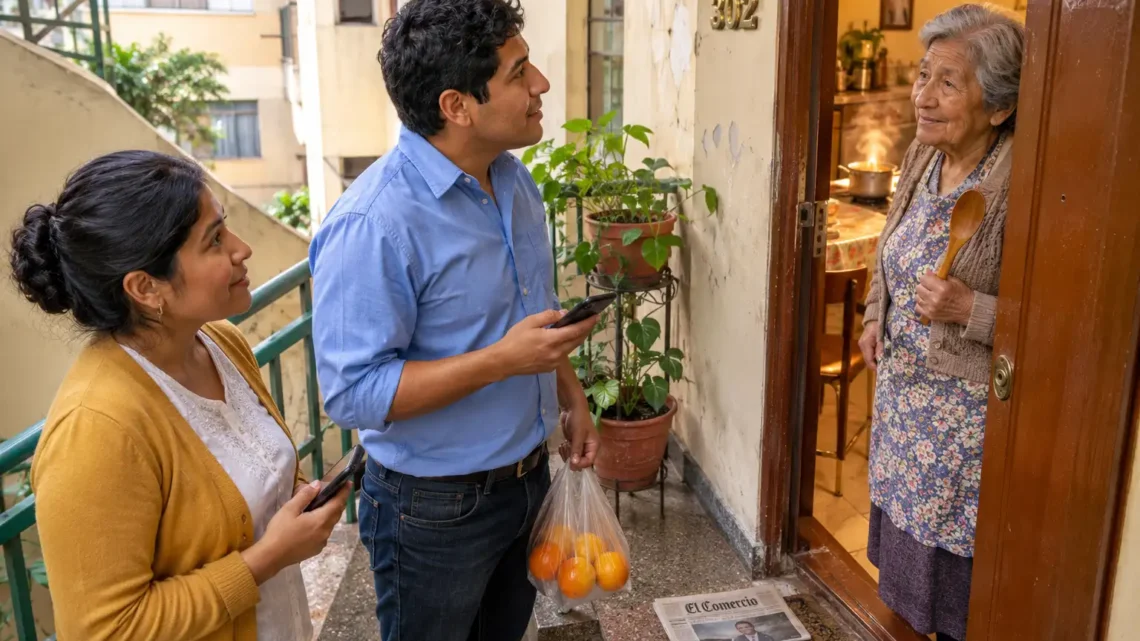
Sunday, 12:40. I stand on Doña Teresa’s landing on Jirón Huiracocha, third floor, with a bag of six oranges that she told me not to replace with anything. The whole stairwell smells of yellow pepper and toasted bread. Through the door I can hear a pot lid and the television and, under both, her humming something from before I was born.
Carmen is two steps below me, pretending to read her phone. Her eyes are not moving on it.
In my other hand, I have the banking app open. The 1,800 is still there, untouched. I could send it back with one thumb. I could record a new voice note, a real one, and hold it up to her ear. I could ring the bell and eat the hen and say nothing at all.
I do not know yet which of those men is walking in.
A true thing said in the wrong place does not become false, it only becomes impossible to take back.