The Girl Who Taught Me Everything About Love Including When to Walk Away
I was 27 when I met Zara, and I thought I finally understood women.
I had dated enough at that point to feel confident. I knew the right things to say on a first date, how to keep a conversation going, when to text and when to leave her wondering.
Trending Now!!:
I had read the books, followed the advice, and convinced myself that I had cracked the code on modern dating.
Zara destroyed that entire theory in under six months.
We met on a Saturday afternoon at a bookstore in Lagos. Not a dating app, not a mutual friend’s party. A bookstore, which should have told me everything. She was standing in the self-help aisle, holding a copy of Attached by Amir Levine, and she had the most focused look on her face, like the book owed her something. I walked over, not to impress her, but because I had been meaning to buy that same book for months.
“That one changed how I see relationships,” I said, nodding at the cover.



She looked at me with zero expression. “Have you finished it?”
“Not yet.”
“Then you cannot say it changed anything.”
She turned back to the page. I stood there for a second, unsure whether to laugh or leave. I laughed. She smiled, just slightly, and that was the beginning of the most clarifying relationship of my life.
Zara was a graphic designer with strong opinions about everything: architecture, jollof rice, people who type in lowercase on purpose, and especially, emotional availability. That last one came up on our third date, at a small restaurant on the island where the music was too loud but the fish was perfect.
“I don’t do situationships,” she said, cutting her fish cleanly. “I’m not interested in anything that doesn’t have direction.”
“That’s fair,” I said.
“It’s not just fair, it’s a boundary. Do you know what you want?”
I told her I wanted something real. And I meant it, at least in that moment. What I did not tell her was that I still had unresolved feelings for my ex, Temi, who had left two years earlier after telling me I was emotionally unavailable. I had never fully processed that. I just moved forward, the way most people do, filling the gap with casual dating and convincing myself I was healed.
Zara had a way of pulling things out of you without trying. She never interrogated. She just created so much emotional safety in her presence that you volunteered information you had buried. Two months into dating her, I was telling her things I had never said out loud.
“You still love Temi,” she said one evening, quietly, not as an accusation but as an observation.
I wanted to deny it. “It’s complicated.”
“It really isn’t,” she said. “You haven’t grieved the relationship. You just moved on. Those are different things.”
She was right, and that is the part nobody tells you about dating in your late twenties. You think experience makes you better at relationships. Sometimes it just makes you better at hiding your patterns. I had an anxious attachment style masked so well beneath confidence and charm that I genuinely could not see it. Zara saw it on week one.
We kept dating. The chemistry between us was real. We made each other laugh, we had the kind of conversations that stretched past midnight without either person noticing, and she cooked the best egusi I had ever eaten in my life, a fact I told her often and she always dismissed with a wave.
But I kept making the same mistake, pulling back whenever things got serious, going quiet for days when I was overwhelmed, and choosing independence over intimacy every single time the relationship demanded I show up emotionally. I told myself I needed space. Zara knew the difference between needing space and running from vulnerability.
The moment it cracked open was a Wednesday night. We had planned dinner. I cancelled last minute, something I had done three times that month, always with a reasonable excuse and always at the last minute. She did not argue. She did not send a long message. She just replied: “Okay.”
That single word scared me more than any fight.
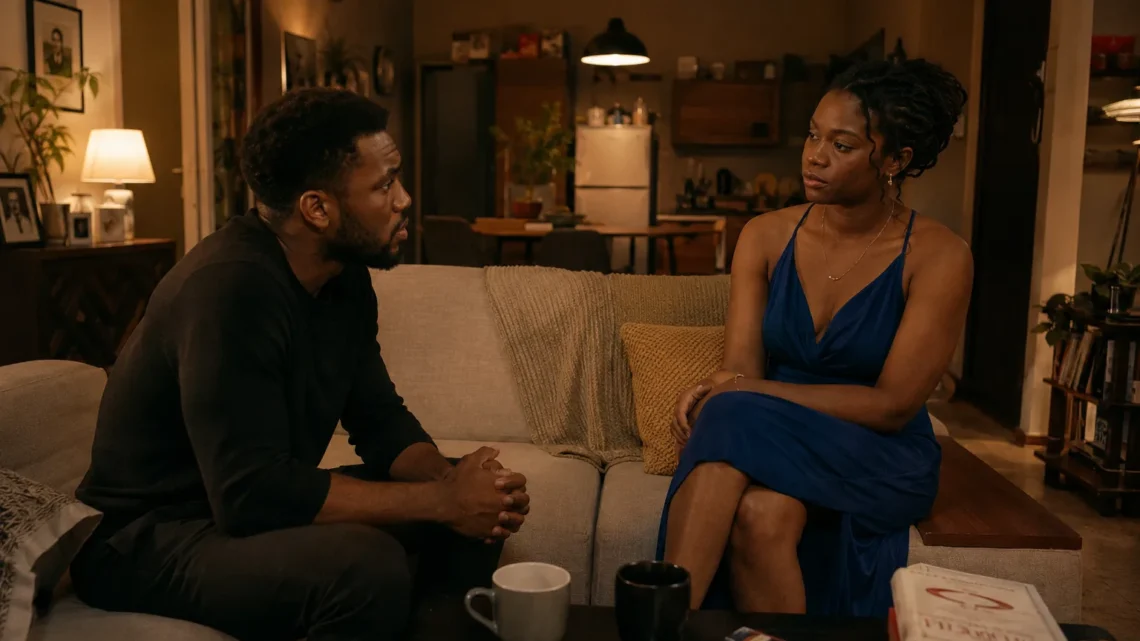
I went to her apartment anyway. She opened the door in a blue dress, clearly on her way somewhere, and she looked at me with the kind of tired eyes that come not from anger but from disappointment.
“I was just leaving,” she said.
“Can we talk?”
She stepped aside and let me in. The apartment was warm, smelled like shea butter and something baking in the kitchen. I sat on her couch feeling like the worst version of myself.
“I don’t know how to do this properly,” I said. “The closeness. I want it but I keep sabotaging it.”
Zara sat across from me, not beside me. That distance was intentional, and I felt it.
“I know,” she said. “And I’ve been patient because I see something real in you. But I am not a rehabilitation project, Michael. I need a partner, not a potential partner.”
“I’m trying.”
“Trying is for people who are still deciding. You need to decide.”
There was a long silence. The kind that fills a room completely.
“I’m not ready,” I finally said. The honesty of it surprised even me.
She nodded slowly, like she had already known and was just waiting for me to catch up. “Thank you for saying that.”
We sat there a little longer. She offered me tea, I declined, and when I left that night, we both understood without announcing it that this chapter was closing. No screaming, no drama, no list of grievances. Just two people acknowledging a truth they had both circled for months.
Here is what Zara gave me that no relationship course or dating advice column ever could. She showed me that emotional intelligence in relationships is not about grand gestures or the right words. It is about consistency, honesty, and the courage to face your own patterns before they become someone else’s problem.
After her, I did the work I had been avoiding. Therapy, actual therapy, not journaling and calling it healing. I learned about my attachment style, my avoidance triggers, and the role that unprocessed grief from Temi had been playing in every relationship since. I learned that communication in relationships is not just about talking. It is about showing up the same way in week twelve as you did in week two.
A year later, I met Adaeze at a friend’s small gathering. We talked for three hours and I did not once feel the urge to pull back. I texted her the next morning. Not three days later, not after calculating the right wait time. The next morning.
We have been together for four years.
Zara was not the love of my life. She was better than that. She was the relationship that prepared me for the love of my life.
And I have never taken that for granted.