The Night My Daughter Stopped Talking to Me And What It Taught Me About Parenting
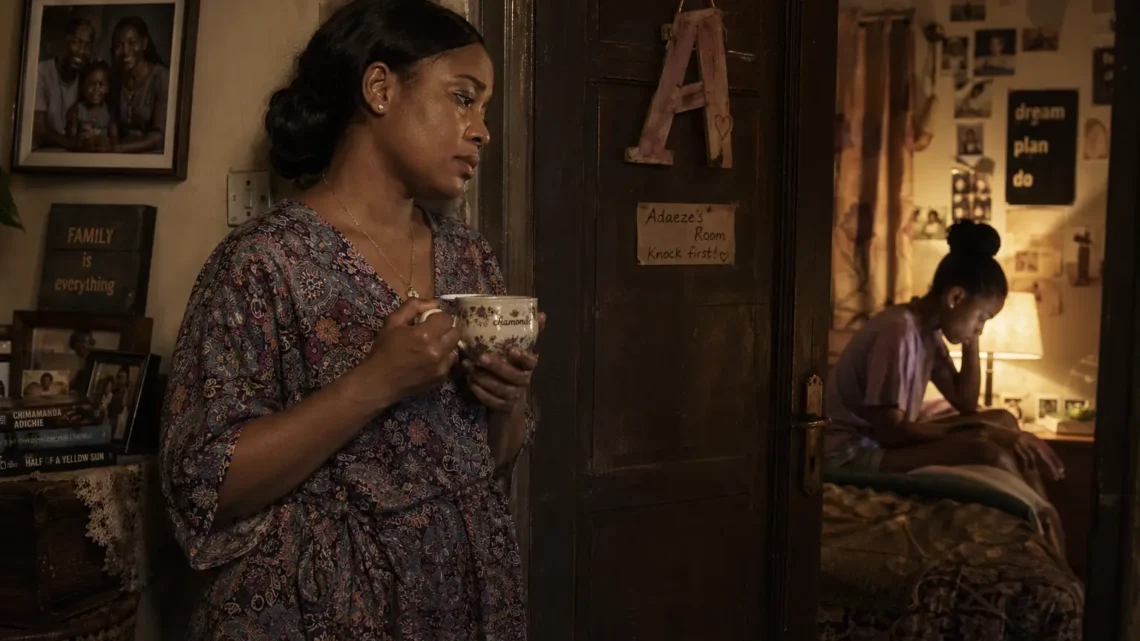
I remember standing outside a closed bedroom door at 11:47 p.m., holding a cup of chamomile tea I had made for no reason other than I needed something to do with my hands.
My daughter Adaeze was fourteen. The door had been shut for three days.
Trending Now!!:
I knocked. Silence. I knocked again. Nothing. I stood there longer than I should have, staring at the little wooden letter “A” she had painted herself at age seven and nailed crookedly to the door, back when she still wanted me in every room she entered.
That letter “A” nearly broke me.
I had been parenting for over a decade by the time Adaeze turned fourteen. I had a younger son, Emeka, who was nine. I had read the books, attended the school meetings, meal-prepped on Sundays, limited screen time, and scheduled family bonding nights every Friday. I had done everything the parenting experts, the child development articles, and the mommy blogs told me to do.
I genuinely believed I had cracked it.




“You’re such a cool mum,” Adaeze used to say, back when she was eleven and still thought I was interesting. She would crawl into my bed on Saturday mornings and we would watch cooking videos together, making up dramatic commentary over people flipping omelettes.
“That man is going to burn the entire kitchen, Mummy.”
“He already did. His eyebrows are gone.”
We would laugh until Emeka padded in, rubbing sleep from his eyes and demanding to know what was funny. Adaeze would pull him under the duvet and we would all three be a pile of warmth and noise and nothing wrong with the world.
I held onto those Saturdays the way you hold a receipt you are afraid to lose.
The transition from childhood to adolescence does not announce itself politely. There is no letter in the post, no meeting request, no gentle forewarning. One morning your child is building a blanket fort and asking you to be the villain in their story, and four months later they are rolling their eyes at the sound of your voice.
Every parent-child relationship I knew had survived this. I told myself I would too.
What I did not know was that the real challenge of raising teenagers is not the attitude or the slammed doors or the three-day silences. The real challenge is what those silences force you to examine about yourself.
The fight that sent Adaeze behind that door had started over something small. It always does. She had come home from school looking wrung out, school bag dragging on the floor, eyes doing that distant thing they did now when she was tired. I asked how her day was. Standard question. Safe territory.
“Fine.”
“What did you do?”
“Stuff.”
I felt the irritation rise before I could catch it. I had had a difficult day at work. Emeka had spilled an entire bowl of garri on the kitchen floor twenty minutes earlier and was currently watching cartoons as though he had done nothing.
The sink had dishes. The laundry was unfolded. I was tired and I was running on the particular brand of exhaustion that only parents of two understand, that feeling of being needed by everyone and replenished by no one.
“Adaeze, I’m talking to you. Can you not just answer me properly?”
She looked up from her phone. Something moved across her face. Not anger, not quite. Something older.
“I said fine, Mummy. What do you want me to say?”
“I want you to talk to me like I’m your mother, not a stranger you’re waiting to get away from.”
“I’m tired.”
“So am I.”
We looked at each other across the kitchen island and the silence between us was not empty. It was full of everything we were both too exhausted to say carefully.
“You never actually listen,” she said, very quietly. “You just wait for me to be done talking so you can tell me what you think.”
She picked up her bag and walked upstairs. The door clicked shut. I stood in the kitchen with the unfolded laundry and the dirty dishes and the sound of Emeka’s cartoon drifting in from the living room, and I thought: she is wrong.
But the thought did not land clean. It snagged somewhere.
That night, after Emeka was in bed and the house was quiet, I sat at the kitchen table and replayed every conversation I had had with Adaeze in the past three months.
I thought about the Monday she had tried to tell me something about a friendship falling apart at school and I had nodded while answering a work email. I thought about the evening she had shown me a short story she wrote and I had praised it, genuinely, but then immediately pivoted to asking whether her homework was done. I thought about the Sunday she had been unusually quiet at lunch and I had put it down to teenage moodiness and moved on.
She had been talking to me. I had been present in the room but absent in every way that counted.
This is the thing about positive parenting that nobody tells you: it is not a system you implement once and then run on autopilot. Emotional intelligence in children is not built from one conversation or one well-timed hug. It is built from ten thousand small moments of feeling genuinely seen. And the cruel irony of parenting is that the decade you spend building that foundation is the exact decade when life is also loudest, most demanding, most exhausting.
I had been giving Adaeze the parts of me that were left after everything else had taken their share. Leftover presence. Distracted love. I had believed, incorrectly, that because I showed up physically, I was showing up fully.
I was a good mother on paper. On paper did not count.
I waited until Friday, our old family bonding night, the one we had quietly let slide over the past year in favour of individual screens and separate corners of the house. I did not knock on Adaeze’s door that morning. I sent her a text instead, because I had learned, slowly and reluctantly, that teenagers sometimes receive the same words better through a screen than through a door.
Hey. No pressure. But if you want to watch something terrible and eat jollof rice on the couch tonight, I’ll be downstairs. I’ll even let you pick the show.
I put my phone down and went to cook.
Emeka appeared in the kitchen within four minutes, apparently having developed the supernatural ability to detect jollof rice from any floor of the house.
“Is that jollof? Is it Friday jollof?”
“Yes.”
“Is Adaeze coming down?”
“I don’t know yet.”
He climbed onto the kitchen counter, which I had told him not to do approximately four hundred times, and sat there watching me stir.
“She cried last week,” he said. “In her room. I heard it.”
I stopped stirring.
“Why didn’t you tell me?”
“Because she said not to.” He shrugged with the unbothered certainty of a nine-year-old who had delivered the information and considered his duty done. “She said you’d make it weird.”
I resumed stirring. Outside the kitchen window, the evening was going orange and slow, the kind of Lagos sunset that looked like someone had spilled something beautiful across the sky.
I heard footsteps on the stairs at seven forty-three. I know the exact time because I looked.
Adaeze appeared in the kitchen doorway wearing her old secondary school hoodie, the grey one with the fraying left cuff. She was not smiling. She was not frowning. She was just there, watching me.
“You made extra?” she asked.
“I made enough for six people. It is a character flaw.”
Something small happened at the corner of her mouth.
“Fine,” she said. “But I’m picking the show.”
“I already said that.”
“I know. I just wanted to say it too.”
We watched two episodes of a reality show so chaotic it required active group commentary to survive. Emeka fell asleep between us by nine, his head tipped sideways onto Adaeze’s shoulder, his breathing the slow even rhythm of a child who has never spent a night worrying about anything.
Adaeze looked down at him for a long moment.
“He still smells like a baby,” she said quietly.
“He will probably smell like a baby until he is thirty.”
She laughed. A real one. Not the polite, managing kind she had been giving me lately. The real kind that came from somewhere genuine and unguarded, the laugh I remembered from the cooking video Saturdays, the one that made her eyes close and her shoulders shake.
I said, “Adaeze, I owe you an apology.”
She looked at me.
“I’ve been here,” I continued, “but I haven’t really been listening. And I think I told myself that being busy and being tired was a good enough explanation for that. It isn’t.”
The room was quiet except for the television, which was now showing someone cry dramatically over a plate of food.
“I don’t need you to be perfect,” she said, after a moment. “I just need you to not look at your phone when I’m talking.”
“That is a fair and reasonable request.”
“And I need you to not immediately try to fix everything I tell you. Sometimes I just want to talk.”
“Also fair.”
“And your jollof rice is better than Aunty Ngozi’s and she does not need to know I said that.”
I put my hand over my heart.
“It goes to the grave.”
She leaned back against the couch and pulled the throw blanket over herself and Emeka, tugging it up to his chin the way she used to let me tuck it up to hers. Outside, Lagos hummed its permanent nighttime hum, all motion and sound and the smell of the city being itself.
“Mummy,” she said.
“Hm?”
“Thank you for the text. It wasn’t weird.”
There is no version of raising children that does not require you to be revised. Every stage of child development asks something new of you, and the something new is almost always something you do not yet know how to give. Raising teenagers taught me that the work of parent-child relationships does not get easier with experience. It gets more specific. The errors become more precise, the repairs more intentional, the love more deliberate.
Work-life balance as a parent is not about equal portions of time. It is about quality of presence, and quality of presence is the first thing that goes when you are overwhelmed. I learned that the hard way, over three days, through a closed door with a crooked wooden letter on it.
Adaeze is seventeen now. She still rolls her eyes at roughly forty percent of what I say, which I have come to understand is a completely normal ratio. She texts me voice notes from her room when she does not want to have a whole conversation but wants me to know something. She sends me memes about mothers and daughters that are, depending on the day, either very sweet or moderately insulting. I cherish all of them equally.
Emeka still climbs on the kitchen counter. Some battles are not worth winning.
On Friday nights, we still do jollof rice. We are not always all together on the couch. Sometimes Adaeze is out with her friends, sometimes Emeka has a game, sometimes I am too tired for anything but bed. But the ritual exists. The door back to each other exists. We built it and we know where it is.
That is the only parenting tip I would give anyone with full confidence: build the door before you need it, tend to it when you can, and do not wait for a three-day silence to remember it is there.
The chamomile tea I made that night, the one I held outside her door and never knocked with, I poured it down the sink. It had gone cold.
But what came after it did not.