The Only Fitness Advice That Ever Actually Worked for Me
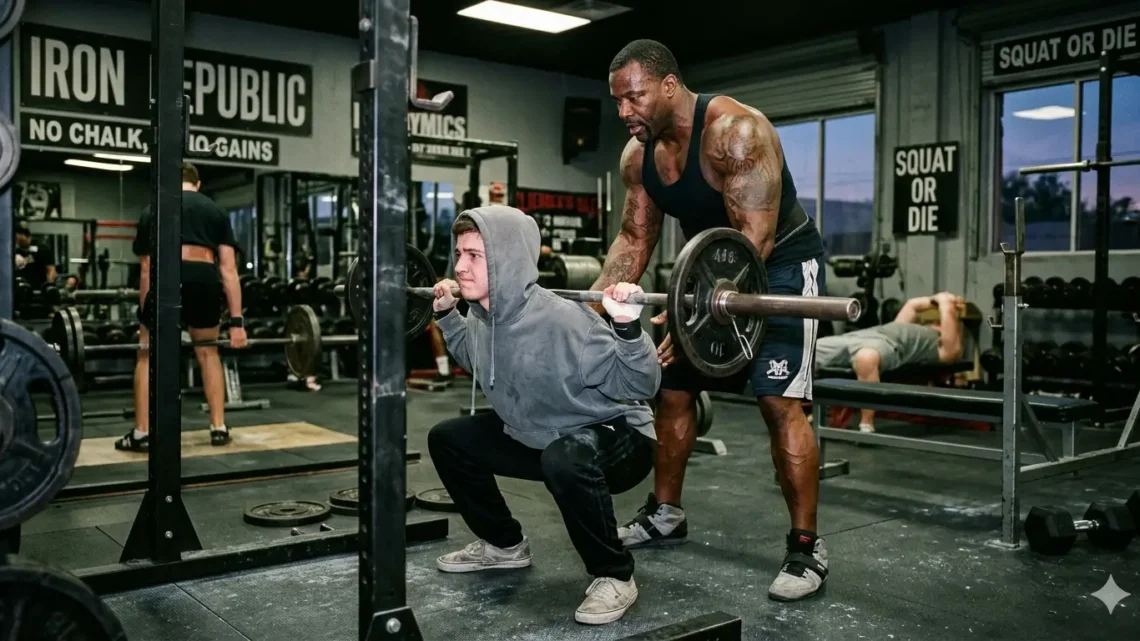
The first time I walked into a real gym, I was 22 years old, 140 pounds soaking wet, and wearing a borrowed hoodie two sizes too big because I thought it would hide how small I was.
It did not hide anything.
Trending Now!!:
The place was called Iron Republic, tucked into a strip mall in Phoenix, Arizona, wedged between a nail salon and a sandwich shop.
The moment those doors swung open, the smell hit me first. Rubber, chalk, iron, and the faint ghost of someone’s pre-workout spilled on a bench. I stood in the doorway for a full five seconds like a tourist who had wandered into the wrong country.
A man the size of a refrigerator looked up from a rack of dumbbells and stared at me. Not rudely. Just the way lions look at things that wander into their territory.
“You lost, brother?” he asked.




“No,” I said, lying through my teeth. “I’m here to train.”
He studied me for a moment, then nodded slowly. “Alright then. Close the door. You’re letting the air out.”
His name was Marcus Webb, and he had been competing in natural bodybuilding competitions for nine years. He was 38, had the vascularity of a roadmap, and held opinions about compound movements the way preachers hold opinions about scripture.
That evening, he watched me attempt a bench press with an empty bar, corrected my grip without being asked, and said something I have carried with me ever since.
“You’re not weak because you haven’t trained,” he said. “You’re weak because you’ve been afraid to start. Those are two very different problems.”
I want to tell you that I immediately got it. That I became some kind of montage success story. But the truth about fitness transformation is that the first three months are mostly just suffering and confusion and eating chicken breast that tastes like nothing.
My workout routine in those early days was a mess. I was doing bicep curls every single session because I wanted arms. I ignored my legs entirely because squats were uncomfortable, and nobody at the gym could see my legs if I wore trackpants.
I was eating maybe 90 grams of protein a day and wondering why my muscle mass wasn’t changing. I was doing everything wrong in the most committed, enthusiastic way possible, which is somehow the most heartbreaking kind of wrong.
Marcus found me one Thursday morning sitting on the locker room bench, genuinely frustrated, scrolling through bodybuilding forums on my phone, convinced I had bad genetics.
“How much are you eating?” he asked.
“A lot,” I said.
“Define a lot.”
“Like… three meals.”
He sat down next to me, took a breath, and said, “Brother, building muscle is a construction project. You cannot build a house without bricks. Your protein intake is your bricks. What’s your bodyweight right now?”
“About 143.”
“Then you need at least 143 grams of protein a day. Minimum. That’s not a suggestion. That’s physics.”
He pulled out his phone and showed me a sample meal plan. Not anything fancy, not some celebrity fitness influencer’s sponsored nonsense. Just eggs, rice, ground beef, Greek yogurt, cottage cheese, oats.
Real food, timed correctly, eaten consistently. He explained caloric surplus for building muscle mass, explained the difference between bulking and cutting, explained what progressive overload actually meant in practical terms rather than textbook ones.
“Every week,” he said, “you need to either add weight, add reps, or add sets. Something has to go up. If nothing goes up, nothing grows. That’s the whole secret. That’s all of it.”
I stared at him. “That’s it?”
“That’s it.”
I had spent three months reading about advanced training splits, debating creatine supplementation, watching YouTube videos about hypertrophy science, when the actual answer was just: eat enough, lift more over time, sleep, repeat.
The next six months were different. I followed a proper strength training program built around the big compound movements. Squats, deadlifts, bench press, overhead press, barbell rows. Marcus coached me through my form on every one of them.
The squat alone took six weeks before I stopped looking like I was sitting down on an invisible toilet. The deadlift terrified me until the morning I pulled 225 pounds and something in my chest cracked open like a door I didn’t know existed.
“There it is,” Marcus said from behind me, grinning. “That face right there. That’s why people do this.”
He was right. There is a specific feeling that comes when your body does something it could not do before. It is not just physical. It rewires something. Your relationship with difficulty changes. Things that used to feel impossible start to feel like problems with solutions instead of walls.
By month eight, I had gained 19 pounds. Not all muscles, of course. Body composition change is never as clean as the transformation photos suggest. There was fat mixed in there, some water, the natural softness that comes with eating in a caloric surplus. But I was stronger. Measurably, undeniably, week-over-week stronger.
I remember the morning I hit 185 pounds on the bench press for the first time. It was a Tuesday. There were three other people in the gym, and none of them cared. But I sat up from that bench and looked at the ceiling for a long moment because I was trying not to do something embarrassing in public.
Marcus walked over and slapped me on the shoulder. “How’s that feel?”
“Like I could cry,” I said.
“Good,” he said. “Means you’re doing it right.”
The part nobody tells you about long-term fitness, about really committing to resistance training as a lifestyle rather than a phase, is that it eventually becomes the most honest relationship you have.
The barbell does not care what you drove to the gym, what your Instagram caption said, or whether you had a terrible week at work. You either do the reps, or you don’t. You either hit the number or you don’t. In a world full of things that can be faked or performed, that kind of clarity becomes addictive.
I went through a cutting phase at the 18-month mark. My first real structured fat loss period, tracking my calories with obsessive precision, maintaining a caloric deficit while trying to preserve as much lean muscle mass as possible. It is miserable in a specific way that is hard to describe to someone who hasn’t done it.
You are tired. You are a little irritable. Everything smells like food. You watch people eat pizza at the table next to you in a restaurant, and you have the quiet internal experience of a man watching a boat leave a dock without him.
But on the other side of it, at 11 weeks in, I stood in front of a mirror and saw something I had never seen in my life. Definition. Actual muscle definition, carved out by months of strength training and dialed-in nutrition. Striations across my chest. My obliques visible for the first time in my existence. I called Marcus.
“I can see my abs,” I said.
A pause. Then: “How many?”
“Four. Maybe the start of six.”
“Brother,” he said, and I could hear him smiling through the phone, “welcome to the other side.”
Eleven years later, I still train five days a week. I have competed twice in natural bodybuilding, placed second in my weight class the second time, and then quietly retired from competition because it turned out I liked training more than I liked competing.
My HIIT cardio is still something I argue with myself about every single Saturday morning before ultimately doing it anyway. My protein intake is as automatic as breathing. I have opinions about creatine supplementation that I will share with anyone who stands still long enough.
But the thing I think about most is a conversation I had with a 23-year-old named Jordan last spring, standing in the same gym I walked into eleven years ago, Iron Republic still wedged between the same nail salon and a new sandwich shop. He was 140 pounds, wearing a hoodie two sizes too big, and he looked like someone who had wandered into the wrong country.
I walked over and said, “First time?”
He straightened up immediately. “No. I’ve been training for a while.”
“Okay,” I said, not pushing it. I turned to walk away.
“Actually,” he said, “yeah. First time.”
I turned back. “Good. What’s your goal?”
“I just want to not look like this anymore.”
I nodded. I knew that feeling with every cell I owned. “Here’s the thing about that,” I said. “You’re not going to not look like this. You’re going to look like something completely new. Those are two very different outcomes. One is running away. The other is building something.”
He looked at me for a moment. “Which one actually works?”
“Building,” I said. “Every time. Building.”
He is still training there. I see him on Thursdays. He has gained 17 pounds in seven months, his deadlift just crossed 200, and last week he walked in wearing a fitted t-shirt instead of a hoodie.
He didn’t say anything about it. He didn’t need to.
Some things you feel before you can say them, and the iron has a way of teaching you exactly which things those are.