The Real Cost of Learning to Code Nobody Talks About
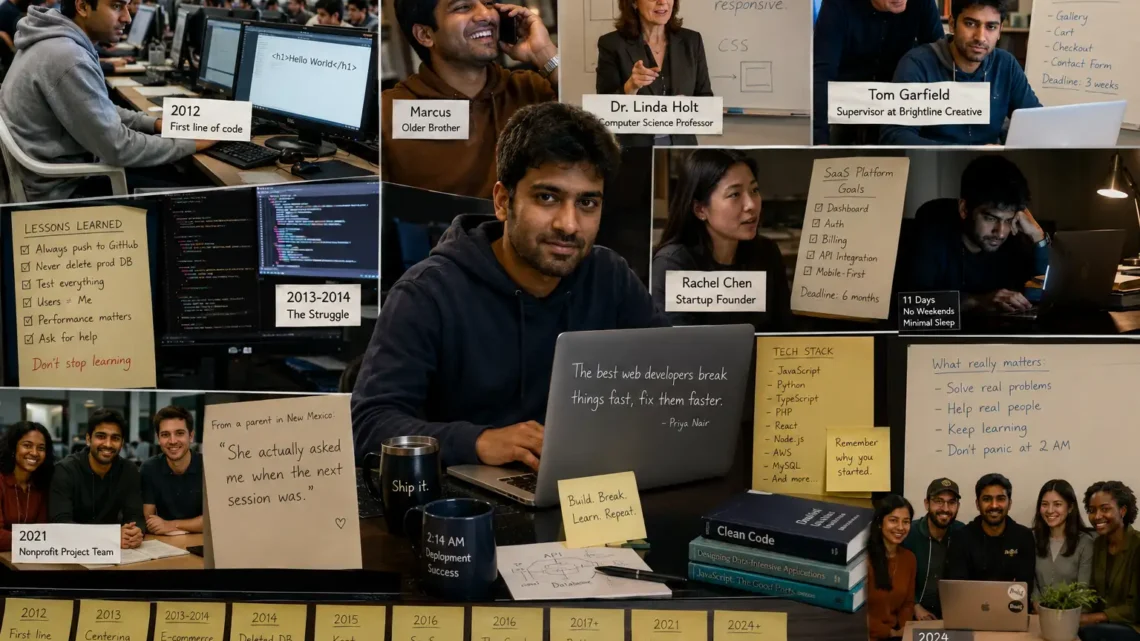
The first time I ever wrote a line of code, I was sitting on a plastic chair in a university computer lab in Austin, Texas, wearing a hoodie two sizes too big, surrounded by people who all seemed to know exactly what they were doing. I did not.
The year was 2012. I was twenty-two years old, broke, and absolutely convinced that web development was my ticket to something better. I had no idea that it would take me three years of failure, one public humiliation, and a single 2 AM breakthrough to finally understand what that something better actually looked like.
Trending Now!!:
I want to be honest with you about something most coding tutorials will never say out loud: the beginning is embarrassing. Not challenging. Not steep. Embarrassing.
I remember opening my first HTML file and typing <h1>Hello World</h1> like I had just invented electricity. I called my older brother, Marcus, and told him I was building a website.
“A website for what?” he asked.
“Just a website,” I said. “I’m a developer now.”




He laughed so hard I had to hold the phone away from my ear.
He was right to laugh. What I had was a heading tag on a blank white page. What I thought I had was a career. That gap between perception and reality is the first wall every aspiring web developer smashes into face-first, and I hit it with my eyes wide open and my confidence fully intact.
The second wall came about three weeks later when my computer science professor, Dr. Linda Holt, dropped a CSS file on my desk and told me to “make it responsive.” I nodded like I understood. I went home, Googled “what does responsive mean in web design,” and spent six hours trying to center a div. If you have ever tried to center a div using pure CSS without knowing what you are doing, you already understand the specific kind of suffering I am describing.
By my second year, I had graduated from HTML and CSS to JavaScript. This was not a promotion. This was a war. JavaScript in 2013 was a different animal. Frameworks like React and Vue did not yet dominate the landscape the way they do today. jQuery was king, and everyone treated it like sacred scripture.
I had a part-time job at a small digital agency called Brightline Creative, and my supervisor, Tom Garfield, handed me my first real client project on a Tuesday morning with a paper cup of coffee and zero sympathy.
“Client wants a fully functional e-commerce website. Product gallery, cart, checkout flow, contact form. You have three weeks,” he said.
I stared at him.
“Tom, I’ve only been coding for eight months.”
“Nine,” he corrected, pointing at the calendar. “You started in September.”
That project nearly destroyed me. I stayed late every single night. I broke the shopping cart logic fourteen times. I once accidentally deleted the entire product database at 11:45 PM and sat in my chair for a full four minutes just staring at the screen, unable to move.
Then I rebuilt it from scratch. That night taught me more about back-end development, database management, and version control than any tutorial ever had. It also taught me to always push to GitHub before touching production. A lesson no one should have to learn twice.
By 2016, I was calling myself a full-stack developer. I had shipped maybe a dozen websites, built a handful of web applications, and started picking up freelance clients on the side. The money was good. The ego was better. That is when I made my biggest mistake.
A startup founder named Rachel Chen approached me about building their entire SaaS platform from scratch. Dashboard, user authentication, subscription billing, API integration with third-party data providers, mobile-first design, the works. She had seed funding and a six-month deadline. I said yes before she finished the sentence.
“Have you built a SaaS product before?” she asked.
“Absolutely,” I told her.
I had not. Not anything close to this scale. But I had watched enough tutorials on Node.js, cloud hosting, and agile development to feel dangerously confident. The first two months were beautiful.
I was writing clean code, using React for the front end, building a Node.js API on the back end, deploying to AWS, and setting up CI/CD pipelines. I felt like a genius. I sent Rachel weekly updates full of technical jargon that made me sound more senior than I was.
Then month three arrived, and the codebase started fighting back.
Performance optimization became a nightmare. The web application was loading slowly because I had ignored lazy loading and was fetching entire data sets on every page render. The UI/UX was pretty, but the user flow made no logical sense to anyone who was not me.
The API kept throwing 500 errors under any kind of concurrent load because I had never properly handled asynchronous operations at scale. I remember a video call where Rachel shared her screen and showed me a user test session. A woman was trying to complete the onboarding flow. She clicked the wrong button three times, got lost between screens, and eventually closed the tab.
Rachel did not say anything for a long moment.
“This is what the investors are going to see in two weeks,” she finally said.
The silence after that sentence had weight.
I worked for eleven straight days after that call. No weekends. Minimal sleep. I rewrote the entire front-end component architecture, optimized database queries, implemented proper error handling, refactored the API endpoints, and completely redesigned the user onboarding experience based on actual UX research instead of what I personally thought looked cool.
On the twelfth night, at 2:14 AM, I deployed the new build to the staging environment and ran through the entire application flow myself. Page load time dropped from 6.8 seconds to 1.1 seconds. The onboarding completion rate in testing jumped to 84 percent. Every API call returned clean, consistent responses.
I leaned back in my chair and looked at the ceiling.
There was no one in the room. No applause. No one to call. My roommate Jake was asleep. The apartment was completely quiet except for the sound of my laptop fan finally cooling down.
But something had shifted. Not in the code. In me. I understood, for the first time at a cellular level, that web development is not about knowing the right syntax. It is about solving real problems for real people under real pressure, and being honest enough with yourself to admit when your first solution is not good enough.
I have been doing this for over ten years now. I have built e-commerce platforms, SaaS dashboards, content management systems, progressive web apps, REST APIs, and everything in between. I have worked with JavaScript, Python, TypeScript, PHP, and more CSS frameworks than I care to count.
I have done front-end development, back-end development, DevOps configuration, and enough technical SEO audits to last two lifetimes. Here is what none of the coding bootcamp advertisements will tell you. The technology changes every eighteen months.
The frameworks shift. What was cutting-edge React architecture in 2019 is legacy code by 2024. The specific tools matter far less than your ability to learn new tools fast, debug under pressure, and communicate clearly with non-technical people who are trusting you with their vision.
My friend Priya Nair, one of the sharpest software engineers I have ever worked with, said something to me once that I wrote on a sticky note and kept on my monitor for three years.
“The best web developers I know are not the ones who memorize the most,” she said. “They are the ones who break things the fastest and fix them the fastest.”
She was right. The ability to look at a broken build at 2 AM and not panic, to read an error log clearly, to isolate the problem and solve it methodically without spiraling, that is the actual skill. Everything else is detail.
In 2021, I led the development of a web platform for a nonprofit organization that connected volunteer tutors with underserved students across three different time zones.
The technical requirements were significant: real-time scheduling, video integration, a custom matching algorithm, multilingual support, and a back end that needed to be both affordable and scalable on a nonprofit budget. We shipped it in four months with a team of three developers.
The performance metrics were clean. The web accessibility scores were some of the highest I had ever seen on a project I worked on. But the moment I remember most is not a technical one.
A week after launch, the project manager, Diane Okafor, forwarded me an email from a parent somewhere in New Mexico whose daughter had been matched with a tutor and completed her first session. The parent wrote one sentence: “She actually asked me when the next session was.”
I read that email four times.
That is what responsive web design is for. That is what clean API integration is for. That is what all the late nights and broken builds and 2 AM deployments are actually for. Not the code. The kid in New Mexico is asking when the next session is.
I run my own small web development consultancy now. We specialize in full-stack web application development, e-commerce solutions, and web performance optimization for growing businesses. I work with a team of developers I genuinely respect, people who care about shipping clean, fast, accessible products and who are not afraid to say, “I don’t know, let me figure it out.”
I still write code every week. Not because I have to. Because I love problem-solving. I love that moment when something broken becomes something working. I love that this industry rewards curiosity more than credentials.
Last month, a young developer named Chris, who had just completed his first JavaScript project, sent me a message asking whether he was good enough to make it in this field. I told him the truth.
“The fact that you’re asking the question means you’re already thinking like a developer,” I wrote back. “Doubt is part of the process. Keep building things.”
He replied with one word: “Okay.”
I think he is going to be just fine. And honestly, after everything, so am I.