What 10 Years in Real Estate Taught Me That No Course Ever Could
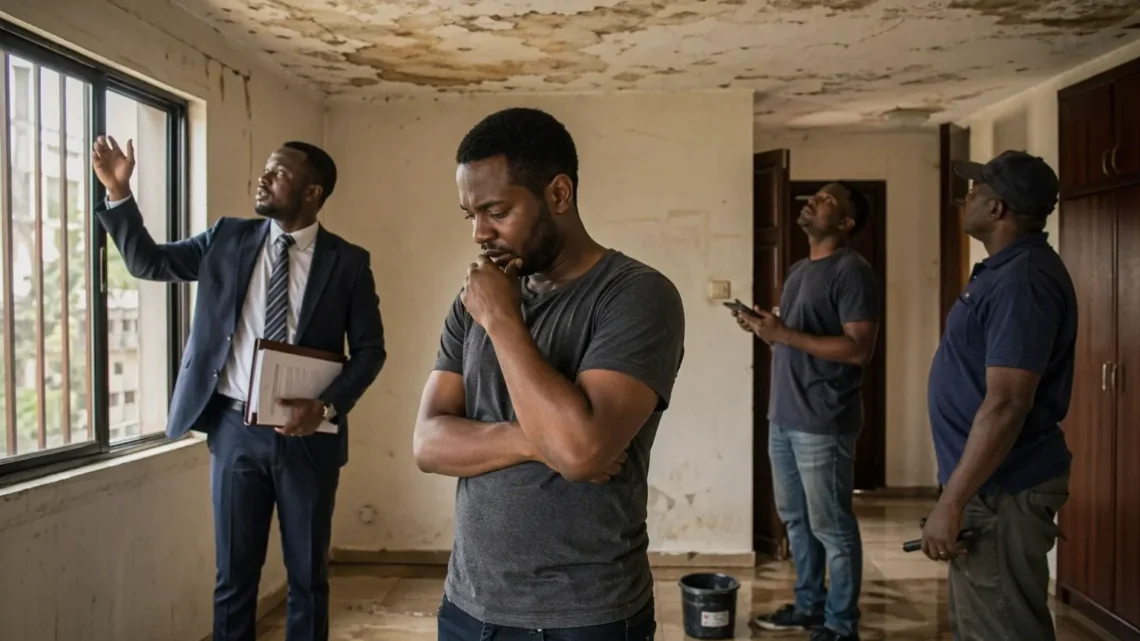
I was 27 years old, standing in the middle of an empty living room in Lagos, staring at cracked ceiling paint and a window that wouldn’t close all the way, and I was absolutely convinced I was making the smartest financial decision of my life.
I was wrong.
Trending Now!!:
But let me start from the beginning, because the beginning is the part nobody ever tells you about when they talk about real estate investment.
They skip straight to the part where they’re sitting on a beach, sipping something cold, watching their rental income hit their account. They never talk about the part where they’re on the phone with a contractor at 11 p.m., arguing about why the bathroom floor has started to bubble.
My name is not important. What is important is that I was a young man with a salary that sounded big at family gatherings and a savings account that told a very different story.
I had been reading everything I could find about property investment, residential real estate, home buying strategies, and long-term wealth building. I had spreadsheets. I had projections. I had a folder on my laptop titled “Financial Freedom” that I had opened every single day for two years without doing anything inside it.




Then Chidi called me.
Chidi was my childhood friend who had, somewhere between secondary school and adulthood, become the kind of person who wore blazers on weekdays and used the word “portfolio” in casual conversation. He called me on a Tuesday afternoon, and his voice had that particular energy it gets when he is about to tell you something that will either change your life or ruin it.
“I found a property,” he said. “Three-bedroom flat in Lekki. The owner is relocating abroad. He wants a fast sale. The asking price is below market value.”
I sat up straighter in my office chair.
“How far below?” I asked.
“Far enough that if you don’t move in the next two weeks, somebody else will.”
This is the first lesson real estate ever taught me, and I learned it the hard way: urgency is a sales tool. When someone tells you the clock is ticking on a property deal, your brain stops being an analytical instrument and starts being a very expensive emotion. I did not know this yet. I just knew that my pulse had quickened.
I went to see the flat on a Saturday morning. Chidi picked me up, and we drove through traffic that had no business being that bad at 8 a.m. The property was on a street that looked respectable from the main road and became progressively more interesting the further you turned into it. The compound had three other flats, a security post with no security, and a generator that, I would later discover, had not worked since 2019.
The real estate agent, a man named Mr. Eze, was already waiting outside when we arrived. He was wearing a tie in the Lagos heat, which told me everything I needed to know about how seriously he took this job. He extended his hand with the practiced confidence of a man who had sold things to many people who would later regret buying them.
“Welcome, welcome,” Mr. Eze said, pumping my hand. “You are going to love this property. Very good location. Appreciating fast. This whole corridor, property values have gone up thirty percent in the last two years.”
“Is that verified data?” I asked.
He smiled at me like a teacher smiling at a child who has asked a slightly annoying but technically correct question.
“Sir, I have been in this real estate market for fifteen years,” he said. “I don’t need a spreadsheet to tell me what my eyes can see.”
Inside, the flat was bigger than I expected. The living room had good natural light. The kitchen was small but functional. The master bedroom had a built-in wardrobe and a view of the neighbor’s water tank, which was not glamorous but was, I told myself, perfectly fine. I walked through each room with the careful slowness of someone pretending to be thorough while already having decided.
The second bedroom had a water stain on the ceiling the size and shape of Lake Chad.
“What is that?” I asked, pointing up.
Mr. Eze barely glanced at it. “Minor roofing issue. The landlord will fix it before handover. It’s already in the agreement.”
“Is it in writing?”
“Everything is in writing, sir. Don’t worry.”
It was not in writing.
I will not bore you with every detail of the negotiation process, partly because it was long and complicated, and partly because I made so many first-time homebuyer mistakes in that period that listing them all would require a separate article. What I will tell you is that I paid too much. Not catastrophically too much, but enough that every real estate investor I later befriended would wince slightly when I told them the number.
I had not done a proper property valuation. I had not hired an independent surveyor. I had not adequately accounted for closing costs, which, if you are reading this and you are new to real estate, will surprise you with how aggressively they add up.
Legal fees, agency fees, land documentation, inspection fees, none of it was in my original budget. By the time I signed everything and handed over the funds, I had drained not just my savings but a loan I had taken against my salary and a contribution from my mother that she described as “a gift” but accompanied with a look that made clear it was actually “an investment she expected returns on.”
I moved in six weeks later with a secondhand sofa, a mattress, and a level of exhaustion I had never previously experienced.
The first night, lying on that mattress in the master bedroom of my own property, I felt something I had not anticipated: terror. Pure, cold, quiet terror. Not the exciting kind. The kind that comes when a decision you cannot reverse has fully landed.
The roofing issue was never fixed before handover.
When the rains came in April, the Lake Chad stain revealed its true ambitions. It spread. It dripped. It introduced itself to my second bedroom ceiling fan in a way that produced a sound I can only describe as “electrical regret.” I called Mr. Eze. He did not pick up the first three times. When he finally did, his voice had lost all the warmth and blazer energy of our first meeting.
“Sir, the property has been handed over,” he said. “Any issues now are between you and the previous owner.”
“The previous owner is in Canada,” I said.
“Exactly,” he said, and hung up.
I sat in my kitchen that evening, eating rice I had cooked without onions because I had forgotten to buy onions, and I thought very seriously about whether I had made a catastrophic life error. My mortgage repayment was due in two weeks.
My generator needed a part that three technicians had now told me was “hard to find but not impossible.” The compound’s communal borehole was producing water that I was charitable enough to describe as “aggressively brown.”
I called Chidi.
“I think I made a mistake,” I said.
There was a pause. “Define mistake,” he said.
“The roof leaks. The agent has disappeared. The water is brown. And I am eating rice without onions.”
“The onions are the most solvable problem,” he said. “Go buy onions. We’ll figure out the rest.”
Here is what nobody tells you about real estate, the part that comes after the purchase, after the stress, after the months of feeling like you have chained yourself to a very expensive rock: property is patient in a way that human beings are not.
I fixed the roof. It cost me money I did not have and required me to live on a budget so tight that I became briefly evangelical about home cooking. I fixed the borehole. I painted. I replaced the ceiling fan. I found a generator technician named Sunday who was so gifted with engines that I started recommending him to neighbors like a proud parent.
Slowly, the flat stopped feeling like a mistake. It started feeling like mine.
Three years after I bought it, a real estate developer began construction on a commercial complex two streets away. A major road expansion project was announced for our corridor. Within eighteen months, property values in that area climbed in a way that made Mr. Eze’s unverified thirty-percent claim look modest in hindsight.
I had a property valuation done out of curiosity. The number the surveyor gave me was significantly higher than what I had paid.
Enough higher that I sat with the report for a long time, just reading the same figure repeatedly with the particular quiet joy of a person who narrowly avoided a disaster and ended up somewhere better instead.
I have bought two more properties since then. I know things now that I did not know when I was 27, standing in that living room with cracked ceiling paint and a very unwise confidence. I know that real estate investment rewards patience more reliably than it rewards speed.
I know that a property with problems is not necessarily a bad investment; sometimes it is just an investment that requires more work. I know that the best time to understand mortgage structures, property appreciation, rental yield, and due diligence is before you need to use those words in a real sentence.
I know that Chidi, for all his blazers and portfolio talk, gave me genuinely good advice when I was panicking in my kitchen with unseasoned rice: solve the solvable problems first.
The rest, more often than not, has a way of working itself out.
If you are thinking about entering the real estate market for the first time, one piece of advice above everything else: do not let urgency replace judgment. The right property will still be the right property after you have taken a breath, done your research, hired an independent surveyor, and read every line of every document placed in front of you. The deals that disappear when you pause to think were usually not deals at all.
The ones that wait for you to be ready? Those tend to be worth the wait.