
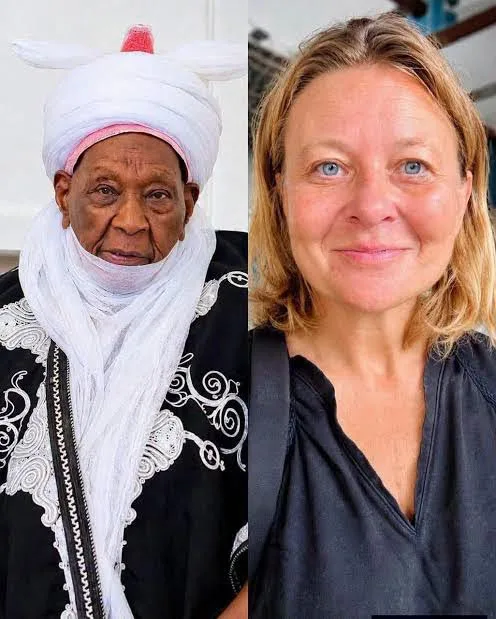
Emir of Daura Barred From Royal Duties Over Tourist’s Sexual Assault Claim
For nearly two decades, the Emir of Daura has presided over one of the most storied royal seats in northern Nigeria. Now he has been shut out of his official duties, and a government panel is preparing to examine what happened when a visitor from Poland was left alone with him inside his palace.
The Katsina State Government on Tuesday barred the emir, Alhaji Umar Farouk Umar, also widely known as Faruk Umar Faruk, from official engagements and travel after the tourist, Mirka Czee, accused him of touching her breast without her consent. Two days later, it named a nine-member committee to investigate.
Trending Now!!:
The order does not remove him from the throne, and it is not a finding of guilt. The emir had not publicly responded to the accusation as of Thursday.
Ms. Czee has said the encounter took place on Nov. 14, during a 30-day journey through Nigeria. By her account, her visit began warmly. She was served food, shown around the palace, introduced to Daura’s place in Hausa history and taken to the royal stables, where she rode a horse.
Her experience changed, she said, when she found herself alone with the emir in a large room. She said he held and played with her hand despite her objections, then hugged her, kissed her cheeks and touched her breast as the meeting drew to a close. She said he laughed as she protested.



“Emir, you cannot be touching,” she recalled telling him.
Ms. Czee, who posts on Instagram as @beduinqa, said she began recording with her Ray-Ban Meta smart glasses after growing uncomfortable, lowering them from the top of her head to capture part of the meeting. She released the footage after leaving the country, explaining that many women who have similar experiences lack the means to document them. Most of her other encounters in Nigeria, she said, had been positive.
A roughly 60-second copy of the video circulating online shows a man in white traditional clothing and a light blue cap seated close to the person filming, before he stands and moves toward the camera. The picture shifts considerably, obscuring parts of the encounter, and the available angles do not conclusively show the alleged touching of her breast. The copy also carries captions in English and Hausa whose author is unclear.
Instagram later removed her post. Ms. Czee said she had not deleted it, suggested that a wave of user complaints might have caused the removal and asked for a human review. Copies continued to spread through other accounts. Meta, which owns Instagram, had not publicly explained the decision.
The Daura Emirate Council said on Monday that it was examining the footage to determine whether it was authentic, altered or generated with technology. Its spokesman, Ibrahim Murtala, said the council would issue a formal statement after the review. A palace source who was not named rejected the accusation as fabricated, a position that went further than the council’s public response.
The police, at that stage, had no case before them. Abubakar Sadiq Aliyu, spokesman for the Katsina State Police Command, said on Monday that the command was unaware of the video and had received no formal complaint. The state’s information commissioner, Dr. Bala Salisu Zango, also said when first contacted that he had not watched it.
Pressure on the government built quickly. Amnesty International Nigeria called for a transparent and independent investigation by state authorities and the police, with accountability for anyone found responsible.
On Monday, Col. Abubakar Dangiwa Umar, a retired officer and former military governor of Kaduna State, sent an open letter urging Gov. Dikko Umaru Radda to suspend the emir immediately. If the video proved authentic, he wrote, the conduct would amount to “an appalling abuse of the dignity, authority and responsibilities of a traditional institution.” He stressed that suspension would not imply guilt, but said the emir should be deposed without delay if the allegations were established.
Sheikh Ahmad Gumi, a prominent Islamic cleric, took a similar position on the principle, saying any emir found guilty of immoral conduct should be “removed and replaced immediately.” Pelumi Olajengbesi, a lawyer based in Abuja, called for an independent police investigation.
That same day, the Katsina and Daura emirate councils and other traditional titleholders met behind closed doors at the Katsina State Foundation conference hall. The emir did not attend, and the discussions were not made public.
The government acted on Tuesday. In a statement delivered by Dr. Zango, it said Governor Radda was deeply concerned and had ordered an inquiry. The administration promised to carry out the panel’s recommendations, appealed for calm and warned against actions that could disturb public order. “The government wishes to assure the public that justice will be served,” the statement said.
The restrictions have reached inside the palace. Police officers and personnel of the Nigeria Security and Civil Defence Corps were deployed to the premises, and the emir was confined to its inner chambers, with some close courtiers denied access to him. The Galadiman Daura, who is also the district head of Mai’Adua and the council’s most senior member, was expected to take over the emir’s official functions.
The investigative committee is led by Justice Amiru Sanusi, a retired judge. Its secretary is Fadila Muhammad Dikko, the state’s attorney general and commissioner for justice.
The other members are Usman Abba, the governor’s special adviser on emirate and chieftaincy affairs; Justice Sadiq A. Mahuta, a retired judge who holds the title of Galadiman Katsina; Isah Dabai, the commissioner for religious affairs; Alhaji Lawal Aliyu Daura; Prof. Halima Kabir of the Department of Languages and Cultures at Ahmadu Bello University, Zaria; Dr. Zango; and Hajiya Khadija Abdulkadir, an economic diplomacy adviser to the Kingdom of Belgium.
The panel’s eight-point mandate directs it to investigate the allegation, invite everyone connected to it, review documents and other evidence, and establish the purpose of Ms. Czee’s visit. It must also determine the extent of any culpability on the emir’s part, recommend sanctions and propose measures to prevent a recurrence, while taking any other steps necessary for justice.
Its report is due within four weeks of its inauguration. The government has urged the public to let the members work “independently and without interference or undue pressure.”
As the official response took shape, Ms. Czee said she was facing a campaign of abuse. Screenshots she posted showed insults, demands that she delete the video and warnings of harm, including threats that she could be tracked down.
Some writers blamed her for the encounter. An individual whose name was not disclosed offered her $50,000 to take the recording down. Amnesty condemned the threats and asked the police to investigate them and protect her, insisting that people who report sexual violence should not be intimidated.
Ms. Czee also published messages that she said came from the emir’s relatives. In one, attributed to his eldest son, Muhammad Faruk, known as Danburam Daura, the writer apologized for her experience and acknowledged, “The man in the video is my father.” He also expressed fear about what could happen if relatives saw the footage.
Other messages, attributed to Ramlat Hassan and Aishaaat Bukar, described as daughters of the emir, and to Rukayya Faruk, who identified herself as another daughter, asked her to remove the video. Their appeals included apologies from Ms. Bukar and Ms. Faruk, while Ms. Hassan said the recording had embarrassed the family. Ms. Czee also said an unnamed son sent a vulgar message about efforts against her post and account, and that an unnamed granddaughter sent threats.
The messages have not been independently authenticated. Ms. Czee said she did not reply to the children and would keep the video online to raise awareness and encourage accountability. In her view, the relatives had not denied the incident but wanted it hidden to protect the family’s image. She has also said that about 90 percent of the responses she received were supportive, and that she needed time and personal space.
Online, the argument soon extended to her own behavior. The activist Martins Vincent Otse, known as VeryDarkMan, called the emir an “embarrassment” and urged him to step down, but also questioned Ms. Czee’s reaction during the meeting. Ossai Ovie Success, a media aide to Gov. Sheriff Oborevwori of Delta State, asked why she had not left sooner, while saying he was not excusing the emir. The commentator Oyemykke raised similar questions about her response.
The case carries unusual weight because of where it is said to have happened. Daura is revered in Hausa tradition as a cradle of the Hausa states. Its founding legend tells of Bayajidda, a traveler who killed a feared serpent at the Kusugu Well, married Queen Daurama and became the forefather of ruling lines across Hausaland. The well remains a tourist attraction.
The town is also the hometown of the late President Muhammadu Buhari. In 2015, weeks after Mr. Buhari took office, the emir honored him with the title of Bayajidda II and presented him with a sword and a horse.
Emir Umar, who is in his 90s, is regarded as Daura’s 60th emir. He ascended the throne on Feb. 28, 2007, succeeding Muhammadu Bashar, who had reigned for about four decades. Nigeria’s emirs hold no formal executive power under the Constitution, but they command deep cultural and religious influence, settle local disputes and oversee networks of district and village heads. State governments have authority over chieftaincy matters, including the discipline of traditional rulers.
Sama’ila Sulaiman, a historian at Bayero University Kano, has described the case as without precedent among the region’s traditional institutions, noting that earlier suspensions stemmed from political, administrative or financial disputes. He also said the government should clarify the reach of its order and suggested that the public had expected a clearer suspension from the throne during the inquiry.
The episode also tests a recent promise from Governor Radda. His administration adopted the state’s version of the Violence Against Persons (Prohibition) Law in 2023. In July, he pledged tougher enforcement against sexual and gender-based violence, faster justice and greater support for survivors, and he called for traditional rulers to help change harmful social attitudes.
The committee’s work is separate from any criminal investigation, and no court has ruled on the allegation. Its findings are likely to shape what the government does next, including whether the emir resumes his duties or faces further sanctions.