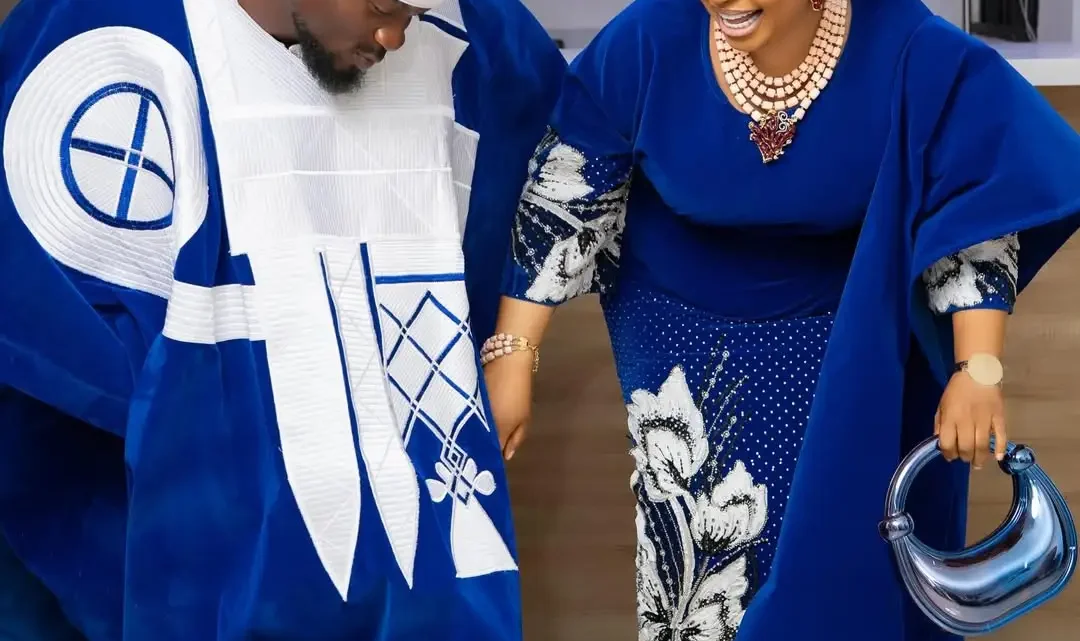
Laide Bakare on Odobodobo Motolani: “We Chose to Listen to Our Hearts”
Laide Bakare, a veteran of Yoruba cinema and a government appointee, has publicly confirmed a romantic bond with digital content creator Odobodobo Motolani, a disclosure that has ignited fierce debate across Nigerian social media.
For years, Laide Bakare kept the most intimate chapters of her personal life tucked well behind the glittering curtain of her public persona.
A stalwart of Nigeria’s Yoruba-language film industry, a serial entrepreneur, and a newly minted government official, she had grown accustomed to occupying every room she entered on her own terms. But in the first week of March 2026, that curtain was pulled back, at her own hand.
Trending Now!!:
In a series of photographs shared on her Instagram account, Bakare, 45, appeared alongside Dada Oluwasola Tolani, the actor and social-media personality better known by his stage name Odobodobo Motolani, dressed in coordinating traditional attire.
The images were warm, deliberate, and unmistakably romantic. The caption she chose confirmed what many of her nearly two million Instagram followers had long suspected.
“Our friendship was built on trust, laughter, respect, and a deep understanding that only we shared. While others had their opinions, we chose to listen to our hearts.”
The post set off a wave of conversation across Nigerian social platforms, drawing praise from admirers who celebrated her unapologetic embrace of romance, as well as pointed criticism from detractors who questioned the wisdom of the pairing. Bakare was undeterred. In a follow-up video the next day, she turned directly to her critics: “Can we let love lead? What if you are wrong and I’m right?”
To understand why the disclosure landed with such force, one must understand just how prominent a figure Laide Bakare has become in Nigerian public life. Born Olaide Bakare on October 7, 1980, in Ibadan, Oyo State, she grew up in a household that was, in more ways than one, a crossroads for the Nigerian entertainment world.
Her father, a hotelier, regularly hosted visiting film crews, and the young Laide absorbed the rhythms and rituals of moviemaking from an early age, though she has said she never originally planned to enter the industry.
She enrolled at the University of Lagos, where she studied History and Strategic Studies, and supplemented her academic training with a diploma in Theatre Studies from the University of Ibadan. By her second year of university, she was already acting professionally, landing a role in the 1999 film Adeyemi, produced by Muka Ray. She was nineteen years old.
Over the subsequent two decades, Bakare built one of the more diversified careers in Nollywood. She acted in and produced more than fifty films, becoming particularly celebrated within the Yoruba-language film tradition.
Her productions include Asiri Owo, Okun Omo Iya, Ewon Laafin, and her debut feature Jejere, which earned a Best Costume Design award at the 2012 Best of Nollywood Awards and was premiered in the United Kingdom. She received a nomination for Most Outstanding Actress in the Indigenous Category at the 4th Africa Movie Academy Awards in 2008.
Her ambitions extended well beyond acting. She founded Simline International, a company with import-export operations spanning Nigeria, the United States, and the United Kingdom. She launched Simline Records in 2018, a music label intended, in her words, to “identify, grow and support talented youths.”
She has served as a master of ceremonies, brand influencer, script consultant, and published author. Her 2024 book, Becoming Laide Bakare: Make Millions in 6 Months, reflects the self-made confidence that has long defined her public image. In late 2025, she was awarded a Doctorate in Arts and Humanities from the American University of Peace and Governance.
Most recently, she accepted an appointment as Senior Special Assistant on Entertainment, Arts, Culture, and Tourism to Osun State Governor Ademola Adeleke, a role that formally thrust her into Nigerian political life.
Bakare’s romantic history has been as closely followed by the Nigerian public as her professional one, and it has not been without turbulence. Her first significant relationship was with Olumide Okufulure, an American-based businessman. That union produced a daughter, Similoliwa Okufulure (Simioluwa Simi Bakare), born on September 3, 2008, in New York City. The relationship ultimately did not survive.
In 2012, Bakare entered a relationship with Alhaji Mutairu Atanda Orilowo, which she has described as beginning after an earlier encounter in Saudi Arabia. The couple married, and the union produced two sons, Oluwadamilare Orilowo, born May 31, 2013, and Oluwajomiloju Abdul-Samad Orilowo, born in October 2014, both in New York City. The marriage ended in separation after Alhaji Orilowo was alleged to be involved in financial fraud and declared wanted by the Economic and Financial Crimes Commission in 2014.
As of her most recent public statements, Bakare has described herself as unattached, a point she made pointedly to an online critic who suggested her new relationship was financially motivated. Her response was swift: she reminded him that she is a financially independent woman.
Her companion in this new chapter of her life, Dada Oluwasola Tolani, represents a newer wave in Nigerian entertainment, a performer whose career was built not on the traditional film set but on the smartphone screen. Known widely as “Odobs,” Motolani has cultivated a following that spans Instagram, TikTok, where he commands upwards of 1.2 million followers, and YouTube, where his channel Mo’Tolani TV regularly releases short-form comedy and drama content.
His most recognized work includes the recurring series Life of Odobodobo, a comedic portrait of Nigerian youth culture, and Campus Life with Odobs, which blends lifestyle storytelling with comedy-driven drama.
On Facebook, his page has accumulated more than 900,000 likes. Motolani has kept the details of his personal background largely private. His full name suggests Yoruba origins, and his performance aesthetic bridges the traditional cadences of Nollywood with the fast-paced vernacular of Nigerian digital culture.
The relationship between the two did not materialize suddenly. Hints of a deepening bond appeared as far back as December 2023, when Bakare introduced a mystery companion on Instagram while speaking about the beauty of love and inviting followers to join them at an event at Amore Garden in the Lekki district of Lagos. By Christmas 2025, the pretense of mystery had largely dissolved.
Bakare shared photographs of herself and Motolani wearing matching pajamas, accompanied by a declaration that love conquers all. Motolani, posting his own version of the moment simultaneously, wrote that he had expected to spend Christmas alone until, as he put it, his baby showed up.
He described her, with evident pride, as “an actress and a politician.” The March 2026 posts brought the relationship fully into the open. The coordinated traditional outfits, the directly romantic language of Bakare’s captions, and her pointed defense against critics left little room for ambiguity.
The disclosure has produced the full spectrum of responses that accompany any high-profile Nigerian celebrity romance. Supporters have applauded Bakare’s willingness to pursue happiness on her own terms. Critics have focused on what they perceive as a mismatch in age and professional stature, and some have questioned whether the relationship is authentic or performative, a skepticism Bakare has met with a mix of defiance and humor.
The backlash has not slowed her. Days after the initial posts, even as online commentary continued to swirl, Bakare departed for Mecca to observe the Umrah pilgrimage during the final ten days of Ramadan, inviting followers to send her their prayer requests. The image of a woman simultaneously defending a public romance and undertaking a religious pilgrimage captured something essential about the complexity of her public identity.
For now, Laide Bakare and Odobodobo Motolani exist in the particular liminal space reserved for celebrities whose private lives have become, at least temporarily, matters of public discussion. Neither has offered the formal declaration, the engagement announcement, or the wedding photograph that would definitively settle the speculation.
Bakare has reiterated, as recently as this month, that she does not currently have a husband. What she has offered is something rarer in the Nigerian public sphere: an honest, unguarded account of a heart in motion, unbothered by the noise of a watching crowd.
Whether the story ends in a traditional ceremony or simply continues on its own quiet terms, it is already, by any journalistic measure, a story worth following, told, as the best ones are, by the people living it.