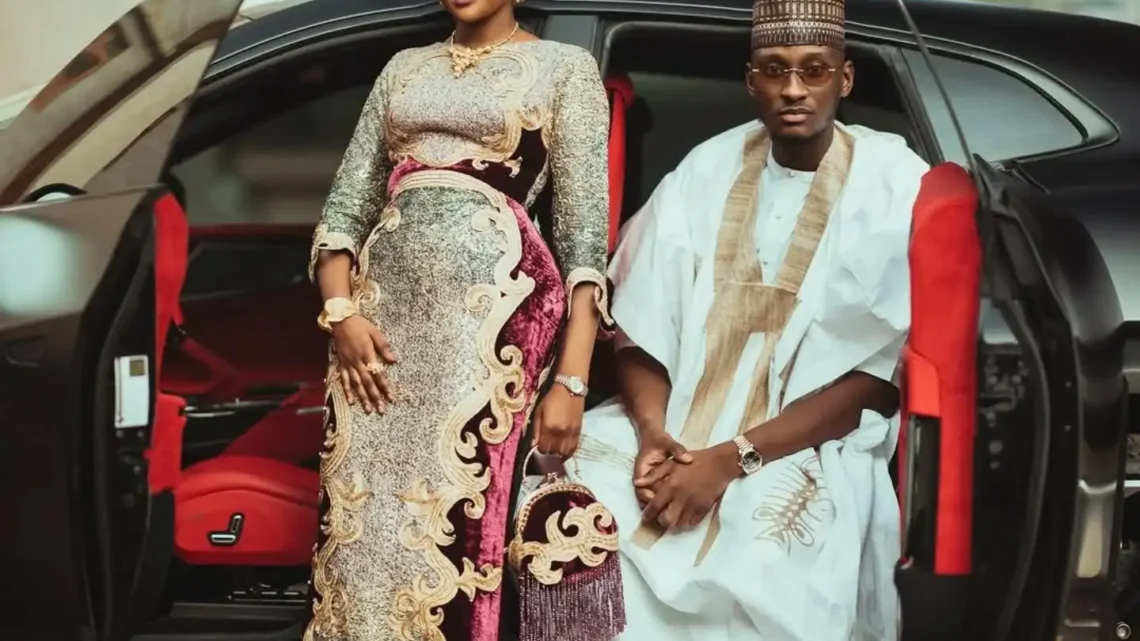
Sadiq Saminu Geidam’s Wedding Was a Luxury Car Show, a Concert, and a Political Gathering All at Once
The marriage of luxury car dealer Sadiq Saminu Geidam to Maryam Nabila Abubakar Isa was not simply a wedding. It was a statement about who holds power, taste, and money in Nigeria’s capital.
The driveway outside the Transcorp Hilton did not look like a driveway on April 12. It looked like a supercar auction that had lost its catalogue.
Ferraris sat bumper to bumper with Rolls-Royces. Lamborghinis idled behind Bentleys. Somewhere in the procession, a 2026 Rolls-Royce Spectre, the British marque’s flagship all-electric saloon, served as the groom’s carriage.
Trending Now!!:
It was, by almost any measure, the most aggressively wealthy convoy Abuja had assembled in recent memory, and it was all organized in honor of one man’s wedding day.
Sadiq Saminu Geidam, the chief executive of AbujaCar, wed Maryam Nabila Abubakar Isa in a ceremony that blended cultural heritage with a distinctly modern brand of opulence. The event drew Nigeria’s political royalty, entertainment royalty, and automobile royalty into the same gilded room, which, given the guest list, may not be three separate categories at all.
Sadiq hails from Geidam Local Government Area in Yobe State, though he was born and raised in Abuja. His entry into the automobile world was not accidental; it was a path paved by his father, the late Alhaji Saminu Geidam, a legendary figure in the Abuja car scene who operated the well-known brand Gdam Motors.
He did not simply inherit that business. He studied Computer Science at Al-Hikmah University, Ilorin, and used that technical foundation to digitize luxury automobile marketing in Nigeria, building a strong online presence where car listings, deliveries, and customer engagement happen in real time. The passing of his father in October 2024 marked a turning point, pushing him not only to sustain the family name but to reshape the industry through AbujaCar. The strategy worked resoundingly.



Today, AbujaCar Properties and Automobile Limited operates as a major player in Nigeria’s high-end car market, dealing in brands such as Rolls-Royce, Lamborghini, Ferrari, Bentley, Porsche, Range Rover, Lexus, and McLaren, with the business expanding further into AbujaCar Rentals, AbujaCar Properties, and lifestyle ventures such as CaféByAbujaCar.
His most talked-about transaction remains the sale of a McLaren Senna Exposed Carbon Edition to the Grammy-winning musician Burna Boy, a deal reportedly worth ₦3.2 billion (approximately $1.9 million USD), placing him in a very exclusive category of automobile dealers handling ultra-rare vehicles in Africa. That relationship would resurface, in a different form, on his wedding day.
Across the hall from the convoy stood Maryam Nabila Abubakar Isa, a woman whose private, composed bearing drew as much attention as the spectacle surrounding her. She is largely described through her wedding documentation rather than personal media interviews, a reflection of a personality that stood out during the multi-day celebration for its calm dignity rather than its noise.
Her bridal appearances leaned into Arewa tradition, favouring cultural authenticity over performative extravagance, a deliberate contrast to the roaring engines outside. Reports from the events highlighted cash gifts, landed property, and a luxury Lexus SUV presented by the bride’s family, reinforcing the strong financial background on both sides of the union. On social media, the wedding was repeatedly described as a “power union,” which is less a romantic phrase than an accurate description of what the room contained.
And what a room it was. Nigeria’s Vice President, Kashim Shettima, attended. So did Seyi Tinubu, son of President Bola Tinubu, whose own public appearances have become social media events in their own right.
Their presence at the same function as a luxury car dealer underscored how completely Abuja’s business class and its political class have fused into a single social orbit, one where seating arrangements communicate alliances as clearly as any official statement. Celebrities and influencers filled the rest of the hall, arriving with the kind of entrances that suggested some guests viewed the occasion as a performance opportunity as much as a wedding reception.
Seyi Vibez, one of Nigeria’s most in-demand live acts, arrived in a supercar and delivered a performance that, according to widely shared video clips, at one point saw him leap directly into the crowd. The image of a recording artist crowd-surfing at an Abuja wedding reception captured something genuine about the night’s energy. It was not a formal event pretending to be fun. It was genuinely, raucously fun.
Young Jonn, the Afrobeats hitmaker known for his smooth production style and effortlessly crowd-pleasing catalogue, also performed, arriving in a similarly conspicuous fashion. Between the two sets, the reception had the atmosphere of a festival held inside a five-star hotel ballroom, which is precisely what the groom’s brand, built on the idea that luxury should feel alive rather than stiff, would have wanted.
Then there was Burna Boy. The African Giant did not attend in person. He sent a video message. For a man whose McLaren was sourced through the groom’s dealership, it was a gesture that landed somewhere between a toast and an advertisement, and the crowd received it warmly either way.
Nigerian social media, which has developed an almost ethnographic interest in the spending habits of Abuja’s elite, processed the wedding with its characteristic blend of admiration and wit. Commenters circulated jokes about backup watches, a running reference to the practice among certain Northern Nigerian millionaires of attending functions with a secondary timepiece in case the primary one is outshone by a neighbour’s.
Others catalogued the cars in the convoy with the thoroughness of automotive journalists. The underlying conversation, though, was less about the couple and more about what the wedding represented: Abuja’s wealth, its particular texture of Northern Nigerian tradition draped in international luxury, its proximity to political power, and the speed with which a young man from Yobe State, armed with a Computer Science degree and his late father’s name, had built himself into the kind of person whose wedding the Vice President attends.
Sadiq Saminu Geidam’s story reflects how modern Nigerian entrepreneurship is evolving: from early exposure in a family car business to building AbujaCar into a recognized luxury brand through digital transformation, consistency, and strategic positioning. His father built Gdam Motors brick by brick, on a foundation of trust and physical presence.
The son built AbujaCar post by post, deal by deal, delivery video by delivery video, on Instagram and across the elite networks of a country where who you know and what you drive are rarely entirely separate questions. Maryam Nabila Abubakar Isa is now, by every public measure, part of that story.
The wedding was several days of ceremony, Arewa traditions honoured and observed, a political elite present and smiling, and somewhere in the middle of it all, a Rolls-Royce Spectre humming silently through the streets of Abuja.
The groom, whose entire career has been about making arriving somewhere feel like an event, arrived at marriage the same way he arrives everywhere else: in the most expensive vehicle in the room.