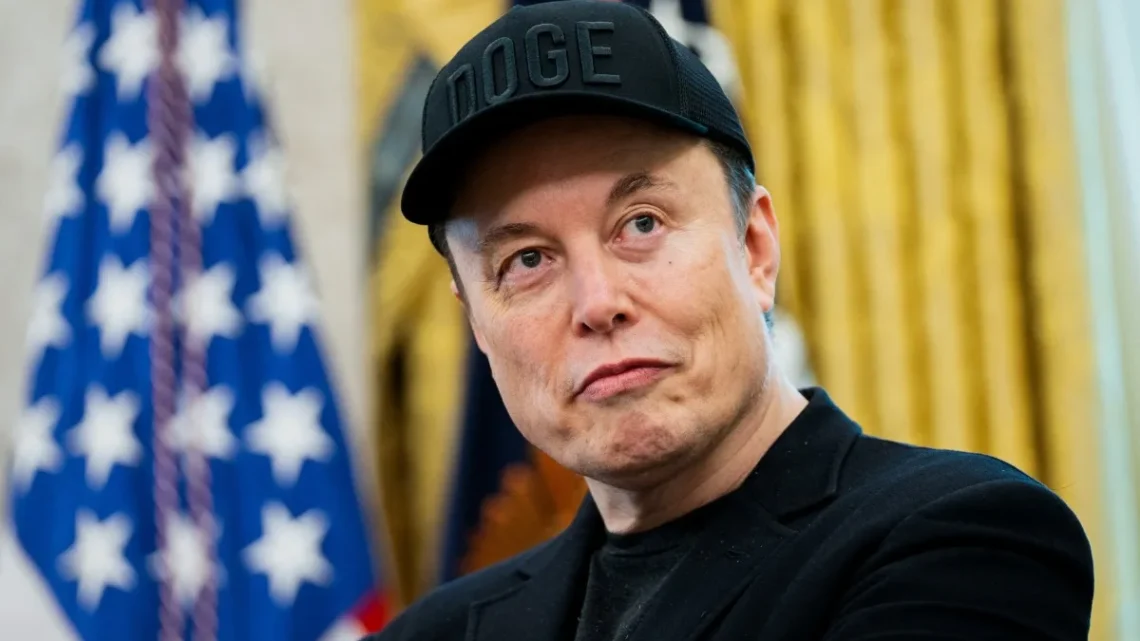
The First Trillionaire: How Elon Musk Crossed a Threshold No Human Has Ever Reached
On a Friday morning in New York, as the Nasdaq’s opening bell rang and crowds gathered outside its MarketSite in Times Square, a moment quietly unfolded that economists, historians, and philosophers of capitalism had long speculated about but never quite expected to see in their lifetimes.
Elon Musk’s net worth surged past $1 trillion as SpaceX, the rocket company he founded and controls, made its debut on the public market. The number itself is staggering in the way that only a handful of figures in human history have been. The world had its first trillionaire, and his name was already the most recognizable on the planet.
Trending Now!!:
SpaceX priced its initial public offering at $135 a share ahead of Friday’s debut on the Nasdaq, trading under the ticker SPCX.
The company offered 555.6 million shares to hit a record $75 billion raised, with underwriters holding a greenshoe option to sell approximately 83 million additional shares if demand outstripped the initial allotment. By the time the market opened, SpaceX opened at $150 per share, marking roughly an 11% gain over its IPO price. The stock climbed further from there, fluctuating within a day range of $150 to $168.75.
At a forecast $1.1 trillion, Musk’s fortune is nearly four times the size of the next-largest in the world, Google co-founder Larry Page’s $292.7 billion. It also exceeds the combined fortunes of Page, Sergey Brin at $270.0 billion, and Jeff Bezos at $251.5 billion, who rank second through fourth. To put that another way: the second, third, and fourth richest people on Earth, pooled together, still cannot match a single man.
The road to this moment was paved not in one industry but in several. Musk became a household name through Tesla and SpaceX before expanding his influence with the $44 billion acquisition of social media platform Twitter in 2022.


His empire today spans electric vehicles, satellite internet, artificial intelligence, neurotechnology, and now the most ambitious spaceflight programme in history. Musk holds approximately 42% of SpaceX’s equity through a dual-class share structure that grants him roughly 82% of voting control via Class B stock.
At the $135 IPO price, his equity stake is valued at $866.5 billion. The rest of his fortune flows largely from Tesla, whose stock has also risen in the euphoria surrounding SpaceX’s debut.
SpaceX operates across three major segments: Space, which covers launches; Connectivity, which is Starlink; and AI, which falls under xAI. Starlink alone generated 61% of the company’s total 2025 revenue.
That satellite internet division, which now counts over nine million subscribers globally, transformed SpaceX from a space launch company into a telecommunications giant with ambitions that extend well beyond Earth’s orbit. SpaceX’s IPO, priced at $1.77 trillion, is the largest in stock market history, far surpassing the $25.6 billion raised by Saudi Aramco in its record 2019 listing.
SpaceX is based in Texas, along the Gulf Coast. In 2024, Musk said he was moving SpaceX’s headquarters from Southern California to Boca Chica, Texas, where the company built and launched its rockets.
Last year, SpaceX successfully converted Boca Chica into an official company town named Starbase through an election, with around 500 people, including SpaceX employees, living in the community at the time. It is a detail that speaks to a broader pattern: Musk does not merely build companies; he builds ecosystems, complete with their own towns, governance structures, and long-term cultural identities.
Audible cheers were heard as SpaceX President Gwynne Shotwell rang the opening bell from the Nasdaq. Shotwell, one of the most consequential executives in modern aerospace, has been the operational backbone of SpaceX for two decades, quietly running the business that Musk so publicly fronts. It was fitting that she rang that bell: the celebration belonged to both of them, even if the wealth does not.
The trillionaire threshold is a number so large it resists ordinary comprehension. At $1.1 trillion in combined holdings in Tesla and SpaceX, Musk’s fortune surpasses the economies of most nations. For context, among the countries whose entire GDP falls beneath his net worth are Taiwan at $977 billion, Ireland at $779 billion, and Sweden at $760 billion.
As a trillionaire, Musk is worth roughly 3% of US GDP. Guido Alfani, a professor of economic history at Bocconi University in Milan, framed the wealth in historical labour terms. Alfani estimated that Musk could command the work of 557,800 people in 2025, versus 116,000 by John D. Rockefeller in 1937 or 48,000 by Andrew Carnegie in 1901. His conclusion was pointed: “If we do this, we can surely conclude that Elon Musk might be the wealthiest person who has ever lived, excluding emperors or other rulers whose wealth is not easily distinguishable from that of the state.”
The political reaction was as swift as the market reaction. Darrell West, a senior fellow at the Brookings Institution who researches wealth inequality, was direct: “Income inequality is a huge problem in America and having our first trillionaire vividly illustrates the problem. This will be an issue in 2026 and 2028.” Democrats have been sharpening their messaging around Musk’s wealth ahead of the midterm elections, framing his fortune as the defining symbol of a broken economic order.
Oxfam reported that a 10% tax on Musk’s projected fortune could generate enough revenue to lift more than 800 million people out of extreme poverty for an entire year, based on global economic data. The anti-poverty organisation went further, noting that his personal fortune grew by more than $550 billion over the past year, at an average rate of over $1 million per minute.
Igor Volsky, director of the Tax the Greedy Billionaires Campaign, put it plainly: “Musk became the world’s first trillionaire because our tax system shields the wealth of the ultra-wealthy from taxation while requiring working people to pay taxes on every paycheck.”
Oxfam also highlighted Musk’s brief but consequential tenure at the Department of Government Efficiency, known as DOGE, which took aim at foreign aid programmes and the Social Security Administration, with consequences expected to reverberate for years.
Critics have accused him of wielding oligarch-like power, raised concerns about governance at his companies, and objected to his increasingly partisan political interventions. Supporters, however, view his no-filter style as part of his appeal.
The tension between those two camps has defined much of Musk’s public life since the Twitter acquisition, and his ascent to trillionaire status has only sharpened the divide. Since acquiring X, formerly Twitter, Musk has faced scrutiny for scaling back content moderation teams, with a study by the Center for Countering Digital Hate finding that misleading election-related posts by Musk accumulated billions of views, while separate academic research noted an increase in hate speech on the platform following the takeover.
Not everyone frames the milestone as a crisis. Michael Morris, a professor of leadership at Columbia Business School, offered a more measured view: “For him, it probably won’t be a very meaningful change. He already has an enormous amount of wealth, and this will be some more zeros.” He added that the moral weight of the number matters less than the structures that produced it.
The rest of the top-ten richest list underscores how concentrated extreme wealth has become: nine of the ten are American, and eight of the ten fortunes were built in technology, with the AI boom lifting the stakes of Jensen Huang, Larry Ellison, and Michael Dell to records over the past year. Together, the top ten hold roughly $3.0 trillion, with Musk accounting for over a third of the total.
Musk’s $1.1 trillion fortune depends partly on SpaceX achieving audacious goals, including putting humans on Mars. That caveat is not a small one. Much of the valuation baked into SpaceX’s IPO price is a bet on futures that do not yet exist: a Mars colony, a fully reusable Starship, a Starlink constellation serving billions.
At $1.75 trillion, SpaceX is trading at between 109 and 116 times its 2025 revenues, a multiple that requires exceptional performance in both its launch services and satellite businesses over a sustained period. The market is not paying for what SpaceX is. It is paying for what Musk insists it will become.
Whether that gamble pays off in decades or collapses under the weight of its own ambition remains the most compelling open question in global business. What is no longer a question is the arithmetic.
On June 12, 2026, a human being became worth one trillion dollars for the first time in recorded history. The threshold, long treated as a thought experiment, turned out to be simply another morning on Wall Street.