Backup Generators and Inverters Compared for Home Use
A generator is undone by an empty tank, and a battery by a heavy load. Knowing which of the two your household is more likely to face settles the choice faster than any spec sheet.
The Consumer Product Safety Commission estimates that portable generators were tied to 765 non-fire carbon monoxide deaths in the United States between 2009 and 2019.
That is about 40 percent of all such deaths linked to consumer products. Battery-based backup has no exhaust at all, and it has a flaw of its own: it stops when the stored energy runs out.
Trending Now!!:
A generator makes power by burning fuel. It can run for days, but it needs fuel, maintenance and careful placement.
A battery inverter system stores power, switches over almost instantly and runs silently, but it empties on a fixed schedule. Standby generators suit multi-day outages and heavy loads. Batteries suit short outages and homes with solar.
The Word Inverter Hides Two Different Machines
An inverter converts direct current into the alternating current that household circuits use. Retailers apply the word to two products that have little else in common.




An inverter generator still has a gasoline, propane or dual-fuel engine. The engine drives an alternator, electronics clean up the output, and the engine speeds up or slows down with demand. It is a better portable generator, and it still produces carbon monoxide.
A battery inverter system has no engine. It stores energy in a battery pack, and an inverter turns that energy into household power on demand. Home units such as the Tesla Powerwall 3 build a hybrid inverter into the battery cabinet, so the same box can also connect to solar panels. Portable power stations are smaller versions of the same idea.
Shoppers who compare an inverter generator with a home battery are comparing a fuel appliance with a storage appliance. The first question for any listing is whether a fuel engine is involved.
The Four Realistic Options
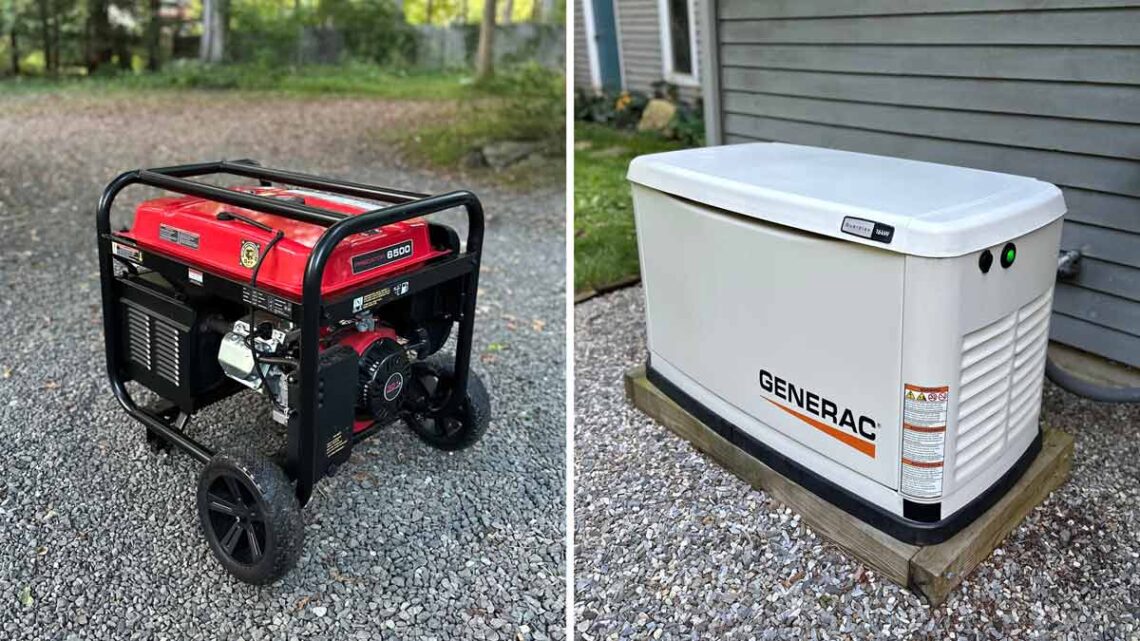
Standby Generators
A standby generator sits outside like a central air conditioner and runs on natural gas or propane. An automatic transfer switch detects the outage, starts the engine and moves the house onto generator power, usually within seconds. Some models restore power in about 10 seconds, and others take up to 30.
Capacities run from roughly 10 kilowatts to well above 20, which is enough for most or all of a typical house. Installed prices are commonly quoted between about $7,000 and $25,000. The spread reflects unit size, gas line work, permits and the distance from the fuel source to the pad.
The main weakness is dependence on a fuel supply. A natural gas unit relies on the utility line staying in service. A propane unit relies on a tank that someone must keep filled.
Conventional Portable Generators
A conventional portable generator is the cheapest way to get real power. Units between 1 and 6 kilowatts typically sell for $500 to $1,800, and larger units of 7.5 to 10 kilowatts run about $2,000 to $3,500. The engine runs at a fixed speed regardless of the load, which makes it loud and thirsty at light demand.
Power reaches the house in one of two ways. Appliances can be plugged into the generator through outdoor-rated extension cords, or an electrician can install a transfer switch or interlock so the generator can feed selected circuits. The second route is far more convenient in a long outage, and it removes the temptation to improvise.
Inverter Generators
An inverter generator trades some price and maximum size for refinement. Because the electronics create the final waveform, the engine is free to idle down when the load is light. Manufacturers cite fuel savings as high as 25 percent at light loads on small units, and the noise reduction is obvious next to an open-frame conventional model.
A common misconception is that inverter generators are weaker. A 5,000-watt inverter generator delivers the same 5,000 watts as a 5,000-watt conventional unit.
The limit is at the top of the range, where the largest conventional portables still exceed the largest inverter models. A household that needs 15 kilowatts or more from a portable machine will probably end up with a conventional one.
Battery Inverter Systems
A home battery is the only option on this list that is silent, fumeless and instant. The Powerwall 3 offers 13.5 kilowatt-hours of storage and 11.5 kilowatts of continuous output, and it is rated to start heavy motor loads.
That is enough to run a central air conditioner during an outage, which many competing batteries cannot do. Extra storage can be added in 13.5 kilowatt-hour increments.
A single unit typically costs around $13,500 installed. It carries a 10-year warranty with 70 percent capacity retention. The price buys power, and storage is the cheaper half. Output in kilowatts is what lets a battery run a big load, but capacity in kilowatt-hours is what keeps it running.
Runtime Is the Real Divide
Generators are limited by how much power they can deliver at one moment. Batteries are limited by both how much they can deliver at once and how much energy they hold. Buyers who size a battery only by its power rating are often surprised at 2 a.m.
The sizing math takes a few minutes:
- List every device that must run, with its running watts. Motor loads such as refrigerators, well pumps and air conditioners draw roughly two to three times their running watts for a moment at startup.
- Add the running watts of everything that could run at the same time. This sets the kilowatts a generator or inverter must supply.
- Multiply the average load in kilowatts by the hours the outage might last. This sets the kilowatt-hours a battery must hold.
- Divide usable battery capacity by that average load to find the runtime.
A hypothetical household shows the problem. A refrigerator averaging 150 watts, 40 watts of LED lighting, a 15-watt router and a 100-watt laptop come to about 305 watts. A 13.5 kilowatt-hour battery would cover that for roughly 44 hours on paper. Conversion losses and extra loads will cut the real figure, but one to two days is plausible.
Add a 3-kilowatt central air conditioner and the average load jumps past 3.3 kilowatts. The same battery now lasts about four hours. Cooling is what separates a battery that carries a house through a storm from one that carries it through an afternoon.
A generator has no such cliff. A standby unit on a propane tank keeps going as long as fuel remains, and a gasoline portable keeps going as long as someone makes fuel runs. The hazard is fuel supply during a regional emergency, when stations may be closed or out of stock.
A usable rule of thumb: compare the longest outage in the past few years with the battery’s runtime at the load that matters most. If the outage was shorter, a battery handles it. If it was longer, plan on a generator, or on solar panels that recharge the battery each day.
Power Quality and Sensitive Equipment
Utility power is close to a pure sine wave. Conventional generators produce a rougher waveform, measured as total harmonic distortion, and the engine speed can drift with load. Most modern power supplies tolerate this, but some audio gear, variable-speed motors and older electronics may hum, run hot or fail early.
Inverter generators and battery inverters produce cleaner output, which is why they are the usual choice for laptops, network equipment and appliances with electronic controls. A standby generator’s built-in voltage and frequency regulation varies by brand and tier, so premium models are marketed as electronics-safe.
Medical equipment needs separate handling. Oxygen concentrators, ventilators and similar devices should be backed up according to the manufacturer’s guidance and the prescribing clinician’s advice.
A standby generator leaves a gap of several seconds between the outage and the restored power, and a device with its own internal battery bridges that gap better than the house circuit does.
Safety and Installation
The generator hazards that kill people are well understood and mostly avoidable. Generator exhaust contains carbon monoxide, which cannot be seen or smelled. The Consumer Product Safety Commission advises running a portable generator only outdoors, at least 20 feet from doors, windows and vents.
A generator should never run in a garage, basement, crawlspace or shed, even with the door open. Battery-operated or battery-backed carbon monoxide alarms belong on every level of the house.
Newer portable generators may include a carbon monoxide shutoff that stops the engine when gas levels rise near the unit. The feature is worth paying for, but it does not replace distance or alarms.
Backfeeding is the second major danger. Plugging a generator into a wall outlet with a male-to-male cord can send current back through the service line and electrocute a utility worker.
A licensed electrician should install a transfer switch or interlock for any portable generator that will power house wiring. Standby generators and home batteries are wired in by licensed professionals under permits, and the inspection is part of what the buyer is paying for.
Fuel storage deserves the same care. Gasoline belongs in approved containers outside living areas and away from any appliance with a pilot light or an igniter. A generator should be shut off and allowed to cool before refueling, because gasoline spilled on a hot muffler can ignite.
Fuel, Maintenance and the Reliability Trap
Gasoline is the weakest link in portable generator ownership. Untreated gasoline can begin to degrade in as little as 30 days inside a generator’s vented fuel system, and ethanol blends last about three months at best. Some manufacturers advise draining the tank if the unit will sit for more than a month.
A stabilizer extends useful life, and a generator that has not been started since last winter is the usual explanation for one that will not start in a storm.
Propane and natural gas avoid the aging problem. Standby units also run periodic self-tests, so a failing starter battery or a fouled sensor shows up before an outage. The starter battery typically lasts two to four years, and replacement costs roughly $100 to $300 installed. Annual servicing keeps the engine in warranty and in working order.
A battery needs almost no attention. The reliability risks lie elsewhere: undersizing, a charge level left too low, or an installation that backs up the wrong circuits. A system that powers the kitchen but not the furnace blower or the well pump has failed the household, however well the hardware works.
Money, Incentives and Daily Value
Cost comparisons often ignore what a system does on the 360-odd days without an outage. A generator earns nothing between storms. A battery paired with solar panels can store midday production for the evening and, on some utility plans, shift consumption away from expensive peak rates.
That daily value reduces the effective price of the battery, though how much depends on local rates and on whether the utility rewards the behavior.
The federal 30 percent residential clean energy credit that once covered home batteries has ended. New installations should not count on it, and a purchase should be priced without that subtraction. State programs, utility rebates and local incentives vary widely, so an installer’s current quote and the utility’s website are the places to check.
Where a Combination Makes Sense
The two technologies cover each other’s weaknesses. A battery carries the house through the first hours and short outages with no noise and no fuel.
A generator takes over when an outage stretches beyond what the battery can cover. Some standby generators and battery systems are designed to work together, with the generator recharging the battery instead of feeding the house directly. Installers can advise on whether a given pairing is supported.
The cost of owning both is the strongest argument against the combination. Households in places where outages rarely last beyond a day are usually better served by one well-sized system than by two partial ones.
A Decision Rule That Holds Up
Start with the longest outage the household has actually faced, and the loads that cannot go dark.
- Outages under about a day, essentials only, solar on the roof or planned: a battery inverter system sized for the essential circuits.
- Multi-day outages, central air or electric heat, or well pumps: a standby generator sized for the whole house.
- Tight budget, occasional outages, and willingness to handle fuel and cords: a portable inverter generator for essentials, with a transfer switch or interlock installed by an electrician.
- Both long outages and a wish for silent, instant switchover: a battery for the first hours and a generator behind it for the rest.
Whichever machine wins, the number to confirm before paying is the one that limits the system: kilowatts for a generator, kilowatt-hours and kilowatts together for a battery.
What People Ask