
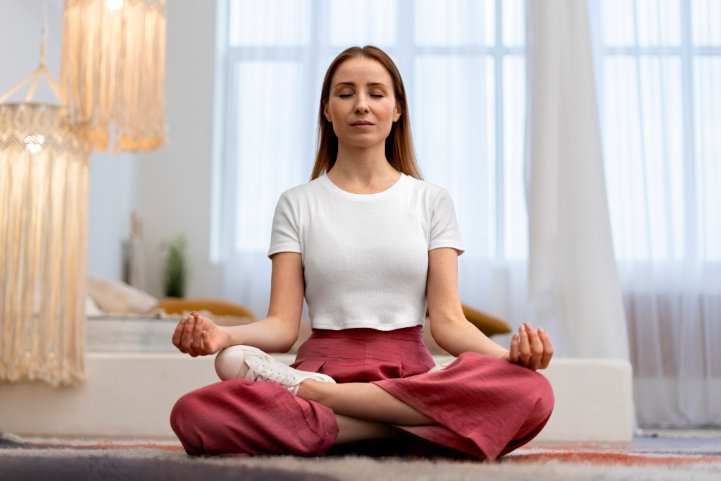
The Actual Research on Meditation’s Effect on Anxiety
Randomized trials show real but modest benefits, parity with escitalopram in one major study, and side effects that are rarely measured.
Meditation reduces anxiety symptoms by a small to moderate margin in randomized trials, with mindfulness-based stress reduction matching the antidepressant escitalopram in one major trial.
The effects are weaker against active treatments, fade somewhat over months, and carry a measurable risk of side effects for a minority of practitioners.
Trending Now!!:
That summary sits far from the claims made in wellness marketing and far from the dismissals found in some online commentary.
The research answers a narrower question than most readers ask: it measures how much anxiety scores fall, compared with what, in whom, and at what cost in time and distress. Each of those qualifiers changes the verdict.
The Size of the Effect
The most-cited review focused specifically on anxiety, led by Kevin Chen and colleagues, pooled 36 randomized trials covering 2,466 observations.
Meditation outperformed waitlist controls by a standardized mean difference of -0.52 and attention controls by -0.59. Against alternative treatments, the gap shrank to -0.27. The authors also noted that most trials treated anxiety as a secondary concern and measured symptoms rather than diagnosed anxiety disorders.




Madhav Goyal and the Johns Hopkins team reached a similar picture across 47 trials and 3,515 participants. Mindfulness programs showed moderate-strength evidence for reducing anxiety, with an effect size of 0.38 at eight weeks that dropped to 0.22 at three to six months.
The review found no evidence that meditation beat any active treatment, including drugs, exercise, or other behavioral therapies.
Two patterns recur across this literature. Benefits are largest right after a program ends and decay without continued practice. Gains also shrink as the comparison group becomes more credible.
The Control Group Problem
A waitlist control is the weakest possible comparison, because participants who receive nothing have no expectation of improvement. Simon Goldberg and colleagues addressed this directly in a meta-analysis of 142 samples and 12,005 participants, sorting studies by the strength of the comparison condition.
Mindfulness-based interventions beat no treatment (d = 0.55), minimal treatment (0.37), non-specific active controls (0.35), and specific active controls (0.23). Against established evidence-based treatments, the difference was essentially zero.
This gradient is the single most useful fact for interpreting any headline about meditation and anxiety. Parity with proven treatments is a meaningful finding, but it is not superiority.
Two further details deserve attention. In that analysis, the strongest evidence was for depression, pain, smoking, and addiction, not anxiety. A follow-up by Goldberg and Raymond Tucker also examined researcher allegiance, the documented tendency for trial results to favor the intervention its designers champion, as a possible explanation for mindfulness outperforming specific active controls.
A separate meta-analysis comparing meditation with relaxation therapy for anxiety, covering 14 trials and 862 participants, found a modest edge for meditation (g = -0.23, number needed to treat of about 7.7) while flagging that few studies were high quality and that allegiance might be moderating results.
Meditation Versus Escitalopram
The trial that changed the clinical conversation was led by Elizabeth Hoge at Georgetown University Medical Center and published in JAMA Psychiatry.
It randomized 276 adults with anxiety disorders to an eight-week mindfulness-based stress reduction course (136 participants) or escitalopram at 10 to 20 mg (140 participants).
Clinician-rated severity fell by 1.35 points on the Clinical Global Impression scale in the mindfulness group and 1.43 in the medication group, which met the study’s definition of noninferiority.
The safety contrast was stark. At least one study-related adverse event occurred in 15.4 percent of the mindfulness group and 78.6 percent of the escitalopram group, and ten patients left the medication arm because of side effects versus none in the mindfulness arm.
The result needs careful reading. Noninferiority means mindfulness was not meaningfully worse, not that it was better. It was a single trial, and the authors themselves called for replication in other settings.
Hoge also stressed that mindfulness demands far more effort than a daily pill: attending weekly sessions and keeping up home practice, which enhances the effect.
Not every patient is willing or able to commit to that. She noted that live videoconference delivery is likely to work if group discussion and question-and-answer components are retained, while the value of app-only practice remains unclear.
Insurance is the practical bottleneck. At the time of publication, Hoge observed that very few insurers reimbursed meditation programs, which means the cost of a course often falls on the patient even when the evidence supports it as a first-line option.
The trial also arrived weeks after the US Preventive Services Task Force first recommended anxiety screening for adults, so more people are likely to be identified and offered treatment choices.
Dose, Format, and the App Question
The programs that produce these results are intensive. Mindfulness-based stress reduction typically involves 20 to 30 hours of training over eight weeks, a very different proposition from ten minutes with a phone.
App-based meditation has its own evidence base, and it is more modest. A meta-analysis of 45 randomized trials of meditation apps found small reductions in anxiety, around g = 0.28 versus control conditions, roughly comparable to other therapeutic apps in the few trials that compared them.
A systematic review of the two market leaders found 14 randomized trials of Headspace and just one of Calm. Nearly all recruited non-clinical participants, most were underpowered, and half of the Headspace trials reported a conflict of interest, typically free premium access supplied by the company, with two reporting employee involvement in design or analysis.
The practical reading: apps have reasonable support as a tool for everyday stress and mild symptoms, but almost no trial evidence addresses their use for a diagnosed anxiety disorder.
The Side Effects the Literature Underreports
Chen’s review reported no adverse effects across its 36 trials. That absence says more about measurement than safety. Researchers at Brown University have pointed out that fewer than a quarter of meditation studies actively assess adverse effects.
When researchers look, they find them. Willoughby Britton and Jared Lindahl documented effects including insomnia, hypersensitivity to light and sound, dissociation, and increased fear or panic.
In a study of mindfulness-based programs, meditation-related effects with negative valence appeared in 58 percent of participants and effects that impaired functioning in 37 percent. Britton and colleagues concluded that this is similar to the rate of transient distress in other psychological treatments, which is an important framing.
A 2025 study led by Van Dam of nearly 900 US meditators, using a 30-item checklist rather than open-ended questions, found that nearly 60 percent reported at least one side effect, about 30 percent described effects as challenging or distressing, and 9 percent experienced functional impairment.
Recent psychological distress predicted more side effects, and residential retreats were linked to impairing ones. Britton has described a mechanism called “relaxation-induced panic,” in which some people become more anxious when they relax, though she cautions that little is known about why.
For an anxious reader, this is the counterintuitive point: the population most drawn to meditation may include people more prone to its difficult effects. Discomfort is not automatically a warning sign, but distress that disrupts sleep, work, or relationships is.
How to Read the Next Claim
Four questions separate a solid claim from a weak one:
- What was the comparison group? A waitlist control and an active treatment answer different questions.
- Were participants diagnosed with an anxiety disorder, or simply scoring high on a symptom scale?
- What was the dose and format? Eight weeks of instructor-led training is not equivalent to occasional app use.
- Who funded and ran the trial, and were adverse effects systematically measured?
For mild to moderate anxiety, a structured, instructor-led program has the strongest support, and the evidence suggests it is worth the time if the person can sustain it.
For a diagnosed anxiety disorder, meditation belongs in a conversation with a clinician as one evidence-based option alongside medication and cognitive behavioral therapy, not as a replacement chosen alone.
Anyone with a trauma history or acute distress is better served by a teacher or therapist trained in meditation safety than by an intensive retreat. Programs such as Brown’s “First, Do No Harm” training exist precisely because teachers were seeing these effects without guidance.
The Bottom Line
The research supports meditation as a legitimate, low-risk-for-most, moderately effective approach to anxiety whose best-case performance matches established treatments and whose typical performance is smaller and less durable than advertised.
The honest summary is neither miracle nor placebo: a real effect, dependent on dose and delivery, with side effects that deserve informed consent rather than silence.
What People Ask