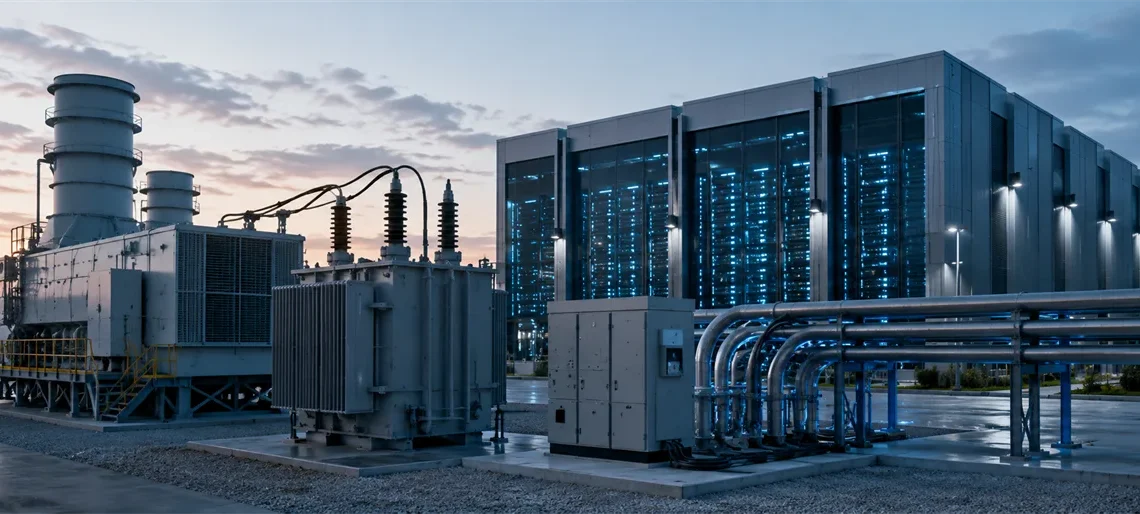
The Environmental Cost of AI Data Centers Nobody Wants to Calculate
Behind every AI query sits a stack of hidden costs: gas turbines running without permits, aquifers drained for cooling, and chip factories nobody audits. Here is what the industry's own numbers actually add up to.
The electricity bill for a ChatGPT query is not the story. The story is everything that happens before and after that query: the gas turbines running without permits outside Memphis, the ultrapure water consumed inside a Taiwanese chip fab, the GPU that will be landfilled in three years.
AI’s environmental cost is not one number. It is a stack of costs, most of them under-disclosed, several of them actively contested in court, and at least one category that the industry has not figured out how to measure at all.
Trending Now!!:
Why the per-query number is a distraction
Every few months, a new estimate circulates for how much energy or water a single AI prompt consumes. The figures vary wildly, and that variance is itself instructive.
Public estimates for a typical ChatGPT query range from roughly 0.3 to 3 watt-hours depending on model size, prompt length, and serving infrastructure, with a reasonable working figure landing around 1 to 2 Wh. Water estimates are similarly scattered, with per-query consumption for ChatGPT-class queries put at somewhere between 0.05 and 0.5 milliliters.
Reporting these figures as a headline number obscures the actual engineering problem: average consumption is not what breaks a grid or drains an aquifer. Peak demand is. Research from UC Riverside and Caltech notes that while per-prompt figures vary widely, peak demand for data centers using evaporative cooling can run six to thirty times the annual average, which is why utilities are being asked to build infrastructure sized for the worst hour of the worst day, not the average minute of the year.
That mismatch is projected to require up to 1.45 billion gallons of additional peak daily water capacity by 2030, at a cost of 10 to 58 billion dollars, much of it likely to land on local ratepayers rather than the AI companies driving the demand. A per-query calculator cannot capture that. Nobody markets a “grid strain multiplier” widget, because it does not flatter anyone’s product.




The electricity number keeps getting revised upward
Every major forecast of AI’s power demand issued in the last two years has been revised upward within months of publication. A United Nations University report issued in June 2026 found that global data centers used 448 trillion watt-hours of electricity, more than all but 10 countries in the world.
It warned that water and energy use and pollution will double within four years. The electricity consumption alone produced about 208 million tons of carbon dioxide, comparable to Argentina’s total emissions.
The International Energy Agency’s trajectory tells the same story from a different angle. Its 2025 Energy and AI report projected global data center electricity consumption rising from 415 TWh in 2024 to roughly 945 TWh by 2030, with AI accelerator workloads accounting for the largest share of that growth, and global data center electricity demand had already reached an estimated 460 to 490 TWh in 2025, ahead of some earlier projections.
Deloitte’s modelling shows a comparable arc, projecting that data centers will make up about 2 percent of global electricity consumption in 2025, or 536 TWh, before roughly doubling to 1,065 TWh by 2030, driven specifically by the fact that generative AI training and inference is growing faster than every other data center workload.
What tends to get lost in the top-line comparisons to national grids is the shape of the growth curve, not just its size. U.S. data center electricity consumption is projected to climb from 183 TWh in 2024 to 426 TWh by 2030, and that growth is arriving in concentrated geographic clusters rather than spread evenly across the grid, which is why regional capacity markets have already started repricing.
PJM’s July 2024 capacity auction cleared at roughly 270 dollars per megawatt-day, an 800 percent jump from the prior year, and by July 2025 the auction hit the market cap near 330 dollars per megawatt-day. That price signal is a direct transfer of AI infrastructure cost onto households and businesses with no connection to AI whatsoever.
Water: the cost that hides behind “efficiency”
Evaporative cooling is often described as efficient, and by one measure it is. Evaporative systems can achieve Power Usage Effectiveness ratios of 1.1 to 1.3, meaning only 10 to 30 percent of a facility’s total energy goes toward cooling.
The efficiency comes from converting water to vapour instead of electricity to refrigerant, which is precisely why the water figures are so large. For every megawatt of heat rejected through evaporative cooling, a facility consumes roughly 1,500 to 2,500 gallons of water per hour, meaning a 100 megawatt hyperscale data center, a common size for AI-focused facilities, can consume 3 to 6 million gallons of water per day during peak summer operation.
The disclosure gap among the companies building this infrastructure is one of the least discussed problems in the entire debate. Google has become the most transparent of the major cloud providers on this metric, and the transparency is not flattering.
Google is now the largest water consumer among disclosing hyperscalers by a factor of more than four versus Amazon, and its water consumption accelerated with each successive AI model generation, with a 34 percent year-over-year increase in 2025 marking the steepest jump on record.
Google has committed to being water-positive by 2030, and its replenishment rate climbed from 18 percent to 78 percent of consumption in two years, though it still needs to reach 120 percent replenishment to hit that target. Meta and Microsoft cannot currently be held to the same standard of scrutiny, not because their footprint is smaller, but because the data is not there.
Meta’s 2025 sustainability data had not yet been published as of mid-2026, and Microsoft’s absolute water consumption figures are estimated from water usage effectiveness multiplied against energy use rather than disclosed directly.
That asymmetry matters enormously for anyone trying to build an honest comparative picture of the industry, because the companies volunteering the most rigorous numbers end up looking the worst by comparison, while the companies withholding data escape scrutiny by default.
The geography compounds the problem. As of 2023, nearly 80 percent of the water consumption from Google’s U.S. AI data centers came from drinking water sources rather than reclaimed or non-potable supplies, and in water-stressed Arizona, data centers have been withdrawing water in the same period that farmers fallowed fields and families went without reliable tap water.
A cooling system’s PUE rating says nothing about whether the water it consumes came from a river with room to spare or an aquifer that took millennia to fill.
The lifecycle nobody wants to price: chips before they ever run a query
This is the category that gets the least attention and arguably deserves the most, because it happens entirely before a data center opens its doors. It is largely invisible in the operational metrics companies choose to report.
The industry term is embodied carbon: the emissions locked into a chip through mining, refining, fabrication, and packaging, long before it processes a single token.
Semiconductor fabrication is one of the most resource-intensive manufacturing processes on the planet, and AI accelerators are making it worse at a pace that outstrips almost every other projection in this article.
Manufacturing emissions from AI GPU production are projected to rise more than twelvefold, from 1.8 million metric tons of CO2 in 2024 to a projected 21.6 million metric tons by 2030, a 64.5 percent annual growth rate that would make this single product category responsible for 8.7 percent of all semiconductor sector emissions by the end of the decade.
The average AI GPU’s embodied carbon is expected to exceed one metric ton of CO2-equivalent by 2029, nearly seven times the footprint of an H100, and the driver is not the logic die anymore. High-Bandwidth Memory is becoming the dominant source of embodied carbon in advanced AI hardware, with the average accelerator projected to integrate roughly 250 HBM dies by 2030, a sixfold increase over current generations.
The water cost of that fabrication rarely enters public conversation at all. A single large fab can use up to 38 million litres of water per day, more than many entire data centers withdraw, and TSMC alone withdrew 105 billion litres of water in 2022 while discharging 71 billion litres of wastewater containing hydrofluoric acid and other toxic contaminants.
The chemistry involved is genuinely dangerous: fabs rely on roughly 500 different chemicals, and fluorinated gases used in the etching process account for 80 to 90 percent of a fab’s direct emissions despite their disproportionately high global warming potential relative to CO2. Some AI labs have begun disclosing this.
Mistral AI estimated the hardware embodied emissions of its Large 2 model at 2,244 tons of CO2-equivalent, or 11 percent of the model’s total footprint, with embodied water accounting for roughly 5 percent of its total water footprint.
That kind of granular, model-level disclosure is still the exception rather than the rule, which is precisely the problem: without it, embodied carbon simply does not appear in most companies’ headline sustainability numbers, even though independent research treats it as the single largest contributor to a data center’s true lifecycle footprint.
Scope 3 emissions, which cover exactly this category, are typically the most significant contributor to a data center’s total lifecycle footprint, and Microsoft’s own Scope 3 emissions accounted for 66 percent of its total in 2023.
Then there is what happens when the chip retires. AI accelerators do not have the service life of a building or even a car.
Chips are commonly replaced after just one to three years, generating a mounting stream of electronic waste that is largely absent from public conversation about AI’s environmental impact, and the human and environmental costs of that disposal are frequently externalized onto communities near mining sites, fabrication plants, and informal e-waste processing operations, making the hardware lifecycle a matter of global environmental justice rather than a purely technical accounting problem.
Where the cost lands: local air, not just global carbon
The most visible fight over AI’s environmental cost right now is not about a carbon ledger at all. It is about what a specific community breathes, and it is playing out in federal court.
xAI’s Colossus data center in Memphis has become the clearest case study of what happens when data center growth outpaces grid capacity, and permitting keeps up even slower. More than 30 natural gas turbines intended for daily use, not emergency backup, were installed at the site, and local residents along with the NAACP filed notice of intent to sue under the Clean Air Act, arguing the project would worsen air quality in a city that already faces high asthma rates and long-standing environmental health disparities. The scale of the pollution at issue is not abstract.
Plaintiffs seeking a preliminary injunction cited turbines capable of emitting 2,507 tons of smog-forming nitrogen oxides, 236 tons of fine particulate soot, 837 tons of carbon monoxide, and 25 tons of formaldehyde annually, and Abre’ Conner, the NAACP’s Director of Environmental and Climate Justice, described it directly: “a data center should not be a potential death sentence for a community’s health”.
The regulatory picture has shifted since the dispute began, though not cleanly in either direction. Shelby County regulators granted xAI permits to operate 15 gas turbines capable of producing up to 247 megawatts, after the company had reportedly been running as many as 35 generators without any permit at all, even as the EPA closed the specific regulatory loophole, classifying turbines as non-road engines to avoid Clean Air Act permitting, that Shelby County had initially used to let xAI operate without public comment or environmental review.
xAI had said its turbines would include selective catalytic reduction emissions controls, but the company’s own turbine supplier later told reporters those controls were not installed on the temporary units used at the site.
The precedent is spreading beyond Memphis. In Nashville, city council members warned that large data centers create electric demands comparable to entire cities and pushed back against the use of emergency-generation provisions to effectively run private power plants, after a data center ordinance there lost a key environmental safeguard.
This is the part of the environmental cost calculation that is easiest to leave out of a corporate sustainability report and hardest to leave out of a public health record. A megaton figure for global CO2 is diffuse and abstract. A gas turbine two miles from an elementary school is not.
Why the number stays uncalculated
None of this is unmeasurable in principle. Every category above has researchers actively trying to quantify it. What keeps a comprehensive figure from existing is structural, not technical.
Disclosure is voluntary and inconsistent. Companies report the metrics that make them look responsible and omit the ones that do not, and there is no standardized requirement forcing embodied carbon, fabrication water, or e-waste into the same report as operational PUE and WUE.
The result is that Google and Amazon, the companies with the most rigorous primary disclosure, end up scored on actual data while Meta and Microsoft are scored on estimates, which inverts the incentive: transparency invites scrutiny, opacity avoids it.
Scope 3 is treated as optional even by researchers trying to be rigorous. Even peer-reviewed studies benchmarking AI’s operational footprint frequently exclude embodied emissions and manufacturing water use entirely, citing the difficulty of attributing a fixed fraction of a chip’s lifetime footprint to any single deployment or query.
That is methodologically defensible and practically means the largest single category of a model’s lifecycle footprint routinely goes unreported in the same papers cited as authoritative sources on AI’s environmental cost.
The externalities are geographically and financially diffuse. The company deploying a model in California is rarely the entity whose ratepayers absorb a PJM capacity price spike in Pennsylvania, and it is never the community breathing turbine exhaust in Memphis.
When the entity generating a cost and the entity bearing it are different, the incentive to calculate that cost precisely, rather than gesture at it in a sustainability report, weakens considerably.
Peak demand is harder to model than average demand, and average demand is what gets published. As the water infrastructure research above shows, the number that determines actual grid and utility investment, peak load, is routinely absent from the per-query and per-model figures that dominate public discussion.
A framework for reading any AI environmental claim
Given the fragmentation above, a useful discipline for evaluating any company’s environmental claim about its AI infrastructure is to check which of the following five categories it actually covers, since most claims cover one or two and imply all five:
Operational electricity at the data center, measured with a stated PUE and sourced against a disclosed grid mix rather than a blended national average.
Operational water, measured with a stated WUE and disclosed by source, meaning municipal drinking water versus reclaimed or non-potable supply, not just a gallons total.
Embodied carbon and water from chip fabrication, ideally disclosed per model or per hardware generation rather than folded into an undifferentiated corporate Scope 3 figure.
End-of-life hardware handling, including disclosed refurbishment, recycling, or landfill rates for retired accelerators.
Local air and community impact from on-site generation, including whether backup or supplemental power comes from permitted, emissions-controlled sources.
A claim that satisfies the first two and is silent on the last three is not lying, but it is answering a much smaller question than the one most readers assume is being asked.
What comes next
The trajectory across every metric in this article points the same direction, and the projections keep landing on 2028 to 2030 as the inflection point where current infrastructure planning either catches up or falls further behind.
The United Nations University’s own framing is stark: current water and energy use and pollution from data centers is expected to double within four years.
Whether that growth arrives with honest, comprehensive accounting or with the same patchwork of voluntary, self-selected metrics that define the industry today will determine whether the environmental cost of AI gets calculated before it gets locked in, or after.