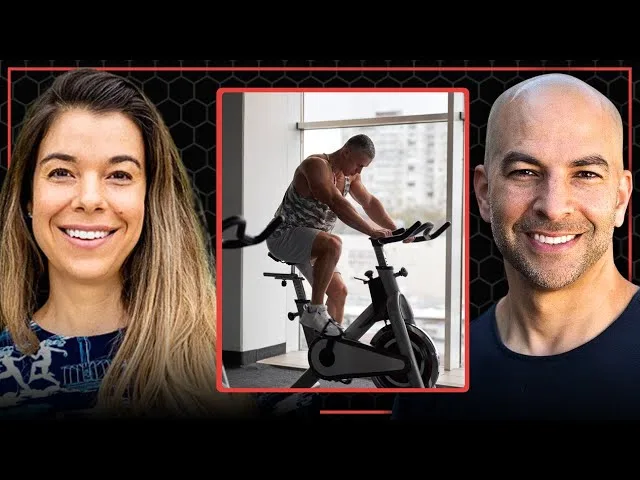
What Peter Attia, Andrew Huberman, and Rhonda Patrick Actually Agree On
Beneath the competing protocols and podcast rivalries, the three biggest names in longevity science converge on a shorter, sharper list of interventions than anyone selling supplements would like to admit.
The internet has turned Peter Attia, Andrew Huberman, and Rhonda Patrick into rival tribes, each with a merch line of supplement stacks, sauna brands, and morning routines that fans defend like sports allegiances.
But strip away the branding and the podcast disagreements over cold plunge timing or NAD+ precursors, and a much narrower, much more useful list emerges: the handful of interventions all three actually endorse, repeatedly, on the record, without hedging.
Trending Now!!:
That list centers on strength training, cardiorespiratory fitness measured through VO2 max, sleep as a non-negotiable pillar of health, adequate rather than excessive protein intake, and heat exposure through regular sauna use, all filtered through a shared insistence on data over trend-chasing.
Understanding where these three actually converge matters more than knowing where they diverge, because the areas of agreement represent the interventions with the strongest evidentiary backing among the entire longevity-influencer ecosystem. Where they disagree, the disagreement is usually about dosage, sequencing, or personal preference, not about whether the underlying mechanism works.
Why the Perceived Disagreement Is Overstated
Content aggregators and comparison blogs have built an entire subgenre around pitting these three against each other. Peter Attia and Andrew Huberman are frequently described as split on Zone 2 cardio protocols. Rhonda Patrick and Attia get framed as divided over cold exposure timing.
Supplement roundups highlight that Attia favors a more conservative, pharmaceutical-grade approach to interventions like rapamycin while Patrick has been more publicly enthusiastic about compounds like sulforaphane and NAD boosters.




These distinctions are real, but they are secondary. They concern implementation details, not the underlying claims about what actually extends healthspan.
A useful analogy: three cardiologists might disagree about which statin to prescribe first while agreeing completely that LDL cholesterol reduction matters. The disagreement is clinical nuance, not a fracture in the science.
Strength Training as a Non-Negotiable Foundation
Every recent synthesis of longevity science places resistance training at the center, and none of the three figures treats it as optional. Attia has stated plainly that strength is the most important modifiable parameter of long-term health, structuring his own training around three weekly sessions built on compound lifts, with particular emphasis on the deadlift as a movement pattern worth mastering regardless of the specific load used.
His reasoning ties directly to what he calls the Centenarian Decathlon, a framework in which the goal of training is not aesthetics or performance benchmarks but the physical capability required to do specific tasks deep into old age, from carrying groceries up a flight of stairs to getting up off the floor unassisted.
Rhonda Patrick has become increasingly outspoken about heavy resistance training in recent public commentary, describing multi-joint compound movements such as deadlifts, front squats, back squats, and Olympic-style cleans as the backbone of her own regimen.
She has specifically pushed back against the cultural fixation on protein intake as the primary lever for muscle health, arguing that training stimulus matters more than supplement optimization and that people should, in her words, become more focused on training and less obsessed with protein timing and quantity.
Huberman, whose audience skews toward habit formation and behavioral science rather than clinical exercise physiology, has consistently reinforced strength training’s role in hormonal regulation, bone density, and injury prevention as people age, framing it as inseparable from any serious cardiovascular protocol rather than a secondary add-on.
VO2 Max and the Cardiorespiratory Consensus
If there is one biomarker all three treat as close to sacred, it is VO2 max, the maximum rate at which the body can use oxygen during intense exertion. Attia has been the most vocal advocate, and notably revised his own public position to emphasize it even further.
In a recent reassessment of his longstanding views, he stated that VO2 max is more strongly associated with reduced mortality risk than any other metric currently available, describing it as the best integrated measure of exercise volume and intensity combined.
His training framework builds VO2 max on top of a broad aerobic base, with roughly 80 percent of cardiovascular training time spent in Zone 2, the moderate-intensity range where conversation remains possible and fat oxidation is maximized, complemented by short, high-intensity Zone 5 intervals once weekly to drive peak aerobic capacity.
Patrick has echoed this cardiorespiratory emphasis through her advocacy of structured interval protocols, including the Norwegian 4×4 method, which she has described as capable of meaningfully improving cardiac function and mitochondrial biogenesis, the process by which cells generate new, more efficient mitochondria.
Huberman has folded similar interval and steady-state protocols into his own published frameworks, tying cardiorespiratory training not just to lifespan but to cognitive resilience and mood regulation, an angle consistent with his neuroscience background.
The shared thread across all three is a rejection of the outdated binary between cardio and strength training as competing priorities. Their collective position treats aerobic capacity and muscular strength as two separate, both-necessary systems, with VO2 max functioning as the single most predictive marker either of them will discuss when pressed to name one number worth tracking over a decade.
Sleep as the Foundation Beneath Every Other Protocol
None of the three figures treats sleep as a lifestyle nicety. Each frames it as a biological prerequisite that determines whether every other intervention, from training adaptation to metabolic regulation, actually pays off.
Huberman’s public platform was arguably built on this exact premise, with his early and widely cited emphasis on morning sunlight exposure within the first thirty to sixty minutes of waking as a mechanism for anchoring circadian rhythm and improving downstream sleep quality.
That specific recommendation has become one of the most widely adopted pieces of health advice to emerge from the podcast ecosystem, in part because it is free, mechanistically well-supported, and easy to implement.
Attia and Patrick both treat sleep debt as a compounding liability rather than something that can be offset through supplementation or willpower, and both have connected chronic sleep insufficiency to worse outcomes across nearly every domain they otherwise discuss, including insulin sensitivity, cardiovascular risk, and cognitive decline.
The agreement here is less about a specific protocol and more about sequencing: all three treat sleep optimization as the intervention that has to be addressed before anything else on a health checklist is worth pursuing seriously.
Protein Sufficiency Without the Obsession
One of the more counterintuitive points of alignment, particularly given how protein-focused the broader fitness content ecosystem has become, is a shared skepticism toward extreme protein targets.
Patrick has been explicit that she does not chase the popular one-gram-per-pound-of-bodyweight benchmark that dominates fitness media, instead operating in a range closer to 1.2 to 1.6 grams per kilogram, and has described pushing her intake higher as counterproductive once total caloric load climbed alongside it.
Attia has taken a similarly measured position, treating protein adequacy as necessary but not as the dominant variable in body composition or longevity outcomes, with training stimulus and consistency doing far more of the work.
This shared stance functions as a useful corrective for readers who have absorbed the message that more protein is categorically better. The consensus among all three is closer to sufficient protein plus consistent resistance training rather than maximal protein as a standalone strategy, a distinction that matters for anyone building a nutrition plan around influencer content rather than individualized clinical guidance.
Heat Exposure and the Underrated Case for Sauna
Regular heat exposure, primarily through traditional sauna use, has quietly become one of the more consistently referenced interventions across all three platforms, and it represents a genuine area of convergence rather than overlap by coincidence.
Attia has publicly revised his view on heat therapy in recent commentary, citing mounting evidence that sauna use may improve sleep quality, support cognitive function, and reduce cardiovascular risk, positioning it alongside VO2 max as an intervention he previously underweighted relative to the strength of the underlying data.
Patrick’s research background includes direct engagement with Finnish sauna cohort studies, most notably the Kuopio Ischaemic Heart Disease Risk Factor Study, which linked frequent sauna use to substantially reduced all-cause and cardiovascular mortality. Huberman has incorporated heat exposure protocols into his published frameworks as a complement to cold exposure, framing the two as distinct tools that trigger different adaptive stress responses rather than interchangeable options.
The mechanistic case each of them cites overlaps heavily: heat shock protein activation, improved vascular function through repeated thermal stress, and downstream benefits for sleep architecture.
It is worth noting that sauna access remains a meaningfully underused intervention relative to how consistently it appears across all three bodies of work, a gap between stated importance and actual public adoption that is unusual for a recommendation with this much consensus behind it.
Where the Real Disagreements Live
None of this erases genuine differences in emphasis and risk tolerance. Attia has taken a more conservative, biomarker-driven approach to pharmacological interventions, requiring stronger clinical trial evidence before recommending compounds like rapamycin outside of specific contexts.
Patrick has historically been more willing to discuss emerging compounds such as sulforaphane and NAD-boosting precursors based on mechanistic and early-stage human data, reflecting her background in nutritional biochemistry.
Huberman occupies a middle position, translating both camps’ findings into behavioral protocols while generally avoiding strong personal endorsements of specific supplements outside of well-established categories like vitamin D, magnesium, and omega-3 fatty acids, all three of which do appear across all three of their recommended stacks in some form.
Fasting protocols represent another area of nuanced divergence rather than outright conflict. All three have expressed interest in time-restricted eating for its metabolic benefits, including improved glucose regulation and reduced inflammation, but they differ on window length, frequency, and how strictly it should be applied, with Patrick noting she adopted a more consistent intermittent fasting approach relatively recently in response to changes in her own body composition rather than as a longstanding fixed protocol.
The Practical Takeaway for Readers Trying to Build a Protocol
For anyone attempting to extract an actionable framework from three overlapping but distinct bodies of public health content, the shared ground functions as a reliable starting point precisely because it has survived scrutiny from three independently skeptical, data-driven experts who have no professional incentive to agree with each other.
A protocol built on the intersection of their views, rather than any single figure’s complete system, would prioritize resistance training three times weekly with an emphasis on compound movements, Zone 2 cardiovascular work forming the bulk of aerobic training volume with a smaller dose of high-intensity intervals layered on top, consistent sleep timing anchored by morning light exposure, protein intake in a moderate and sustainable range rather than a maximized one, and regular sauna sessions as a low-cost, well-supported addition rather than an afterthought.
The broader lesson extends past any specific protocol. When three researchers with different training backgrounds, different audiences, and different commercial incentives independently converge on the same handful of interventions, that convergence is a stronger signal than any one of their individual endorsements would be alone.
The disagreements that dominate comparison content and social media debate are real, but they sit on top of a foundation that is far more unified than the discourse around these three figures tends to suggest.
What People Ask