What VO2 Max Actually Measures and Whether You Should Care About It
The fitness metric now displayed on every smartwatch has become one of the strongest predictors of how long you'll live, but the number on your wrist isn't measuring what most people assume it is.
VO2 max measures the maximum rate at which the body can pull in oxygen, transport it to working muscle, and convert it into usable energy during an all-out effort.
It is expressed in millilitres of oxygen consumed per kilogram of body weight per minute, and it is the closest thing exercise science has to a single number for the ceiling of the aerobic engine.
Trending Now!!:
A high score correlates with lower long-term mortality risk; a low score is one of the strongest predictors of early death that medicine has identified.
That last sentence is not marketing language. It is the conclusion of some of the largest cardiovascular outcome studies ever run, and it explains why a metric once confined to exercise physiology labs and Olympic training centers now sits on the home screen of millions of fitness watches.
Understanding what the number actually represents, and where the popular wrist-based version of it breaks down, separates useful self-monitoring from a false sense of precision.
The Three Systems the Number Is Really Testing
VO2 max is not a measure of lung capacity, despite the common assumption that it is primarily a breathing metric.




It is a composite readout of three linked systems working at their absolute limit simultaneously: pulmonary function (how efficiently the lungs load oxygen into the blood), cardiac output (how much oxygenated blood the heart can pump per minute, driven mainly by stroke volume rather than heart rate alone), and muscular extraction (how effectively the mitochondria inside muscle fibers pull that oxygen out of circulating blood and use it to produce energy).
VO2 max depends on oxygen delivery through atmospheric oxygen, air exchange in the lungs, the pumping power of the heart, and arterial blood flow to the muscles, and it also depends on oxygen demand from the tissues, since mitochondria consume nearly all of the oxygen that gets used.
In healthy, untrained adults, the heart is usually the limiting factor, not the lungs. This is a point competing consumer-facing articles frequently gloss over: someone with excellent lung function can still post a mediocre VO2 max if cardiac output or muscle-level oxygen extraction is the weak link. That is also why endurance training, not breathing exercises, is what moves the number.
Training thickens the heart’s left ventricle, increases stroke volume, expands capillary density around muscle fibers, and raises mitochondrial mass, and all four adaptations show up together as a higher VO2 max score.
How the Number Gets Measured, and How It Gets Guessed
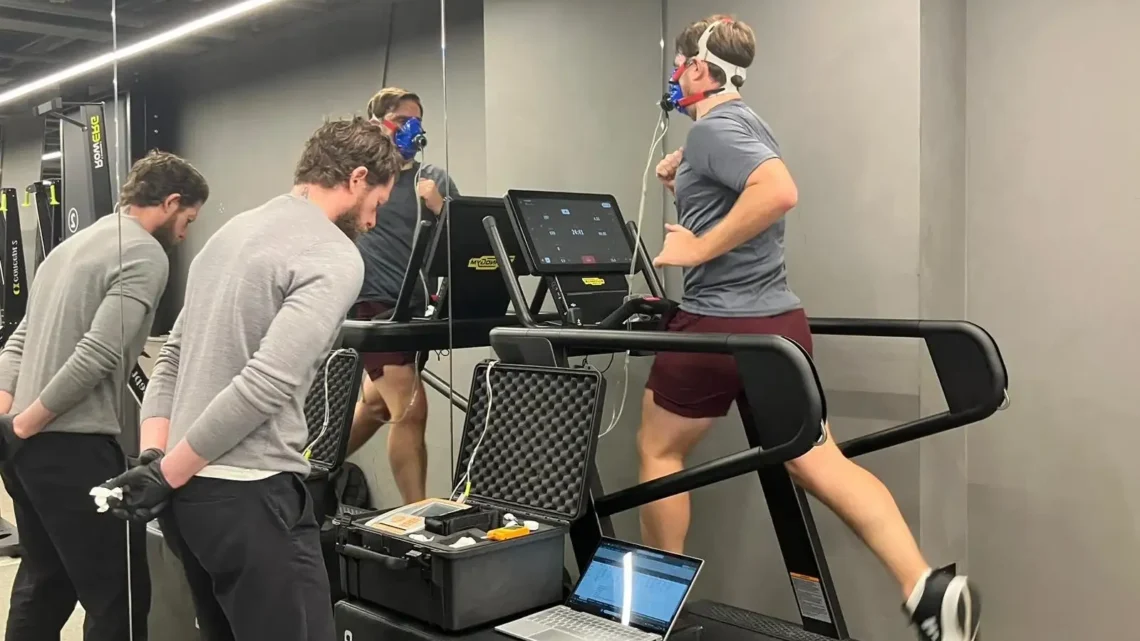
The gold standard is a laboratory cardiopulmonary exercise test: a subject runs on a treadmill or pedals a stationary bike while wearing a mask connected to a metabolic cart, with intensity increased in stages until the subject reaches volitional exhaustion and oxygen consumption plateaus despite increasing workload.
A tightly fitted mask or breathing snorkel connects to a bulky oxygen reading machine as the test subject exercises at full effort. This direct method is precise but expensive, physically demanding, and impractical outside a clinical or sports-science setting, which is exactly why almost nobody reading a VO2 max estimate on a smartwatch has ever had it measured this way.
Consumer wearables from Apple, Garmin, and similar brands do not measure oxygen consumption at all. They use heart rate data, pace, and personal information such as age, weight, and sex to run a prediction algorithm rather than measuring gas exchange directly.
A 2025 validation study of the Apple Watch’s VO2 max feature against laboratory testing found the algorithm to be reasonably useful as a trend indicator but noted its limits as a substitute for direct calorimetry, the true gold standard. The estimates tend to land in the right range for moderately active people doing steady outdoor runs.
Still, they drift further from the true value at the extremes of fitness, and for activities other than running or walking. This is the detail most wearable marketing omits: the number on a watch face is a heart-rate-based inference, not a physiological measurement, and treating it as clinically precise is a mistake even serious runners make.
Why the Number Predicts How Long People Live
The reason VO2 max earned its reputation extends well beyond athletic performance. A 2018 analysis published in JAMA Network Open followed 122,007 adults who completed treadmill exercise testing at the Cleveland Clinic and found cardiorespiratory fitness to be the single most powerful predictor of survival among all the variables studied, with no ceiling on the benefit: risk kept dropping as fitness climbed, even into the “elite” range.
A 2022 analysis in the Journal of the American College of Cardiology examined more than 750,000 U.S. military veterans and found that each 1-MET increase in VO2 max, roughly 3.5 mL/kg/min, was linked to a 13 to 15 percent drop in mortality risk, regardless of age, body mass index, sex, or existing health conditions.
Separate research using the UK Biobank, one of the largest cardiorespiratory fitness datasets in the world, found that all-cause mortality was roughly 8 percent lower and cardiovascular mortality about 9 percent lower for every one-metabolic-equivalent difference in fitness.
A 46-year follow-up of the Copenhagen Male Study, published in JACC, tracked middle-aged men free of cardiovascular disease and found that each unit increase in VO2 max was associated with roughly 45 additional days of life, with results holding even after excluding people who died within the first decade of follow-up, which rules out reverse causation as an explanation.
Perhaps the most consequential recent finding, and one that competing articles on this topic rarely surface, concerns the relationship between fitness and body weight. A 2025 systematic review and meta-analysis covering nearly 400,000 individuals found that people with good cardiorespiratory fitness showed no significant increase in mortality risk regardless of their body mass index, while unfit individuals carried two to three times higher mortality risk regardless of their weight category.
That finding does not excuse ignoring body composition altogether, but it reframes the priority: for someone choosing where to spend limited effort, raising fitness appears to matter more than the number on a scale.
What Counts as a Good Score
There is no single universal benchmark, because VO2 max is heavily shaped by age, sex, training history, and genetics. Normative data drawn from healthy young adults puts an average score for men in their early twenties in the mid-40s (mL/kg/min), with women typically scoring somewhat lower due to differences in haemoglobin concentration and average heart size.
At the same time, elite endurance athletes such as professional cyclists and cross-country skiers can post scores above 80. A sedentary adult might score in the low 30s, while elite endurance athletes can reach values above 80.
Age is the other major variable, and it moves in one direction without intervention. Studies show that VO2 max tends to decline naturally after age 30, dropping roughly 5 to 10 percent per decade, which means a “good” score at 25 is not the same target as a good score at 55.
Clinicians increasingly frame the number against age- and sex-adjusted percentiles rather than a fixed threshold, similar to how blood pressure or cholesterol gets interpreted relative to a population, not a flat cutoff.
How to Actually Raise It
Of the training methods studied for improving VO2 max, the most extensively validated is a Norwegian protocol built around four-minute intervals, developed by exercise physiologists Jan Helgerud and Jan Hoff at the Norwegian University of Science and Technology and studied extensively by Ulrik Wisløff’s Cardiac Exercise Research Group.
The structure is specific: four work intervals of four minutes each at 90 to 95 percent of maximum heart rate, separated by three minutes of active recovery, bookended by a warm-up and cooldown. In the original controlled trial, this protocol produced a roughly 7 percent increase in VO2 max over eight weeks, outperforming continuous moderate-intensity training in the same time frame.
The mechanism matters more than the exact numbers, because it explains why shorter, harder efforts underperform this format. Four minutes is long enough to drive the heart toward its maximum stroke volume.
This central cardiovascular adaptation raises VO2 max, whereas shorter sprint intervals do not sustain that cardiac demand long enough to produce the same effect. The protocol has since been tested in clinical populations with striking results: a 2007 trial published in Circulation applied it to heart failure patients and found peak oxygen uptake improved by 46 percent compared with 14 percent in a moderate-exercise comparison group, a gap that helped establish high-intensity interval training as a legitimate tool in cardiac rehabilitation rather than a purely athletic one.
A practical weekly approach that reflects current exercise-physiology consensus:
- Two structured high-intensity interval sessions per week, following the four-by-four format or a comparable variant such as six three-minute or eight two-minute intervals at similar intensity
- The remaining aerobic training kept easy, at a conversational pace, to allow recovery between hard sessions
- A minimum of six to eight weeks before expecting a measurable change, since cardiac and mitochondrial adaptations take time to accumulate
- Medical clearance before starting near-maximal interval training for anyone with existing cardiovascular risk factors or a sedentary history
Whether the Average Person Should Actually Care
The honest answer depends on what someone plans to do with the number. For competitive endurance athletes, VO2 max remains a legitimate performance ceiling worth tracking in a lab setting, since it caps how much aerobic capacity training can eventually unlock.
For the general population, the mortality data makes a stronger case for caring about the underlying fitness than about the specific digit on a watch face. The research consistently points to cardiorespiratory fitness, not a precise VO2 max score, as the variable that predicts longevity, and fitness improves the same way regardless of whether it is being tracked by a $15,000 metabolic cart or a $300 wearable.
Where obsession becomes counterproductive is in treating a wrist-based estimate as a diagnostic tool. Wearable VO2 max scores fluctuate with sleep, hydration, recent training load, and even GPS accuracy during a run, and none of that noise reflects an actual change in cardiovascular physiology.
The more useful habit is watching the multi-month trend line rather than any single reading, and using that trend as a signal to keep training consistently rather than as a number to chase for its own sake. A rising trend over a training block means the interventions are working. A single day’s number, high or low, means very little on its own.
What People Ask