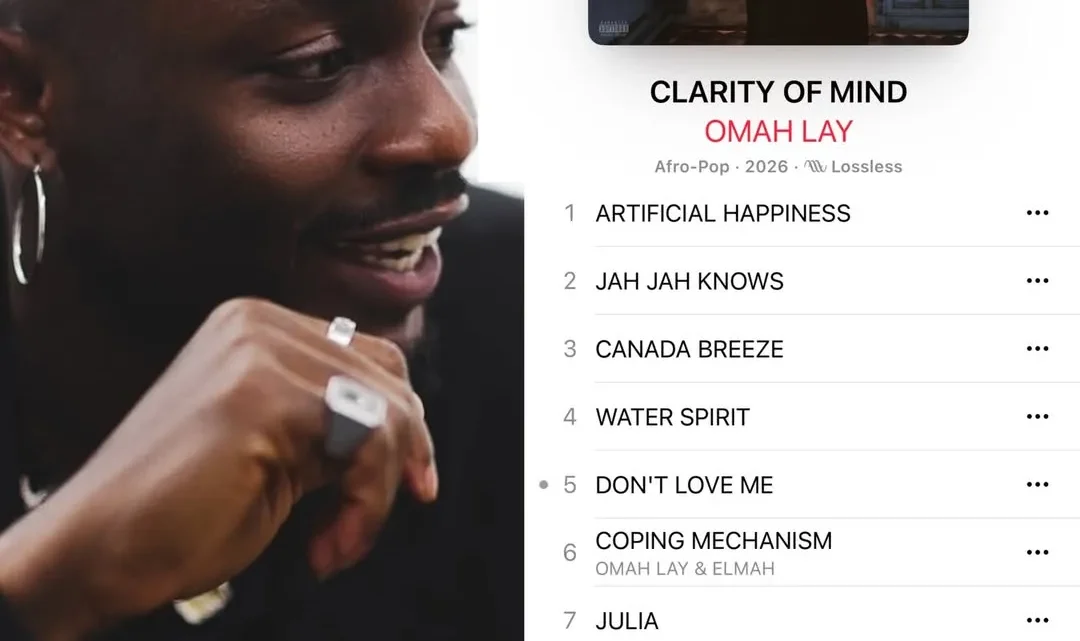
OMAH LAY: Clarity of Mind Album Review
Stanley Omah Didia’s sophomore project arrives heavier with meaning than its 33 minutes suggest, and the weight is entirely earned.
There is a particular kind of artist who survives being robbed, not of money or credits, but of a vision. The kind of theft that doesn’t leave fingerprints, that happens in private, between people who were supposed to be peers.
Omah Lay experienced exactly that, and what he made from the wreckage is Clarity of Mind, released on April 3, 2026, via KeyQaad and Warner Records. Twelve tracks. Thirty-three minutes. One featured artist. And enough emotional residue to fill a room for days.
Trending Now!!:
Four years separated this sophomore album from Boy Alone, his 2022 debut, and Omah Lay spent most of that stretch watching his original plans collapse. On the Zach Sang Show in 2024, he explained that he had shared an unreleased sound with a fellow artist he trusted, and that artist dropped an album five months later using the same idea.
He trashed the original sessions and started over from scratch. That reset is the invisible spine of Clarity of Mind, and it explains why the album carries the texture of a man who had to relearn what he was trying to say.
What he was trying to say, it turns out, is both simpler and more complicated than most Afrobeats albums will attempt in 2026. He is trying to hold the sacred and the sinful in the same hand without either one burning him. He does not always succeed. But the attempt is honest, and honesty in Nigerian pop music at this scale is rarer than the streaming numbers suggest.
If Boy Alone captured an artist in the midst of emotional dislocation, Clarity of Mind finds him fresh off a deliberate recalibration, returning with a clearer sense of self. “I decided to chill for a minute, take care of myself, take care of my family, put my mind back in the right space,” he told Apple Music’s Africa Now Radio. “It feels like I’ve just been inside doing all this healing, all this self-growth, and I looked at a bunch of records that I made during this time, and I’m like, yeah, this is clarity of mind.”
The production architecture here belongs almost entirely to Tempoe, his long-term collaborator, who handled the majority of the album’s twelve tracks. The producer also worked with Davido and Omah Lay on the Grammy-nominated track “With You,” further strengthening their collaborative chemistry.
That partnership is the album’s biggest structural asset and, in places, its limitation. Tempoe’s fingerprints give Clarity of Mind a steady mid-tempo bed that suits Omah Lay’s half-sung, half-mumbled delivery. But when seven or more tracks share the same production philosophy, even a great sound starts to feel like furniture: dependable, present, and slightly invisible.
Track 1: Artificial Happiness Rating: 8 / 10
The record starts with a substance talking back. Cannabis is the raconteur on “Artificial Happiness,” telling him not to stop. It is a sharp, counterintuitive way to open an album about mental clarity: let the vice speak first.
The production here is mid-tempo, warm at the edges and slightly dissonant underneath, which is exactly the right sonic bed for a lyric about chasing the wrong comforts. Omah Lay likens his stubbornness in losing himself to his vices to dying at the war front. The song sets the mood well for the album, even if it does not land any single knockout line.
This is an opener doing exactly what a great opener should do: establish the emotional weather without giving away the forecast. The restraint here is notable. A lesser artist would have overproduced this into a statement track. He lets it breathe, and the breathing is the point.
Track 2: Jah Jah Knows Rating: 6.5 / 10
He tells his Bisi not to wait for him on “Jah Jah Knows.” “As you see me, I no dey too sure, I don’t know what to do with my life.” Then he asks a question that is smarter than it sounds: “Tell me who be policeman, if it wasn’t for the uniform.” Take the fame, the weed, the money away, and who is he? Only Jah Jah knows.
That question deserves a more compelling delivery than it receives here. “Jah Jah Knows” features very traditional drum rolls, with harkat-inspired Hindu choral vocals simmering underneath. Omah Lay sings about losing himself in his chase for success and legacy, telling his love interest not to wait around for him because of his higher calling.
This talking point is reminiscent of the survivor’s guilt that haunted his debut album, and the problem is that his performance here is nothing close to great or even impressionable. It is just functional. Functional is not a crime in music. But on a 12-track album with no padding room, functional is not quite enough. The lyric is interesting. The execution holds it hostage.
Track 3: Canada Breeze Rating: 8.5 / 10
This is where the album finds its legs. “Canada Breeze” begins with jagged drums, and the opening line lands immediately: “Fly from January to January, still I never reach.” That image, the endless flight that never resolves into arrival, is the most universal thing on the record.
It speaks to every Nigerian who has chased a visa dream, every artist who has toured extensively and still felt homeless, every human being who has worked hard and still felt lost. The track is indented with the sort of drums that mimic the soaring rhythms on marching drumlines.
The production is the most texturally interesting on the album, and Omah Lay’s melodic instinct is at its sharpest here. He knows when to lean into the beat and when to pull back, and that dynamic awareness makes “Canada Breeze” feel bigger than its three or so minutes. This is the album’s most complete song, writing and production pulling in the same direction at the same time.
Track 4: Water Spirit Rating: 7 / 10
“Water Spirit” delves into spiritual yearning and the desire for cleansing and renewal, marrying hypnotic rhythms with poetic lyricism. It functions as a mood track more than a standalone statement, and there is nothing wrong with that when the mood it creates is this specific.
The production is softer here, more submerged, like listening through glass. It is another hall-of-fame debauchery record in the making, even as it does not stray beyond his antics of indulging in toxic coping mechanisms of intoxication and sex, but that is not an issue when he finds the right way to sell it.
“Water Spirit” does not reach for anything it cannot hold, which is both its limitation and its strength. It exists to create a particular atmospheric space between “Canada Breeze” and “Don’t Love Me,” and it does that job with quiet competence. On another album, it might be a highlight. Here it is a necessary breath.
Track 5: Don’t Love Me Rating: 7.5 / 10
One of three pre-released singles on the album, “Don’t Love Me” was the most emotionally direct thing Omah Lay put into the world before the project dropped. The drum patterns mirror that of an emo-trap production, while retaining the punch of Afro-percussion.
The chorus is really good, though the verses are underwhelming in places. That gap between chorus and verse is the frustrating thing about this track. He writes a hook that grabs you by the collar, and then the verses loosen their grip just enough to let the momentum slip.
What the song does well is its central emotional honesty: the admission that he already knows he will cause damage, and the request to be left alone because of it is not selfishness. It is, in its own complicated way, a form of care. That nuance is more sophisticated than most Afrobeats songs on the subject of romantic avoidance will attempt, and it earns the track its place on the record.
Track 6: Coping Mechanism (feat. Elmah) Rating: 8.5 / 10
The album’s only collaboration is also its most emotionally generous moment. Elmah’s presence on “Coping Mechanism” softens the record for a moment. She asks him to smile, she can see something wrong in his countenance, and his verse is the most unguarded on the album.
“Unhappiness is hurting me, I can’t feel my shoulders anymore. Is it because I carry all the load?” He says he tours the world looking for where he might belong. It is the one track where nobody is telling anybody to shut up.
Elmah’s vocals are so angelic that the voice essentially functions as an instrument on the record. The drums are soft, like rain drops pattering on a windowpane on a cold night, and the soothing ambience of the record is the feeling of being snuggled under a warm blanket.
It is the most therapeutic track on the album. The decision to limit the entire project to a single feature pays off here more than it could have anywhere else. The contrast of two voices in genuine conversation, rather than the standard guest verse drop-in, makes the vulnerability feel earned rather than performed.
Track 7: Julia Rating: 5 / 10
Here is where the album’s momentum stalls for the first time. “Julia” turns a table booked for twenty into a solitary night, hallelujah and hosanna ringing out, while he would rather be alone than with anyone else. That kind of moment, small, specific, quietly defeated, is where the album’s title makes sense.
The concept is genuinely interesting. The execution does not match it. The electric guitar does give it a nice touch, but it is mostly a rehashing of “Canada Breeze”’s template without the lyrical ingenuity. On a 33-minute album, “Julia” is the one track that asks you to give time you cannot quite justify spending.
The feeling it is reaching for is real. The song does not fully reach it. This is the kind of track that gets lost in shuffle mode and that nobody defends when it comes up in conversation, which is, in its own way, a verdict.
Track 8: Waist Rating: 8 / 10
Nobody saw this one coming, and that is precisely what makes it work. “Waist” is a party track about a woman’s backside that stops mid-bounce to pray. “Jesu chai o, scatter my enemies, confuse them with little things,” he sings, then admits in the next breath, “I’m making wrong decisions, anytime I see ikebe.”
The Samson reference arrives as the punchline: “Wetin kill Samson? Na still ikebe o.” The funniest line on the album, full stop. But the humor is not the song’s actual achievement. The achievement is how seamlessly the comedy and the theology coexist. He is not mocking religion.
He is being honest about the gap between what he knows and what he does, and he is using the oldest story in the Bible to make that gap feel universal. That kind of cultural shorthand only lands when the writer grew up inside the references rather than reading about them, and this lyric has Port Harcourt in its bones.
Track 9: Mary Go Round Rating: 6.5 / 10
“Mary Go Round” is a pleasant detour that does not quite justify its place in the sequence. The production is smooth, the melody is easy, and Omah Lay’s vocal performance is technically assured throughout.
What the track lacks is urgency, the sense that this particular song needed to exist on this particular album at this particular moment in the artist’s life. It has the feel of a strong B-side, the kind of song that would have worked well as a bonus track on a deluxe edition, but that sits slightly awkwardly inside a project built on emotional intention.
There is nothing wrong with it and nothing especially memorable about it. In a different sequencing position, it might have served a stronger purpose. Here, between “Waist” and “I Am,” it is the pause before the album’s best run of songs.
Track 10: I Am Rating: 9 / 10
The album’s philosophical peak and its most fully realized moment. Built on repetitive affirmations, the song blurs the line between confidence and inner conflict, presenting Omah Lay in his most unfiltered state. It is a meditation on grappling with ego, temptation, and success while searching for peace within it all.
The math fits in consecutive lines: “Everybody know say smoking is dangerous, but once I see marijua’, I go light am. Money is the root of evil but every day I pack am.” The genius of “I Am” is that it never resolves the contradiction.
He does not repent. He does not celebrate. He simply states the paradox of being a self-aware person who keeps doing the things he is self-aware about, and in that refusal to wrap the human experience in a tidy bow, the track becomes genuinely moving.
The production here is minimalist by design, almost hypnotic in its repetition, which forces the lyric to carry full weight. It does. This is the song you send to someone when you want them to understand what the album is actually about.
Track 11: Holy Ghost Rating: 8.5 / 10
The best of the three pre-released singles and one of the album’s two or three defining tracks. “Holy Ghost” calls the spirit his cocaine, his confidence booster, his mami water, then in the verse confesses that tequila is hitting his liver and every girl looks like wife material when he smokes indica.
The production quality here comes down to Lekaa Beats’ creativity in breaking the generic formula of Amapiano-fusion beats and finding fresh ways to incorporate log drums. That production innovation is what separates “Holy Ghost” from the Tempoe-produced majority of the album, not because Tempoe’s work is poor, but because the sonic distinction makes this track feel like a different key in the same lock.
The log drum arrangement is the kind of textural decision that rewards repeated listening. The more you hear it, the more you notice how much structural work it is doing beneath the melody.
Track 12: Amen Rating: 6 / 10
Album closers carry an unfair burden. They must summarize, elevate, and release the listener all at once. “Amen” attempts this but does not fully deliver. The song asks God for peace of mind and enough money to buy anything he wants, in that order, while protecting his step in brand new Louis Vuitton.
There is something endearingly honest about that sequencing, peace before luxury, even if the luxury is still in the prayer. The problem is execution. The production is derivative of the same pulsating bounce that defined “Canada Breeze,” and Omah Lay’s introspection here is surface-level at best, disappointing from a writer of his caliber.
The album deserved a closer that landed with the emotional weight of everything that preceded it. “Amen” lands softly when it needed to land firmly. It is not a bad song. It is an insufficient ending, which is a harder thing to forgive on an album that earned its emotional stakes over 30 minutes.
THE VERDICT
Clarity of Mind is an album with a very good album inside it, and the work of separating the two is not unpleasant. Its best moments, “Canada Breeze,” “I Am,” “Holy Ghost,” “Coping Mechanism,” and “Waist,” represent Omah Lay at the level of writing and sonic intelligence that made Boy Alone a generational debut.
Its weaker moments, “Julia,” “Mary Go Round,” and the closing “Amen,” suggest an artist who may have been too close to the material to edit it with the necessary distance.
The album has charted number one on Apple Music in multiple African markets, including Nigeria, Ghana, Gambia, Liberia, and Sierra Leone, with international traction in the United Kingdom, Canada, France, and the Netherlands.
Those numbers are deserved, not because the album is flawless, but because it is honest in a way that translates across borders. Omah Lay’s decision to cut his signature hair marks a symbolic reset, echoing the themes of renewal and transformation embedded in the album. It is the kind of gesture artists make when they are serious about the transition they claim to be undergoing.
Four years is a long time. A stolen vision, a scraped project, and a second start from nothing is a hard way to make a sophomore album. Clarity of Mind carries all of that weight, and it carries most of it with grace. The mind is not perfectly clear yet. But it is clearer than it was. And the music it produced in that in-between state is worth every minute of your time.
TRACK RATINGS SUMMARY (TheCityCeleb)
- Artificial Happiness: 8 / 10
- Jah Jah Knows: 6.5 / 10
- Canada Breeze: 8.5 / 10
- Water Spirit: 7 / 10
- Don’t Love Me: 7.5 / 10
- Coping Mechanism ft. Elmah: 8.5 / 10
- Julia: 5 / 10
- Waist: 8 / 10
- Mary Go Round: 6.5 / 10
- I Am: 9 / 10
- Holy Ghost: 8.5 / 10
- Amen: 6 / 10
OVERALL ALBUM RATING: 7.5 / 10
TheCityCeleb Rating System: 9-10 = Masterpiece, 8-8.9 = Excellent, 7-7.9 = Very Good, 6-6.9 = Decent, 5-5.9 = Mediocre, Below 5 = Weak