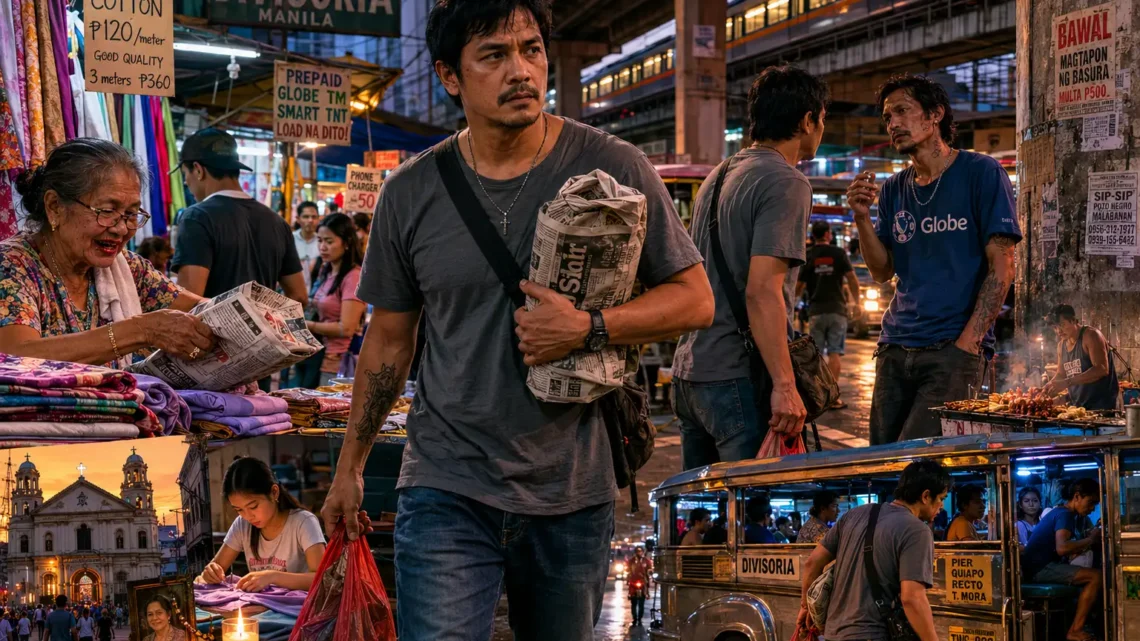
Ex-Convict’s Quiet Choice Under Manila’s LRT Tracks
Six years after prison, Bayani just wants fabric for his niece's debut gown. But an old friend with an old debt has other plans, and beneath the rattle of Manila's elevated trains, one quiet decision will decide who he really is now.
Bayani counted the pesos twice before sliding them across the counter, because in Divisoria, you learned fast that a careless hand made you a target.
The vendor, an old woman with betel-stained teeth, did not look up as she wrapped his three meters of cotton in a newspaper.
Trending Now!!:
Behind him, the market roared: tricycle horns, a vendor hawking pirated phone chargers, the smell of fried isaw curling through the humid air. Six years since he had walked these aisles as a free man.
Six years since Quiapo Church, two blocks from here, had been the last place he prayed before everything went wrong.
He had told his sister, Marites, he was only coming to buy cloth for her daughter’s debut gown. That part was true. The other part, the reason his palms were sweating through his shirt, he had not told anyone.
Renato was supposed to meet him under the LRT tracks at six.



Bayani had done eight years in Bilibid for a robbery that was never supposed to end with a security guard bleeding out on a Makati pavement. Renato had been the one holding the gun.
Renato had also been the one who disappeared the moment the sirens started, leaving Bayani to take the fall alone, the silence costing him the back half of his twenties. They had grown up two doors apart in Tondo, had served as altar boys together at the same parish, and now Renato wanted to talk, after all this time, like the years owed nothing.
Bayani walked north past the Pier, where container ships sat heavy and patient against the gray skyline of Manila Bay. The sun was already dropping fast, the way it did in this city, sudden and orange, no patience for in-between light.
He thought about the parole officer’s warning. Any contact with known associates, and you go back. He thought about Marites, who had sold her sewing machine twice over just to keep a lawyer on his case. He thought about the eleven thousand pesos Renato had mentioned on the phone, money that was supposedly owed to Bayani from a debt nobody else remembered.
Under the tracks, the noise of the trains overhead swallowed every other sound, which was probably why men still chose this place for things they didn’t want heard.
Renato stood there in a faded Globe Telecom shirt, thinner than Bayani remembered, a scar now tracking down his jaw that hadn’t been there before prison took one of them and freedom, apparently, had not been kind to the other.
You came, Renato said, like he hadn’t expected it.
You said you had my money.
Renato’s eyes moved past him, scanning the crowd the way men scan a room when they are not alone in their plans. It’s not far. My cousin’s place, near Balut. Ten minutes.
Bayani felt it then, the old instinct from inside, the one that told him when a cell had gone quiet in a way that meant something. He had survived eight years by trusting that instinct over comfort, over hope, over the desperate hunger to believe someone had finally come to make things right.
Eleven thousand pesos, and you couldn’t bring it here, Bayani said.
It’s not like that.
Then what’s it like?
A jeepney rattled past, headlights cutting gold across Renato’s face, and Bayani saw it clearly now, the flicker of someone calculating, someone deciding how much truth a situation could survive. There’s a guy, Renato said finally. He remembers you from before. He wants to talk business. Real money, Bayani. Not eleven thousand. Eleven hundred thousand, maybe more, just for moving something across the bay.
The train above them screamed past, and in that wall of sound Bayani understood that the meeting had never been about debts at all.
He thought of the gown fabric in his bag, still smelling of the market, meant for a fifteen-year-old girl who called him Tito and didn’t know the word ex-convict yet.
He thought of his mother, two years gone now, who used to light a candle every night he was inside and never once asked him if he’d done it. He thought of the version of himself that might have said yes to this, six years ago, hungry and angry and certain the world owed him violence in return for what it had taken.
I have a debut to get ready for, Bayani said. My niece. She’s turning fifteen next month.
Bayani.
Tell your guy I’m not interested. Tell him the old me died in Bilibid, and the new me has a fitting to get to.
He turned before Renato could answer, walking back toward the lights of Divisoria, the newspaper-wrapped cloth pressed tight against his ribs like something worth more than its weight. Behind him, Renato called his name once, twice, and then the trains swallowed even that.
It was only three blocks later, passing beneath a flickering signage for a load and padala shop, that Bayani allowed himself to exhale, his hands shaking now in a way they hadn’t beneath the tracks.
He had walked toward danger today expecting an old debt, and what he had found instead was an old version of himself, dressed up and waiting, asking quietly if he wanted to come back.
He did not.
By the time he reached the jeepney stop, the city’s evening had turned electric, vendors lighting gas lamps, the scent of grilled corn cutting through diesel fumes, and somewhere behind him, Renato was still standing under the tracks, perhaps already dialling another name from the past, searching for someone who hadn’t yet learned how to say no.
Bayani boarded the jeepney home, the fabric warm against his chest, and for the first time since his release, he did not look back to see who was following.