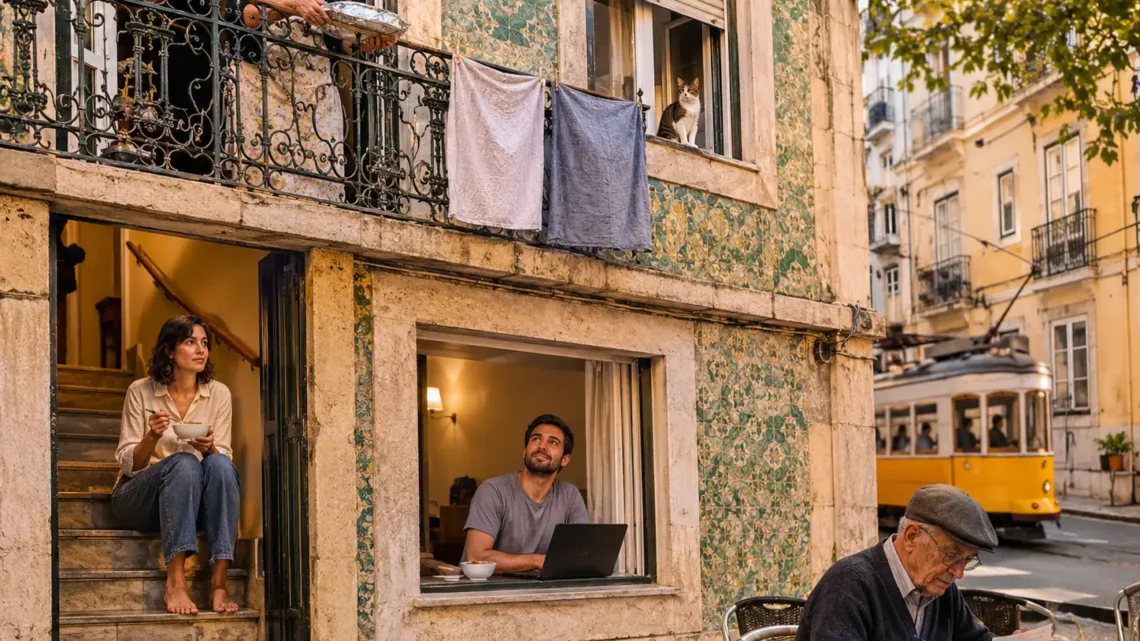
Her Father Caught Us at 11:40 on a Tuesday, and What He Said Next Made Me Hate Myself
The pipe behind my bed knocked twice, and I knew Inês was starting her shower on the floor above while her father sat in the café on Rua Angelina Vidal, doing the crossword with a pen he never let anyone borrow.
I had lived in Arroios, Lisbon, for fourteen months by then. The flat cost me €780 a month, which in this city is almost a joke, and I took it because my customer support salary from a logistics firm in Amsterdam had stopped stretching. My last place ate half of it in rent. This one ate a third, and I felt like I had beaten the cost of living.
Trending Now!!:
Armando Cardoso owned the whole building. He was seventy-one, wore a flat cap indoors, and collected rent in cash on the first of every month, writing receipts in biro on a pad that looked older than me. He lived on the third floor with his wife Fátima.
Their daughter Inês had moved back into her childhood bedroom at thirty-one to save for a deposit of her own.
It started with a dead lightbulb. She came down with a replacement because her father’s knees could no longer manage the ladder, and she stood in my kitchen holding a Philips bulb in one hand and a bag of shopping in the other. She looked at my counter, where a bowl of cereal sat next to a laptop.
You are eating breakfast for dinner, she said.




It is a lifestyle, I said.
She laughed with her head back, properly, and the sound stuck in me the way a bad song does. Nothing happened that night. She changed the bulb, I held the chair, and her hand stayed on my shoulder one second longer than balance required. We both pretended the second had not been counted.
I knew about Rui. Everyone in the building knew about Rui, a physiotherapist from Setúbal with a good jaw and a church group, who came on Sundays and shook Armando’s hand like he was closing a deal.
The wedding was set for June, and the invitations were already at the printer. I knew all of this and still left my door unlocked on a Thursday in October, when it was raining sideways and she knocked with a bowl of arroz doce and no reason.
I would love to say it was passion. It was a Thursday. I was tired, she was tired, and the rain made the whole street sound like it was being erased. Her mouth tasted of cinnamon. She backed me against the fridge, and the magnets slid off one by one onto the tiles while neither of us bothered to catch them.
Afterwards, her coconut shampoo was all over my pillow, and she lay there looking at my ceiling stain like it was a map of somewhere she had never been allowed to go.
This is stupid, she said.
Yes, I said.
She stayed another hour.
We made rules, the way people do when they want to feel in control of something that is already in control of them. The pipe would knock twice when it was safe. Tuesdays and Thursdays only, when Armando was at the café and Fátima was at the market in Alvalade.
Never in her room. Never on the stairs. Never, ever, a message on WhatsApp with her name in it. I saved her as “Dentist” and she saved me as “Plumber,” and this felt very clever for about two months.
I should say what the nights were like, because the story is dishonest without it. She was funny in bed in a way I had not expected, direct and unembarrassed, with a habit of narrating her own opinions into my neck. She told me what she wanted, and she told me when I was being too careful.
Nobody had talked to me like that in years. I had spent a long time inside a headset muting myself for strangers in other time zones, and here was a woman who made me loud.
Two days a week became three. Three became lunch breaks. I would be on a call with my manager Joost in Amsterdam, camera on, nodding at a spreadsheet, and the pipe would knock twice.
I would say my internet was acting up, and I would walk the nine steps to my bedroom door with my pulse in my ears. Joost started asking if I was sleeping properly. I said burnout, which was easier than the truth and half believable.
The mistakes arrived the way they do in real life, small and stupid and in plain sight. She came downstairs four days a week with wet hair, and nobody takes that many showers. The window in my bedroom fogged in the afternoons. She left a hairband on my kitchen chair, a black one, and I put it in the drawer with the takeaway menus like that would make it disappear.
Fátima knew first. I realised later that she must have. In April she started leaving a plate outside my door, covered in foil, usually bacalhau com natas or a thick slice of bolo de arroz, and she never mentioned it. I thought it was kindness. I now think it was the kind of food you give someone you know is about to lose everything.
The Tuesday it ended, I had a call at eleven and nothing to say in it. Inês was in my kitchen with her shoes off, and I had just told her I was thinking of renewing the lease for another year, which was my way of asking whether we were something. She looked at me for a long time and said she did not know. The key turned in the front door.
I had forgotten that a landlord keeps a key to everything. Armando had come to read the gas meter, because the gas company had sent a letter, and he stood in the hallway with his cap on and his reading glasses pushed up on his forehead. He looked at me.
He looked at her shoes by the sofa. Then he looked at the cereal bowl in the sink, as if that were the only thing in the room he could process.
He did not shout. I would have preferred it.
Put your clothes on, he said. Both of you.
He sat at my kitchen table, took the pen out of his shirt pocket, and waited while we dressed in the bedroom without speaking. Inês buttoned her blouse wrong and did not fix it. When we came out he was writing something on the back of the gas letter, slowly, in neat capitals.
Eleven months, he said, not looking up. I am old, not blind. The stairs talk.
Senhor Armando, I said, she came to me first.
It was true. It was also the cheapest thing I have ever said, and I watched it land on him like a coin dropped in a church. Inês made a small sound, almost a laugh, and walked past us both and out of the flat. I heard her climb the stairs, one floor, two floors, three, and a door close.
Armando finally looked at me. He was not angry. He looked like a man doing arithmetic he had already done many times.
You have until the end of the month, he said. I will not charge you the last rent. Do not mistake this for kindness. It is so I do not have to take any more of your money.
He left the key on the table. I stood in my kitchen for a long time with the hairband in my pocket, because I had taken it out of the drawer without noticing.
I am writing this from a rented room in Porto now, €540 a month, with a landlord who is thirty and uses Airbnb language like “guest experience.” Last night my phone lit up with a number I had never saved. It was a message from Inês, sent at 2:14 in the morning.
Rui does not know. Papa will not tell him. Mama says the wedding goes ahead and we never speak of this. Tell me she is wrong.
I have been looking at it since yesterday. I have typed an answer eleven times, one for each month, and deleted every one.
The cheapest rent I ever paid was the most expensive thing I have ever owed.