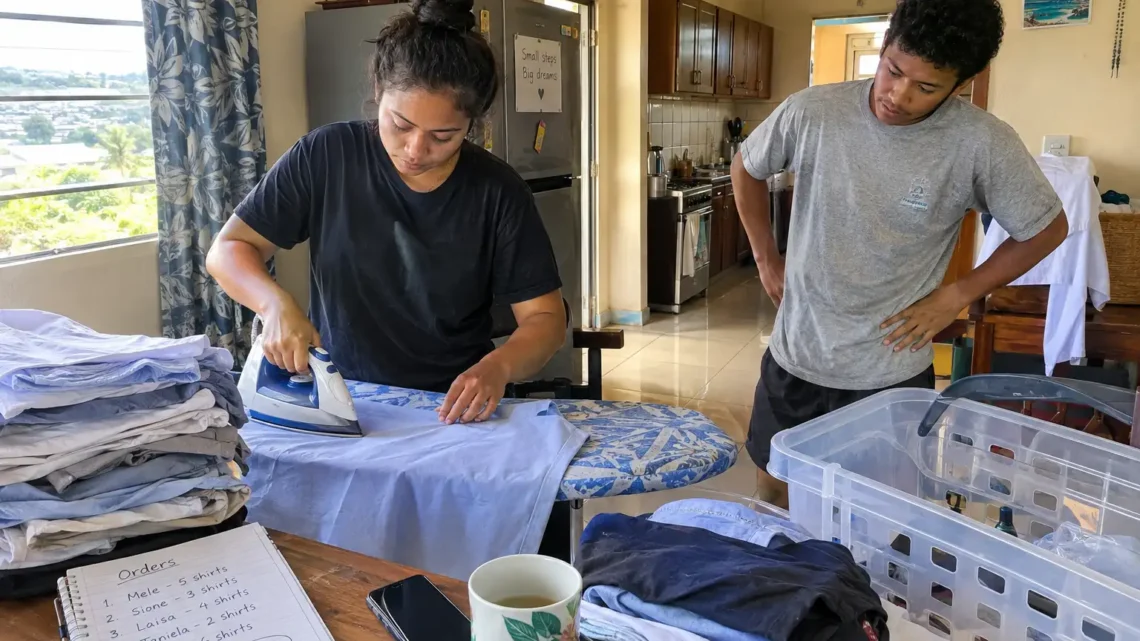
Her Small Side Hustle Was Finally Taking Off, Until Her Friend Did Something She Never Expected
The first shirt caught fire at 7:18 on a Sunday morning, and Litia was standing barefoot in the kitchen when the smoke alarm started screaming.
Turn it off, please!
Trending Now!!:
Her younger brother, Jone, came running from the bedroom with a towel over his head.
What did you do?
Nothing. The shirt did it.
The shirt was not, technically, alive. It was a pale blue office shirt belonging to a customer who had paid Litia FJD 4 to have it washed, dried and ironed before Monday morning.




The iron had left a brown mark near the pocket.
For three seconds, neither of them spoke.
Then Jone looked at the shirt, looked at his sister, and said, You know this is not how people get financial freedom, right?
Litia laughed so hard that she had to sit down.
Three weeks earlier, the whole thing had sounded clever.
She worked five days a week at a small stationery shop near Victoria Parade in Suva. The pay was enough to keep the lights on, buy food, help with the rent and occasionally do something that was not strictly necessary, such as buying an iced coffee after work.
Lately, though, everything seemed to cost a little more.
Rice. Bus fares. Cooking oil. Mobile data. The small things were the worst because they never arrived alone. They came in groups.
One evening, after checking her bank balance at a bus stop on Waimanu Road, Litia opened her notes app and wrote down the numbers.
Rent.
Groceries.
Electricity.
Bus fare.
Phone.
Then she stared at the remaining amount.
It looked embarrassed.
She had been reading personal finance tips online, mostly the kind that told people to stop buying coffee and somehow become rich. Litia had never believed coffee was the reason anyone was broke, but she did understand the larger point.
She needed another source of money.
That was when her aunt mentioned the ironing.
People hate ironing, Auntie Sala told her over the phone. They will pay somebody else to hate it for them.
The idea was almost insulting in its simplicity.
Litia already knew how to iron. Her mother had taught her when she was fourteen. She could make a school uniform look almost new, and she had spent enough years around office clothes to know the difference between a shirt that had been ironed properly and one that had simply been attacked with heat.
She started with twelve shirts.
That was it.
She posted a message in two Suva WhatsApp groups.
Sunday ironing service. Pickup Saturday afternoon, return Sunday evening. FJD 4 per shirt.
Within an hour, five people replied.
By Friday, she had twenty-three shirts.
By Saturday, she had thirty-eight.
By Sunday morning, one of them was smoking.
After the fire alarm incident, Jone helped her move the ironing board away from the curtain.
You need a system, he said.
I have a system.
Your system is putting thirty-eight shirts in one pile and praying.
It worked until now.
Exactly.
She looked at him.
Are you helping or giving a TED Talk?
Helping.
He picked up a shirt.
This one has a name on the collar.
I know.
This one says Mele.
I know.
The burning one says Mele too.
Litia closed her eyes.
That was how she learned her first serious lesson in side hustle income. Customers did not care whether the business was small. They expected their clothes to come back looking like their clothes.
She called Mele.
Hi, it is Litia. I need to tell you something before you come.
There was silence.
Then Mele said, That sounds bad.
It is not terrible.
That sounds worse.
Litia explained about the mark.
Mele sighed.
Can it be fixed?
I think so.
Think?
I can take it to a cleaner tomorrow.
Another silence.
How much?
Nothing. I will pay.
Mele finally said she would come by later.
That afternoon, Litia took the shirt to a dry cleaner near the city centre. The cleaner looked at the brown mark, rubbed the fabric between two fingers and gave her a price that made her stomach drop.
FJD 18.
The shirt had earned her FJD 4.
She paid anyway.
The money came out of the little envelope where she had been keeping her side hustle earnings.
When Mele collected the shirt, she inspected the pocket carefully.
The mark was almost gone.
You paid for this?
Yes.
You did not have to.
I did.
Mele nodded, then handed her FJD 4.
Litia almost refused it.
Instead, she took it.
That evening, she transferred FJD 18 back into her main account and stared at the transaction.
The side hustle had made her poorer.
For the first time, she wondered whether all the online advice about extra income was written by people who had never tried turning an ordinary skill into a business.
Still, the orders kept coming.
By the following week, people were asking for bedsheets.
Then work trousers.
Then school uniforms.
Someone asked whether she could iron curtains.
She said yes before checking whether curtains could even fit through her front door.
They could not.
Her little business started spreading through Suva in the most ordinary way possible. One person told another. Someone posted a photo in a WhatsApp group. A woman from Tamavua dropped off eight shirts. A man who worked near Laucala Bay began leaving his clothes with his neighbour because he was never home when Litia came around.
She bought a second iron.
Then a larger ironing board.
Then plastic garment bags.
She started using a notebook to record names, phone numbers, pieces and payments.
Jone called it her company headquarters.
Please respect the office, he said one evening, pointing at the kitchen table.
The office contained a half-eaten bun, three hangers, a calculator and a packet of instant noodles.
This company is going public, Litia said.
Please wait until the company can afford proper chairs.
For the first time in months, she began to feel less trapped by money.
Not rich.
Not even comfortable.
Just less trapped.
She started reading about budgeting for beginners and made a simple rule. Every payment from the ironing business went into three envelopes.
Supplies.
Savings.
Home.
The savings envelope was the smallest.
She did not care.
At least it existed.
Then came the order that nearly broke everything.
It arrived through Mele.
My cousin has a conference, Mele said over a voice note. She needs forty-two shirts and twenty-six trousers done by Sunday. Can you manage?
Litia listened to the message three times.
Forty-two shirts.
Twenty-six trousers.
It was the biggest order she had ever received.
The payment would be FJD 272.
She calculated the electricity, transport, bags and cleaning costs.
There would still be enough left to matter.
She agreed.
The clothes arrived Saturday afternoon in two enormous bags.
Litia spent six hours working.
By midnight, her shoulders hurt.
At 2:15 in the morning, she was still ironing trousers.
At 4:40, she fell asleep sitting upright on the sofa.
At 6:10, Jone woke her.
You are going to be late.
She jumped up.
The first thing she saw was the pile of finished clothes.
The second thing she saw was rain hammering against the window.
Suva rain could turn a normal day into a logistics problem in minutes.
She needed to get the clothes to the customer across town.
The bus was late.
The first one passed without stopping because it was full.
The second stopped, but there was barely enough room for her and the garment bags.
She squeezed in anyway.
Everyone stared.
A woman holding a shopping bag looked at the shirts.
Wedding?
Conference.
The woman nodded as if conferences were known to require fifty pieces of perfectly ironed clothing.
Halfway there, Litia received a message.
We need to cancel the order.
She read it twice.
Then a voice note arrived.
The conference had been cancelled.
The clothes were no longer needed.
Litia stood inside the crowded bus, holding dozens of freshly ironed clothes while rainwater ran down the windows.
She called Mele.
What happened?
They cancelled this morning.
But I already finished everything.
I know.
I bought the bags.
I know.
I paid for cleaning.
I know.
There was a pause.
Then Mele said something that made Litia stop talking.
She says she cannot pay because she did not use the clothes.
Litia looked out through the wet window.
What does that mean?
I do not know.
The bus moved through the traffic near Suva Market.
For a few seconds, Litia thought about saying nothing. She could keep the clothes. She could refuse to return them until someone paid. She could send the whole story into the WhatsApp groups and let everyone decide who was wrong.
Instead, she said, Tell her I am bringing them back.
Mele asked why.
Litia looked down at the garment bags.
Because they are hers.
She returned the clothes that afternoon.
No payment came.
For two days, Litia barely touched the ironing board.
She was angry with Mele.
She was angry with the customer.
Mostly, she was angry with herself for believing that one large order could change everything.
Then, on Wednesday evening, someone knocked on the door.
It was Mele.
She was holding an envelope.
My cousin paid me this morning.
Litia did not move.
Mele handed her the envelope.
Inside was FJD 272.
Litia counted it twice.
She paid?
Yes.
Why did you tell me she could not pay?
Mele looked uncomfortable.
Because she was angry. I thought you would understand.
Understand what?
Mele looked down.
I wanted to keep some of the money.
That was the part Litia had not expected.
The cancelled order had not been cancelled at all.
The conference had happened.
The clothes had been worn.
The customer had paid.
Mele had simply decided that the easiest person to delay was the woman running a tiny ironing business from her kitchen.
For a moment, Litia wanted to say something cruel.
Instead, she asked, Why?
Mele started crying.
Her electricity bill was overdue.
She had borrowed money from someone else.
She was embarrassed.
None of it made what she had done disappear.
All of it made it harder to hate her.
Litia gave her back FJD 20.
Take this.
Mele shook her head.
No.
Take it.
Why?
Litia shrugged.
Because I know what it feels like to look at a bill and not know which part of your life you are supposed to sacrifice.
Neither woman spoke for a while.
The next morning, Litia changed her business rules.
No large order without a deposit.
No exceptions.
No matter who asked.
She typed the new policy into her phone and sent it to every customer.
Jone read it and nodded.
Look at you.
What?
Businesswoman.
She rolled her eyes.
The truth was less glamorous.
She still ironed shirts on Sundays.
She still counted every dollar.
She still took buses through Suva carrying garment bags while hoping nobody asked whether she was going to a wedding.
The difference was that she no longer believed that making more money was only about working harder.
Sometimes it was about knowing when to ask for payment before doing the work.
Sometimes it was about saying no.
Sometimes it was about keeping a small amount aside, even when the amount felt almost pointless.
Three months later, Litia had enough saved to replace the old iron.
She bought it on a rainy Saturday.
When she brought it home, Jone examined the box.
Does this one catch fire?
Only if you annoy it.
He stepped back.
I respect the new management.
That night, Litia put the old iron in a cupboard.
She did not throw it away.
It had started the whole thing.
On Monday morning, she received another large order.
She looked at the message.
Then at the new iron.
Then at the savings envelope tucked behind the rice container.
She smiled and typed her reply.
The deposit is required before work begins.
This time, she waited for the answer before touching a single shirt.
Sometimes making ends meet starts with learning that your time is worth asking to be paid for.