How I Built a Profitable Online Store From Scratch With No Experience and No Savings
There is a specific kind of silence that falls over a room when you have just spent your last $200 on a laptop you are not sure you know how to use properly.
I know that silence. I lived inside it for about four minutes in the winter of 2013, sitting on the edge of my bed in a studio apartment in Austin, Texas, staring at the loading screen of a second-hand Dell that smelled faintly of someone else’s coffee. Outside, the street was cold and ordinary. Inside, I had just made what felt either like the bravest or the stupidest decision of my life.
Trending Now!!:
I was 26. I had just quit my job at a shipping logistics company after three years of watching my soul slowly dissolve under fluorescent lighting. I had no savings worth mentioning, no business plan worth printing, and no clue, genuinely no clue, how to build an online business from the ground up.
What I did have was stubbornness, a half-remembered YouTube rabbit hole about e-commerce and dropshipping, and a dangerous amount of belief that the internet had made it possible for ordinary people to sell things to strangers across the world and actually build a life from it.
I opened a browser tab. I typed “how to start an online store with no money.”
That search changed everything.



The first thing I built was embarrassing. I spent two weeks assembling a Shopify store that sold phone cases. Not a specific niche of phone cases. Not premium, customized, or even particularly good phone cases. Just phone cases, because a forum post I read said phone accessories were a “proven high-demand product category,” and I believed it the way a child believes a cereal box claims to be part of a balanced breakfast.
I sourced everything through a dropshipping supplier I found on AliExpress. I uploaded blurry product photos. I wrote product descriptions that were essentially translated Chinese manufacturing notes with the word “premium” inserted three times. I named the store something I will not repeat here. I hit publish.
Then I waited.
My friend Marcus, who had been doing freelance web design for years, came over that Saturday. He stood behind me, looked at the screen for a long time, and said, “Bro. Who is this store for?”
I said, “Everyone.”
He picked up his coffee mug, took a slow sip, set it back down, and said, “That’s the problem.”
He was right, of course. Targeting everyone in e-commerce is the same as targeting no one. That is the first real lesson this industry teaches you, and it teaches it the hard way, through silence and zero sales notifications and a marketing budget you burned on Facebook ads that generated exactly three clicks, two of which were probably your own.
By week three, I had made $0. By week five, I had spent $340 total, including the Shopify subscription, the ad spend, and a “complete e-commerce masterclass” I bought at 2 a.m. that turned out to be an hour of a man explaining what a shopping cart was.
I shut the store down.
I almost quit right there. I genuinely did.
But I had coffee with a woman named Diane, a former colleague who had been quietly running a successful online store selling handmade ceramic planters for about two years. She drove a car she owned. She worked from home. She picked her kids up from school at 3 p.m. every day. I had always wondered how, and that afternoon I finally asked.
She leaned across the table and said, “You’re not selling a product, you’re solving a problem for a specific person. Do you know who your person is?”
I said I was trying to reach a broad audience to maximize revenue potential.
She looked at me the way a teacher looks at a student who has memorized the wrong chapter.
“That’s marketing language,” she said. “That’s not a person. Find your person. One person. What do they want? What keeps them up at night? What would make them feel like their life is slightly better? Sell them that.”
I drove home and sat with that for a long time.
The concept she was describing, narrowing to a hyper-specific niche market rather than chasing volume, is the foundational principle that separates online businesses that survive from the ones that burn through their owners’ savings and disappear inside six months. Most people learn it from a blog post. I needed Diane to say it to my face before it landed.
I came back with a different approach.
This time, I spent three weeks doing nothing but product research. I read forums. I joined Facebook groups for hobbies I did not personally have. I used Google Trends, keyword research tools, and competitor analysis obsessively. I was looking for the intersection of three things: a product people actively searched for, low competition in the search results, and a passionate, specific audience willing to spend money.
I found it in an unexpected corner: left-handed artists.
Left-handed people who painted, sketched, and did calligraphy faced a specific, consistent problem: most tools were designed for right-handed users. Smudging. Uncomfortable grip angles. Ink that did not dry fast enough. It was not a glamorous niche. It was not trending on social media. But it was real, it was underserved, and the community was vocal about what they needed.
I built a store called Sinister Studio. (Sinister is the Latin word for “left.” The community loved it immediately.)
I sourced left-handed calligraphy sets, quick-dry inks, smudge guards, and ergonomic pencil grips. I wrote product descriptions that spoke directly to the frustration every left-handed artist had experienced. I started a blog with SEO-optimized content targeting long-tail keywords like “best pens for left-handed artists” and “how to avoid smudging when writing left-handed.” I built an email marketing list from day one, using a free guide as the lead magnet.
I ran one small Instagram ad. Spent $40.
The first sale came in at 11:47 p.m. on a Tuesday. I was already in bed. My phone buzzed. I picked it up, saw the Shopify notification, and sat up so fast I knocked my glass of water off the nightstand.
It was a $23 order for a calligraphy starter kit, shipped to a woman in Portland, Oregon, who I would never meet.
I sat on the edge of my bed, in the dark, holding my phone, and I cried a little. Not dramatically. Just the quiet kind of crying that happens when something you were not sure was possible actually happens.
Over the next eighteen months, Sinister Studio grew faster than I was honestly ready for.
I brought in Carlos, a digital marketing consultant I met through a local business networking event, to help manage the paid advertising side. He restructured my Facebook ad campaigns from broad interest targeting into tight custom audiences built from email lists and lookalike modeling. The cost per acquisition dropped by 38% in the first month.
“You have a good conversion rate,” he told me one afternoon, scrolling through the analytics dashboard. “Your product pages are doing the work. Most stores lose the customer between the ad and the cart. Yours don’t.”
“Why do you think that is?” I asked.
He pointed at the screen. “Because your copy reads like a person who actually uses this stuff. You’re not selling features. You’re selling the feeling of not smudging your page after twenty minutes of careful work.”
That was the insight I carried forward into everything that came after: e-commerce is an emotional transaction first, a financial one second. Customer acquisition is really just the process of finding the people who already feel the problem you are solving, and then proving you understand that feeling before you ask for the credit card number.
I added a subscription box. Then digital products, downloadable practice worksheets and technique guides for beginners, which gave me my first taste of genuine passive income because digital products have no inventory cost, no shipping logistics, and no supplier delays. Selling a $12 downloadable PDF at 3 a.m. while you are asleep is a feeling that never fully loses its magic.
By month twenty-two, the store was clearing $14,000 a month in revenue. I had moved out of the studio apartment. I had a small team of three: Carlos for ads, a customer service specialist named Priya, and a content writer who kept the blog updated with fresh SEO content every week.
I was not yet rich. But I was free.
In year four, I made the classic scaling mistake that has buried dozens of online businesses I have watched up close: I expanded too fast, too wide, without the infrastructure to support it.
I launched three new product lines in the same quarter. I moved into Amazon FBA, listing our top products in their fulfillment network. I hired two more contractors without proper onboarding systems. I started a second store in a completely unrelated niche because someone in an online business forum told me “diversification is the key to long-term revenue.”
By month three of that experiment, I was managing five browser tabs, two Shopify dashboards, an Amazon Seller Central account that stressed me out every morning, and a team that was confused about priorities because I was confused about priorities.
Priya knocked on my office door one Thursday morning. She stood in the doorway and said, “I need to tell you something and I need you to actually hear it.”
I looked up.
“The customer response time has slipped to 48 hours. Returns are up 22%. Three of our top reviewers left one-star reviews this week because orders were late. We are losing the thing that made people love us.”
I stared at her.
“You built this on being a store that actually cared,” she said. “Right now we don’t look like we care.”
That was the most important meeting I had that year, and it happened standing in a doorway.
I shut down the second store. I pulled back from Amazon temporarily to rebuild the fulfillment process. I focused everything back on Sinister Studio, on the community, on the customer experience, on the email marketing sequences that had originally built the loyal base we had.
It cost me nearly $30,000 in lost revenue and botched inventory to learn a lesson that I could summarize in one sentence: protect what works before you build what is next.
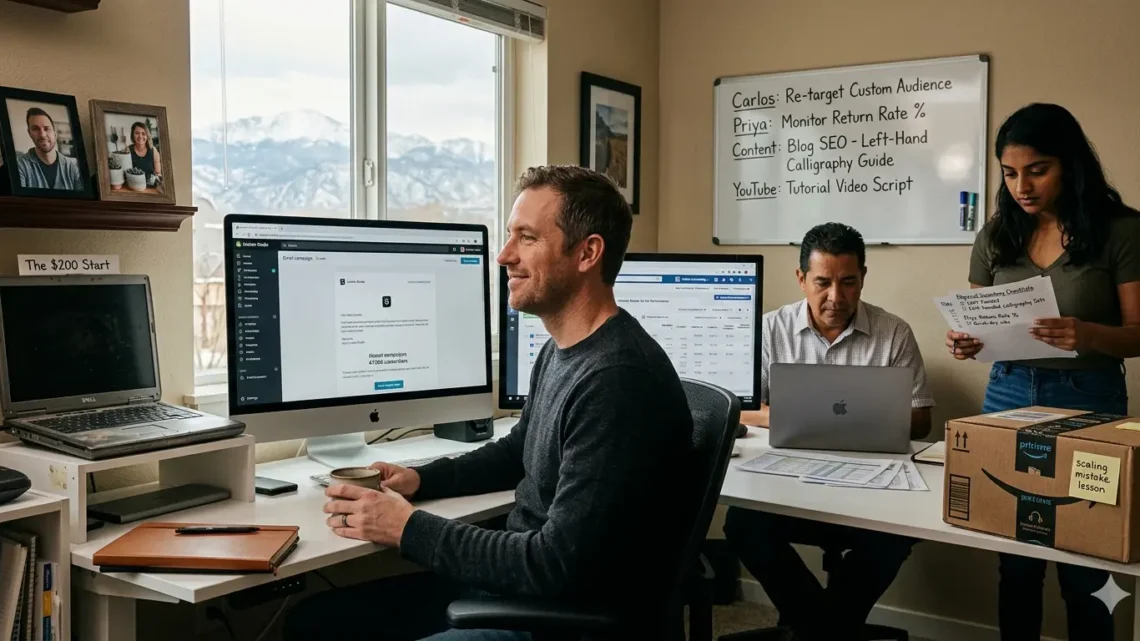
I am writing this from a home office in Denver, Colorado, with a cup of coffee that is already going cold because I keep forgetting it is there. Outside the window, the mountains are doing what mountains do, which is standing there looking completely unbothered by everything.
Sinister Studio is ten years old. It generates consistent revenue across multiple channels: the flagship Shopify store, a curated Amazon presence we rebuilt properly, a digital products library, a YouTube channel with tutorial content that doubles as brand authority, and an email list of 47,000 subscribers that remains the single most valuable asset the business owns, more valuable than any social media following, any ad account, any product line.
I have made every mistake this industry has to offer. I have burned ad spend on audiences that never existed. I have chosen suppliers who ghosted entire shipments. I have watched conversion rates fall off a cliff during algorithm changes I had no control over. I have hired wrong, priced wrong, launched wrong.
And I have learned, slowly, that building an online business is not really about finding the perfect product or cracking the perfect digital marketing strategy. It is about the willingness to stay in the room after the bad months, to ask better questions, to listen to the Dianes and the Priyas when they tell you something important, to understand that e-commerce is not a shortcut to wealth but a genuine craft that rewards patience and specificity and care.
The laptop I started with cost $200 and smelled like somebody else’s coffee.
I still have it on a shelf in the corner of this office.
I never throw it away. Some days when I am in the middle of a hard decision, I look at it, and I remember the silence that fell over that room when I first turned it on, not knowing anything, not having anything, just the strange, stubborn belief that the internet was big enough for me too.
It was.