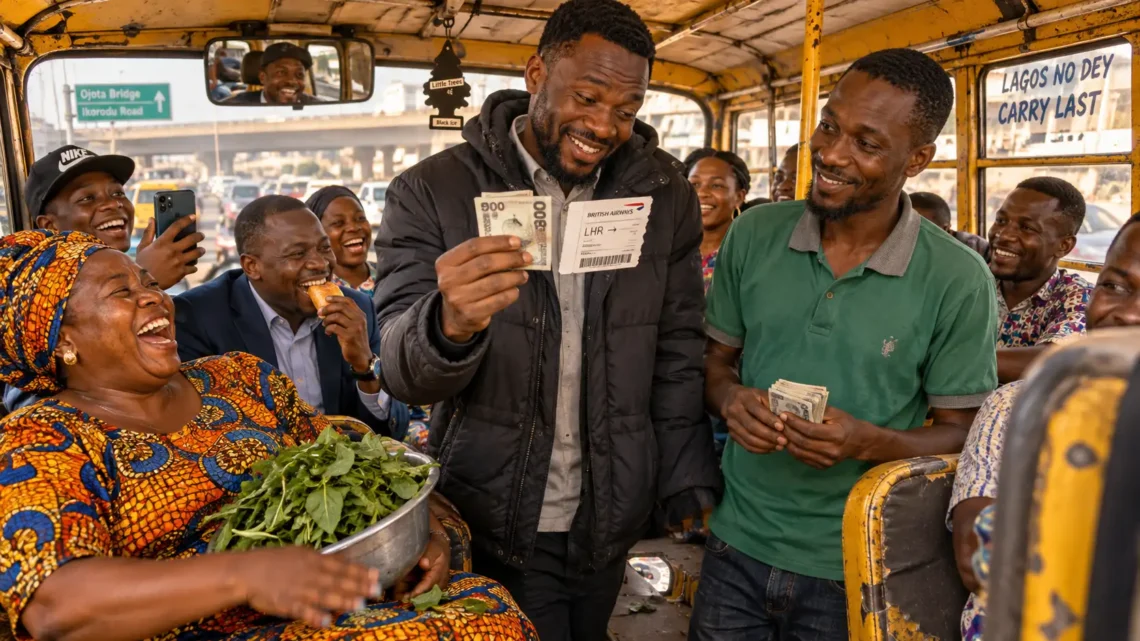
How I Came Back From Manchester Thinking I Knew Lagos
The man had my four hundred naira and I was going to get it back if it took the whole length of Ikorodu Road.
I stood up in a moving danfo in Lagos, one hand on the rusty roof bar, the other holding my phone in front of his face like a lawyer presenting evidence.
Trending Now!!:
Outside, the evening was doing its usual thing. Horns, hawkers, a boy running beside the bus with a tray of Gala on his head.
Everybody should hear this, I said. This man collected one thousand naira from me at Yaba and gave me nothing. Nothing.
The conductor looked at me the way you look at a goat that has walked into your kitchen. His name was Segun, though I did not know it yet. He wore a green polo shirt gone grey at the collar, and a roll of notes sat folded between his fingers like a hand of cards.
I had been back in Lagos for eleven days. Six years in Manchester, a master’s degree, a job in logistics, and a cost of living that finally wore me down. Rent was eating my salary and my salary was eating my peace, so I came home with two suitcases, a winter jacket I had no business wearing, and a lot of opinions.



My cousin Chuka had warned me at the airport. Don’t come and do Manchester in Lagos, he said. This city will humble you before the week ends. I told him I was born in Surulere and knew every road by heart.
The roads had moved on without me. That evening a Bolt from Yaba to Ojota quoted me N9,500 because rain was threatening somewhere in the sky. I stood at Tejuosho doing the maths, decided I was a man of the people, and climbed into a danfo with a yellow body, a black stripe, and a hole in the floor where I could watch the road go by.
The fare was N600. I gave Segun a N1,000 note and he said, Change small, oga, I go bring. Then the bus lurched, everyone leaned left together, and I opened a voice note to my girlfriend Adaeze in Enugu to complain about the traffic.
Somewhere around Fadeyi he pressed something into my palm. I did not look. I was mid-sentence. Babe, the problem with this city is that nobody respects time, I was saying, and I pushed whatever it was into the inside pocket of the jacket and kept talking.
Twenty-five minutes later, crawling toward Ojota, I remembered I was owed money.
Bring my four hundred naira, I said.
I gave you, oga, Segun said. At Fadeyi.
You did not.
Check your pocket.
I will not be searched on a public bus, I said, which is a sentence nobody in the history of danfo had ever said out loud.
Then I stood up, and the real mistake began.
There were fourteen people on that bus and every one of them found an opinion at the same moment. A man in a navy suit, chewing a sausage roll, said conductors all have PhDs in short-changing. A schoolboy in a Nike cap started filming me while I filmed Segun. A woman with a basin of ugu leaves on her lap hissed through her teeth and said nothing yet, which was worse.
In Manchester, a bus driver gives you a receipt, I announced.
Then go and enter Manchester bus, the woman said.
The whole bus laughed. Even the driver laughed, and he had not looked back once since Jibowu. My ears went hot, which is the moment a sensible man sits down. I stayed standing, because being wrong in public is a hole and I decided to dig it deeper.
I told Segun I would post him on X. I told him I had followers. I had 214, and eleven of them were my own old school friends.
Oga, post me, Segun said, tired. Make I stand for the picture?
The suit man snorted. The woman with the ugu leaves, whose name I would learn was Mama Tunde, leaned forward on her seat like someone waiting for the second half of a football match.
Then Segun did something that has followed me home every night since. He pulled out a second roll from his back pocket, peeled off two N200 notes, and held them out to me. Take am, he said. Make we finish this thing. I get more passengers to drop.
My hand went out. I still cannot explain this part to Adaeze. My hand actually went out to collect money from a man who had done nothing wrong, and for one full second I felt like I had won.
Mama Tunde hit my wrist with a bunch of ugu leaves. Young man, don’t touch that money, she said. Check your pocket!
Madam, I am not going to…
Check am!
So I put my hand inside my jacket to prove there was nothing there. I pulled it out slowly, like a magician who has forgotten the trick. Two soft N200 notes, folded in half, and the stub of an old Heathrow boarding pass I had kept as a souvenir.
Nobody said a word for about three seconds. It was the longest silence I have ever heard in a danfo.
Then the schoolboy screamed, Manchester don collect! and the bus exploded. The suit man choked on his sausage roll. The driver braked on the Ojota bridge because he was laughing too hard to steer. Mama Tunde slapped her own thigh so hard that ugu leaves jumped out of the basin.
I was about to check it, I said. This made it worse.
Somebody started a chant. Man-ches-ter! Man-ches-ter! The schoolboy was still filming, and I knew exactly where this clip was going to end up. I laughed too, because the alternative was dying. I laughed until my eyes watered and the whole bus laughed with me.
Only Segun did not laugh.
He took his two notes back, folded them into the roll, and said, No wahala, oga. I wanted him to shout. I wanted him to say something I could argue with. His calm was heavier than any insult.
I pulled N2,000 from my wallet and said sorry three times. He pushed my hand away, gently, like a man closing a door on a sleeping child. Oga, keep am, he said. Four hundred naira is not the problem.
Then what is? I asked.
He looked at the floor, at the hole where the road ran underneath us. The owner takes eighteen thousand every day before I touch one naira, he said. Last month, one passenger said I short-changed him. Nobody checked any pocket. The owner took five thousand from my own money. This week alone, you are the third person to call me thief.
The laughter went out of the bus like air out of a tyre. The suit man stopped chewing. The schoolboy lowered his phone.
Abeg, one thing, Segun said. The video you were recording. Delete am. My mother is in Ibadan. She thinks I work in a bank in Lagos. Her pastor’s niece is on WhatsApp.
Mama Tunde turned her face to the window and wiped her eye with the back of her wrist. Nobody on that bus looked at anybody.
I deleted the video while he watched. I showed him the gallery, then the Recently Deleted folder, like a man proving he had nothing to hide. This time I did check my pockets properly. Segun nodded once and said, Thank you, oga, and I wanted the Ojota bridge to open and take me.
Then my phone buzzed in my hand.
Seven minutes before the pocket, before the ugu leaves, before any of it, I had sent the clip to a group called Lagos Gist and Gbedu. Four hundred and twelve members. I had typed the caption with so much confidence: “Conductor wey wan chop my N400, I no gree.”
The little ticks beside it were blue. A hundred and eighty people had watched it. Under it, in a column I could not stop reading, were laughing faces, a fire emoji, and a stranger asking, Who is this conductor? Somebody go find am, make e trend. My cousin Chuka had already put it on his Instagram story with three crying faces.
I looked up. Segun was reading my screen upside down, the way people in Lagos learn to read everything. He said nothing.
My thumb hovered over the words Delete for everyone. The bus had stopped at Ojota and nobody had stood up to get down.
Being wrong costs nothing until somebody else has to pay for it.