How I Learned My Husband’s Affair Through a Diesel Smell
I married Tunde on a Saturday in July, the kind of Lagos rain that comes sideways and ruins every aso-ebi in sight.
I buried what was left of that marriage exactly three years later in our compound in Magodo, standing over a dead Mikano generator with a wrench in my hand and nothing left to say to him.
Trending Now!!:
It started, like most disasters in this city, with NEPA. Or Eko Disco, if you want to be correct about it, because by then they had changed the name and changed nothing else about the actual electricity.
We had moved into the Magodo Phase 2 house in our first year of marriage, proud of ourselves, two young professionals with a generator big enough to run the AC, the fridge, and Tunde‘s precious gym equipment all at once.
He called it Big Joe. I thought that was a stupid name for a generator. He thought I had no soul.
You don’t understand what this generator means to me, he said one evening, polishing the thing like it was a Bentley, Big Joe has never failed me. Not once.



It’s diesel and metal, Tunde, I said. It doesn’t love you back.
He laughed that laugh, the one that used to make me forgive him for everything, and for a while, that was enough.
We were that couple. The one other couples on Lambo Street, Magodo, pointed to and said see how fine, see how rich, see how they manage power better than anybody.
Our compound was the one with light at 1am when the whole street was in darkness, because Big Joe never slept.
Then came the woman from Lekki.
Her name doesn’t matter, not in this story, because she’s not really the point. Tunde is the point. Tunde, who started taking calls in the generator house, the small concrete shed behind the kitchen, where the noise of Big Joe was loud enough to swallow any conversation.
I noticed it the way wives notice things, slowly, then all at once. He started servicing that generator like it was his second job. Sundays, instead of church, he was in that shed with his phone wedged between his ear and shoulder, oil on his hands, voice low under the engine’s roar.
I confronted him on a Tuesday, the worst day to confront anybody about anything, because Tuesday has no momentum, no Friday relief waiting at the end of it.
Who is she, I asked him, standing in the doorway of the generator house while Big Joe rattled between us like a third party in the argument.
There’s nobody, Bisi, he said, not even bothering to turn off the generator, which told me everything. Why are you doing this.
Because you smell like Chanel and you don’t wear Chanel, I said. And you’ve spent more nights in this shed than in our bed this month.
He didn’t deny it properly.
Men in Lagos have perfected a particular kind of non-denial, the kind where they look offended instead of guilty, where they make your accusation the crime instead of their affair.
You’re always suspecting me of something, he said, like I had insulted his ancestors. Big Joe kept running through the whole thing, indifferent, diesel-fed, loyal only to fuel.
The marriage didn’t end that day. It ended in installments, the way most Lagos marriages do, not with one dramatic door-slam but with a thousand small withdrawals. He stopped coming home before midnight.
I stopped asking where. My mother, ever practical, told me on the phone, Bisi, a man who is faithful to his generator before his wife has already shown you his real address. I laughed so hard I cried, and then I just cried.
The thing about Magodo, about Lagos generally, is that everybody knows your business before you’ve finished living it. By the time Tunde moved his things out in March, three of my neighbors had already told me, gently, over the fence, that they’d seen a Lekki number plate parked outside our gate on nights I thought he was at his mother’s in Ogudu.
The compound that used to have light at 1am when the street was dark now had light at 1am for one person only, me, sitting alone in a three bedroom flat too big for my new silence, listening to Big Joe hum outside like nothing had happened, like its job was simply to keep running regardless of who was left in the house.
I kept the generator. That part surprises people when I tell this story. My friend Funke asked me, why would you keep a man’s generator, sell it, get a smaller one, start fresh. But it wasn’t his anymore in my head.
Somewhere in those three years, through every blackout, every NEPA disappointment, every night I sat outside the shed waiting for him to finish a call he claimed was “work,” Big Joe had become mine too.
I had learned to start it myself, to check its oil, to know the particular cough it made before it needed servicing. The generator didn’t cheat on me. The generator showed up every single time the city failed me, which, this being Lagos, was often.
The day the divorce papers were finalized, I went out to the shed, started Big Joe just to hear something familiar, and sat on the concrete step in the diesel smell and the noise, and I let myself cry properly for the first time in months. Not for Tunde.
For the version of myself who had believed a generator’s loyalty could be mistaken for a man’s.
It died on me eight months later, ironically, on the one night I had a man over for the first time since the divorce, a quiet, unremarkable accountant named Chidi who didn’t own a Bentley or a nickname for his generator or, as far as I could tell, any secrets at all.
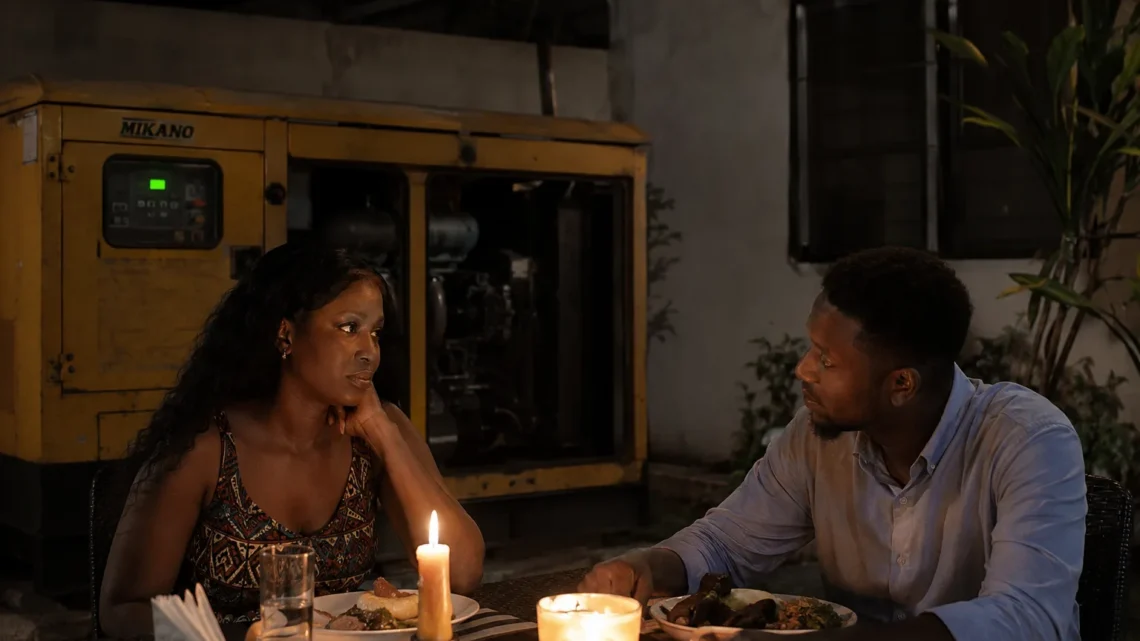
Big Joe sputtered, coughed, and went silent in the middle of dinner, plunging the whole house into the kind of total Lagos darkness that makes you laugh because what else can you do.
Should I look at it, Chidi asked, already standing, already rolling up his sleeves without being asked twice.
No, I said, surprising myself, let it rest. It’s done enough for one lifetime.
We ate the rest of dinner by candlelight, and outside, for once, the silence where Big Joe used to roar felt less like loss and more like peace, the kind that doesn’t need diesel to keep it running.