I Bet My Rent Money on Bitcoin in 2013; Here’s What Happened Next
The first time I heard the word “blockchain,” I was sitting in a damp basement apartment in Austin, Texas, eating cold ramen noodles out of a styrofoam cup and pretending I had a plan.
It was 2013. I was 26 years old, $34,000 in student loan debt, and I had just been laid off from a junior developer job at a company that made software for parking lots.
Trending Now!!:
Not exactly the glamorous tech career I had imagined when I was staring at my computer science degree on the wall of that tiny apartment, wondering what I was supposed to do next.
The radiator in the corner made a sound like an old man coughing every twenty minutes. I had counted.
Marcus, my college roommate and the only person I knew who wore a tie on Zoom calls before Zoom calls were even a thing, sent me a link at 11:47 on a Tuesday night. The message just said: “Read this. Seriously.”
It was the original Bitcoin whitepaper by Satoshi Nakamoto.



I opened it. I closed it. I opened it again.
I read it three times before sunrise.
By morning, I did not fully understand peer-to-peer electronic cash systems or cryptographic hash functions or distributed ledger technology. But I understood the feeling behind it. Someone, somewhere, was furious at banks.
Someone was tired of middlemen taking cuts, of transaction fees eating into wire transfers, of financial institutions deciding whose money moved and whose did not. That anger, I recognized immediately. I had felt it every time I watched a $35 overdraft fee drain my checking account like a slow leak in a tire.
I called Marcus.
“Walk me through this,” I said. “What actually is Bitcoin?”
He took a breath. I could hear him push back from his desk. “Okay. Forget everything you know about money for a second. Imagine a spreadsheet. But instead of living on one computer, it lives on ten thousand computers simultaneously. Every transaction ever made is recorded on it. No one owns it. No government can delete it. No bank can freeze it. That’s the blockchain.”
“And Bitcoin just… runs on top of that?”
“Bitcoin IS that, basically. It’s the first application. The currency that proved the concept works.”
I stared at my empty ramen cup. “How much does one Bitcoin cost right now?”
He paused. “About a hundred and twenty dollars.”
I had exactly $400 in my bank account, set aside for January rent. I told myself I would not touch it. I told myself that very clearly, out loud, to the coughing radiator.
I bought three Bitcoin by the end of the week.
What nobody tells you about early cryptocurrency investing is how lonely it is. There was no mainstream conversation about digital assets in 2013. No crypto Twitter.
No Reddit threads with thousands of upvotes breaking down DeFi protocols. No YouTube influencers explaining Ethereum smart contracts over lo-fi beats. There was just a small, strange, passionate community of people who believed they had stumbled onto something that would rewrite the global financial system.
My coworkers at my next job, a mid-level development gig at a logistics company, thought I had joined a cult.
“You bought what?” my manager Derek asked during lunch one afternoon, looking at me like I had told him I’d invested in magic beans.
“Bitcoin,” I said. “It’s a decentralized digital currency built on cryptographic proof.”
He stared at his sandwich. “So it’s not real money.”
“All money is just an agreement,” I said. I had rehearsed that line.
Derek went back to his sandwich. That was the end of the conversation.
But I kept reading. I kept learning. I started understanding things like cryptocurrency wallets, private keys, public keys, blockchain consensus mechanisms, and the difference between proof-of-work and proof-of-stake.
I spent weekends diving into forums, following developers who were building on early versions of what would become the Ethereum network. When Vitalik Buterin published the Ethereum whitepaper in late 2013, I read it the same way I had read Nakamoto’s, except this time I understood more of it, and what I understood made the hairs on my arms stand up.
Smart contracts. Self-executing code living on a blockchain. Programs that run without any human intermediary, that cannot be censored or shut down, that automatically enforce the terms of any agreement the moment conditions are met.
I thought: this is not just money. This is infrastructure.
By 2017, my original $360 investment had become something I was afraid to look at directly, the way you avoid staring at the sun. Bitcoin had climbed past $10,000. I had added to my holdings slowly over the years, picking up fractions of coins during the quiet periods, the long flat stretches when the price barely moved and the mainstream world had forgotten Bitcoin existed again.
I also held Ethereum. I had gotten in at under $10.
I was not rich yet. But I could see it from where I was standing.
And that is exactly when I made my worst mistake.
Sofia, a woman I had been dating for about four months, had a brother named Ethan who described himself as a “blockchain entrepreneur.” Ethan wore slim-cut blazers and spoke in complete paragraphs. He had strong opinions about everything and the handshake of a man who had read a book about handshakes.
“You need to hear about this project,” he told me over dinner one evening, sliding a glossy one-page summary across the table like a poker card. “It’s called VaultCoin. New altcoin, limited initial offering. The team is brilliant. The whitepaper is solid. It’s going to do what Bitcoin couldn’t.”
I looked at the paper. It had a logo that looked like a futuristic padlock and a roadmap that promised a “fully decentralized financial ecosystem” by Q3 of the following year.
Every part of me that had spent four years learning about blockchain technology was sending quiet alarm signals. No named development team. Vague tokenomics. A roadmap with no technical specifics. The whitepaper, when I finally read it, was twelve pages of marketing language dressed up in jargon.
But Ethan was persuasive. And Sofia was watching me with a look that said she trusted her brother completely.
I moved a significant portion of my portfolio into VaultCoin.
You already know how this ends.
VaultCoin collapsed six weeks later. The developers vanished. The project’s social media accounts went silent overnight. The website, which had been slick and professional, redirected to a blank page. It was a rug pull, clean and surgical, and I had walked into it with my eyes open and let sentiment override everything I knew.
I sat in my apartment, which was significantly nicer than the Austin basement but suddenly felt just as small, and I looked at the number on my screen for a long time.
I had not lost everything. But I had lost enough that “everything” felt accurate in an emotional sense.
I called Marcus.
“Tell me I’m an idiot,” I said.
He was quiet for a moment. “You know what you did wrong.”
“Yes.”
“Then you don’t need me to say it.”
“I kind of do, Marcus.”
“You let someone else’s conviction replace your own research. In crypto, that’s the one thing you can’t afford to do. Due diligence isn’t optional. It’s survival.”
I wrote that down. I still have it on a Post-it note stuck to the edge of my monitor.
I did not sell what remained. That decision, made mostly out of stubbornness and partly out of genuine belief, turned out to be the most important financial decision of my life.
I went back to learning. I went deeper. I started studying decentralized finance, what people were beginning to call DeFi: lending protocols, liquidity pools, yield farming, staking mechanisms.
I started following the rise of NFTs, not as digital art collectibles but as proof-of-ownership infrastructure with applications in gaming, real estate, and intellectual property. I watched Layer 2 scaling solutions begin to address the congestion problems that had long plagued the Ethereum network.
The technology was maturing. The ecosystem was expanding in ways that even the most optimistic early adopters had not fully predicted.
And the price of Bitcoin and Ethereum, after a long and painful bear market that tested every conviction I had, started climbing again.
Then it climbed some more.
By 2021, I was sitting in a completely different apartment, in a completely different city, with a completely different relationship to the word “wealthy.”
I had paid off my student loans. I had a modest investment portfolio in traditional assets alongside my crypto holdings, because ten years of hard lessons had taught me that diversification is not a buzzword, it is a survival strategy. I was consulting for blockchain startups, helping them think through tokenomics and smart contract architecture and crypto security practices.
I was doing work I genuinely loved, for the first time in my life.
Last spring, I ran into Derek, my old manager from the logistics company, at a conference in Denver. He recognized me first.
“You’re the Bitcoin guy,” he said, extending a hand.
“I prefer ‘blockchain professional,’” I said, smiling, “but yes.”
He laughed, a little uncomfortably. “I should have listened to you back then.”
I shook my head. “I lost a huge chunk of what I had made on a scam coin in 2017. You probably would have done the same thing I did.”
He looked surprised. “Really?”
“Crypto doesn’t care how smart you are,” I told him. “It only cares how disciplined you are. Those are very different things.”
He nodded slowly, with the look of a man recalculating something privately.
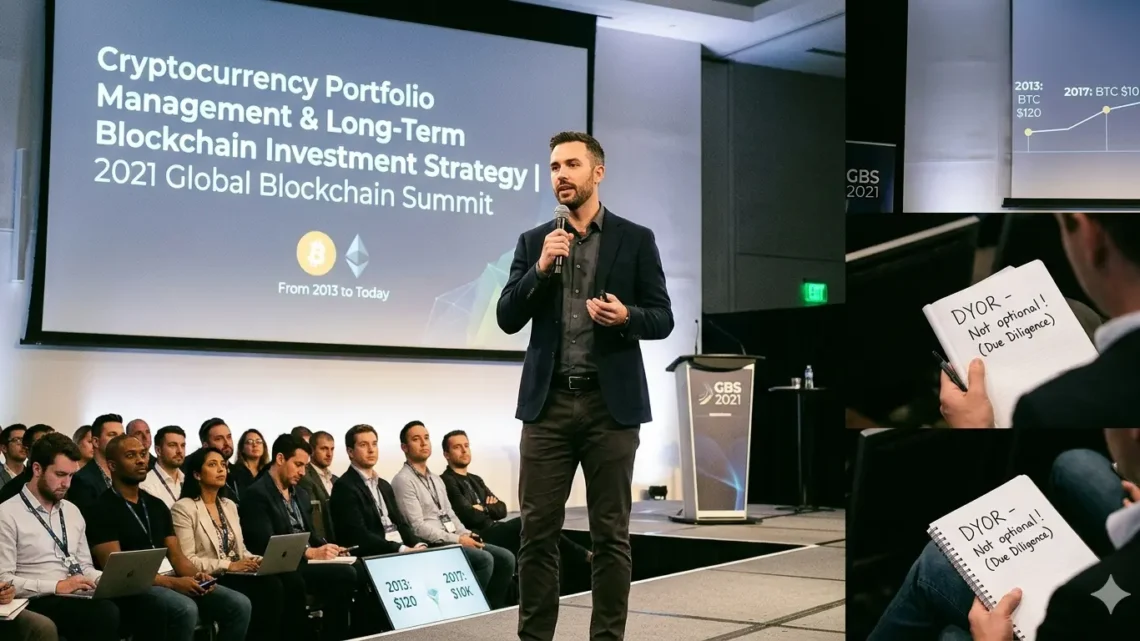
We shook hands again, and I walked toward the conference hall where I was scheduled to speak on cryptocurrency portfolio management and long-term blockchain investment strategy. Three hundred seats. Every one of them is filled.
I thought about that basement apartment in Austin. The coughing radiator. The cold ramen. The $400 I was not supposed to touch.
I thought about Satoshi Nakamoto, whoever they really are, sitting somewhere in the world, having set off a chain reaction that restructured my entire life without ever knowing my name.
And I thought about the one thing I wish someone had told me on day one, the thing I now say at the start of every talk I give:
“Blockchain technology is the most transformative financial innovation of our generation. But it will humble you before it rewards you. Come in with your eyes open. Stay longer than feels comfortable. Never invest more than you can afford to lose. And never, ever let someone else’s excitement replace your own research.”
The applause started before I even finished the sentence.
Some lessons, it turns out, make very good endings.