I Lived at Number 16, So Why Did the Government Keep Sending Letters to Number 18?
The letter from city hall said I had seven days to prove that I lived in my own home, which would have been easier if the address on the letter had actually existed.
I read it twice at the kitchen table in Brussels, Belgium, while my coffee went cold beside my phone.
Trending Now!!:
The letter had my name, my national identification number, my apartment number, and a warning in bold type that failure to respond could lead to an administrative fine.
The problem was the address.
Rue des Mimosas 18 did not exist.
My apartment was on Rue des Mimosas 16.




I checked the envelope again. Same thing.
Maybe they moved your house while you were sleeping, my sister Nadia said in a voice note.
I laughed, then stopped laughing when I realized she might have a point.
I had lived in the same apartment for six years. I knew the cracked blue tile outside the entrance, the bakery downstairs that started smelling like butter before seven every morning, the old man on the third floor who watered plants from a plastic bottle, and the exact spot near the corner where the pavement always collected rain.
I knew my address.
City hall apparently had other ideas.
The next morning, I took the letter to the municipal office.
The waiting room was already full. People sat on plastic chairs holding folders, envelopes, passports, birth certificates and the particular expression of people who had been told to bring one document but had discovered they needed twelve.
A screen above the reception desk displayed numbers.
My number was 147.
The screen showed 119.
I sat down.
A woman beside me was holding a baby and a folder so thick it looked like she was preparing for court.
First time? she asked.
Unfortunately.
She nodded with the quiet understanding of someone who had already suffered here.
When my number finally appeared, I walked to Desk 8.
The clerk was a young man named Thomas. He looked at my letter, typed something, frowned, typed again, then looked at me.
You are registered at Rue des Mimosas 16.
Yes.
This letter says 18.
Yes.
He looked at the screen again.
Do you live at 18?
No.
Then why did you come here?
I stared at him.
Because you sent me a letter telling me to prove that I live at 18.
Thomas blinked.
Right.
He turned his monitor slightly away from me.
That was when I knew the afternoon was going to be long.
After several minutes, he explained that the municipality had recently updated part of its address database. Some properties had been renumbered or reassigned during an administrative review.
I asked whether my apartment had been renumbered.
He checked.
No.
I asked whether there was a Rue des Mimosas 18.
He checked again.
No.
I asked what I was supposed to prove.
He smiled in the careful way people smile when the answer is not their fault.
That is what we are trying to find out.
I left with a new form.
The form asked me to confirm my current address.
I wrote Rue des Mimosas 16.
Underneath it, there was a box asking whether I had ever lived at Rue des Mimosas 18.
I checked no.
The next box asked for the date I moved away from Rue des Mimosas 18.
I left it blank.
The form would not submit without a date.
I went back to Desk 8.
Thomas looked at the screen.
Put the date you moved.
I never lived there.
Then put the date you stopped living there.
I never started living there.
He rubbed his forehead.
Okay. Do not put anything.
The form will not let me continue.
He looked at me.
I looked at him.
Neither of us spoke for a few seconds.
Then he quietly slid the form toward himself and wrote something in a box I had not noticed.
Try again.
It worked.
I walked home feeling strangely victorious.
For the first time in my life, I had defeated a government form.
I should have known better.
Three days later, another letter arrived.
This one said my previous response had been received.
It also said my proof of residence was incomplete.
They wanted a utility bill showing Rue des Mimosas 18.
I stood in my hallway holding the letter while my neighbor Sophie came upstairs carrying groceries.
You look like somebody just died, she said.
My address did.
She put down her shopping bag.
I showed her the letter.
She read it slowly.
Then she started laughing.
Not politely.
She had to lean against the wall.
I am sorry, she said between laughs. It is not funny.
It is becoming funny.
No, it is definitely funny.
That evening, I sent a photo of the letter to our building group chat.
Within five minutes, seven people had replied.
Sophie said the same thing had happened to her mother.
Marc from the second floor said his parking permit now listed a building number that did not exist.
Someone from the top floor said their electricity company had suddenly changed their address too.
Then Sophie wrote:
Wait. Maybe the whole street is wrong.
That was when the group chat exploded.
People began checking their documents.
One resident discovered that their bank still had the correct address.
Another had an incorrect address on an insurance policy.
A third had received a government envelope addressed to a property two doors away.
Someone sent a screenshot of an online map.
Someone else sent a photo of the street sign.
Then Marc wrote the sentence that changed everything.
Does anyone know why the city is asking about number 18?
Nobody did.
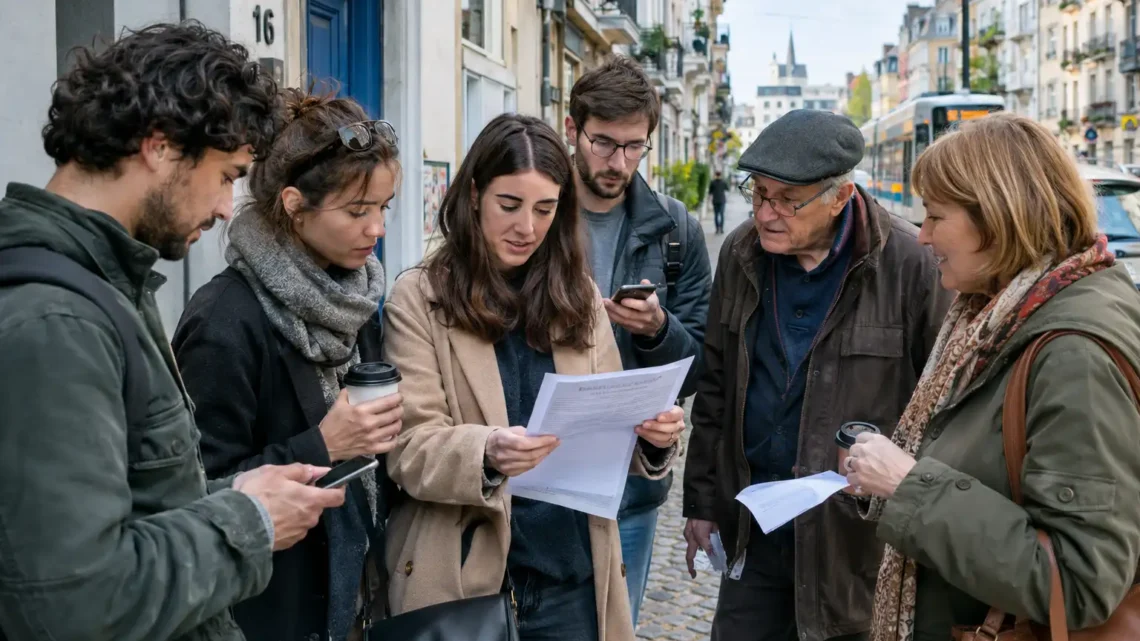
The following Saturday, a small group of us met outside the building.
There were six of us.
Nobody had planned a protest. We were just confused adults standing on a pavement in Brussels, comparing official letters like children comparing strange drawings.
Sophie had brought coffee.
Marc had printed screenshots.
I had the original letter.
An elderly resident named Henri arrived last. He had lived on the street for more than thirty years and knew everybody’s building history better than the municipality seemed to.
He listened quietly.
Then he said something none of us had considered.
Number 18 used to exist.
Everyone looked at him.
He pointed down the road.
Before the renovation.
He explained that decades earlier, a narrow building had stood between two properties. It had been demolished before most of us moved into the area. The empty space later became part of another property.
Nobody had thought about it because the old number had disappeared from everyday life.
Apparently, it had not disappeared from every database.
That afternoon, we found an old photograph online.
There it was.
Rue des Mimosas 18.
A tiny building squeezed between two larger ones.
The photograph showed a green door, two windows and a flower box.
The building was gone.
The address was not.
The following Monday, I returned to city hall.
This time, Thomas recognized me.
He looked tired.
Rue des Mimosas 18, he said.
The famous nonexistent house.
He smiled.
We found it.
You found a building that no longer exists?
We found the record.
He explained that an old property record had been linked incorrectly to a newer administrative database. During an update, the system had treated the old address as an active residential address.
That explained the letters.
It did not explain why I had received one.
Thomas looked embarrassed.
The system selected several residents for verification because the records overlapped.
So I was selected because my apartment is next to a house that disappeared before I lived here?
He paused.
Basically.
I laughed.
He laughed too.
Then he became serious.
You should keep all these letters.
Why?
Because the system may generate another one before the correction is complete.
I stared at him.
How many more?
He shrugged.
I do not know.
That answer followed me home.
For the next two weeks, I checked the mailbox with the suspicion usually reserved for bad news.
Nothing came.
Then one Thursday evening, another envelope arrived.
Rue des Mimosas 18.
This time it was not from the municipality.
It was from a delivery company.
Someone had apparently ordered a package using the nonexistent address.
The recipient’s name was not mine.
I called the number on the label.
A man answered.
I explained that the address did not exist anymore.
There was a long silence.
Then he said:
That is strange. I have lived there since March.
I looked at Sophie, who was standing in my doorway.
Where?
The man gave the address again.
Rue des Mimosas 18.
I told him there was no 18.
He laughed nervously.
I am looking at the building right now.
I stepped outside.
The street was quiet.
Cars passed.
A tram rattled somewhere beyond the next intersection.
The bakery downstairs was closing for the evening.
There was still no building between number 16 and number 20.
I asked the man to send me a photo.
A few seconds later, my phone buzzed.
The photograph showed a completely different street.
Same number.
Different city.
Different country.
The delivery company had matched the address incorrectly.
I sat on the stairs and laughed until Sophie asked what was wrong.
I showed her the picture.
She stared at it.
Then she said something that made me stop laughing.
At least that house exists.
A month later, the municipality finally corrected my record.
The letter arrived with an apology and a reference number.
I framed the letter.
Not because it was important.
Because after weeks of trying to prove that I lived somewhere I had lived for six years, it felt ridiculous enough to deserve a place on the wall.
Sometimes Nadia still sends me voice notes about it.
How is life at number 18?
I always answer the same way.
Quiet. The neighbors are imaginary.
The strange thing is that I still pass that empty space every day, and for a second I sometimes expect to see the old green door from the photograph.
It is not there.
Only the pavement remains, holding the outline of a place that vanished years ago but somehow managed to survive in the paperwork.
I used to think an address was simply where you lived, until a computer told me that sometimes a place can disappear without ever leaving the records behind.