I Read My Insurance Policy Out Loud and It Changed Everything
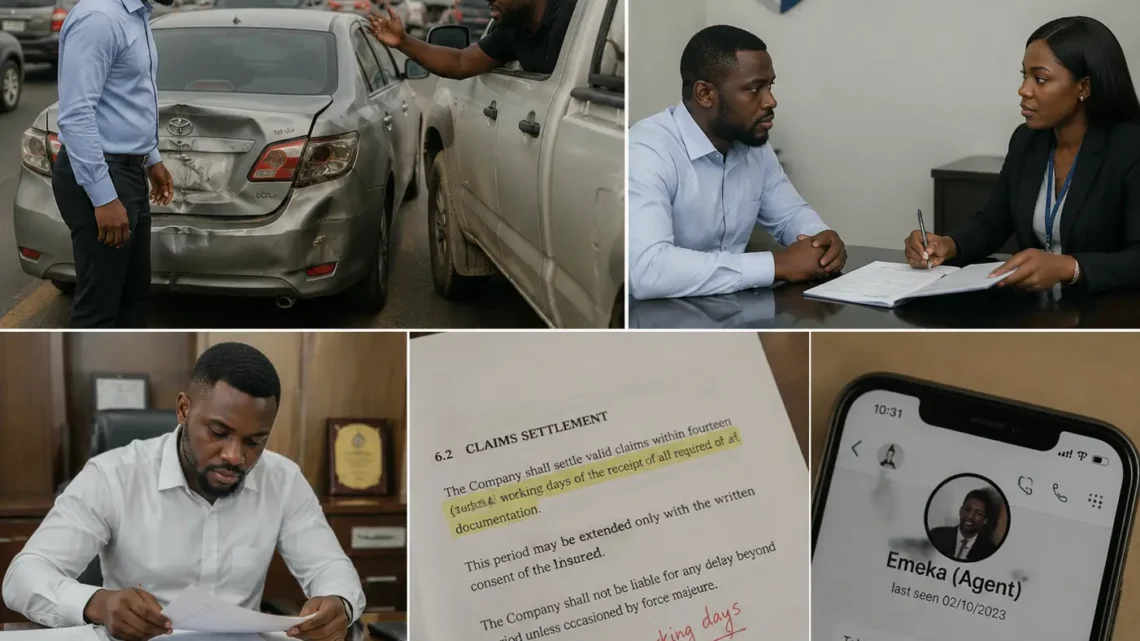
I was standing on the Third Mainland Bridge with smoke curling out of my bonnet and an okonko trailer driver leaning out of his window, shouting that I should have just stayed for una house instead of driving a car I couldn’t afford to fix.
That was the beginning of the worst two months of my adult life, and it started, of all places, with a rear-end collision I didn’t even cause.
Trending Now!!:
My name is Tobi, and I had comprehensive insurance. I want that on record, because for six weeks a company called Trustshield Assurance made me feel like a criminal for saying those words out loud.
It happened on a Wednesday evening in September, the kind of Lagos evening where the traffic from Oworonshoki to Adeniji stretches so long you start recognizing the same hawkers three times because you haven’t moved.
A Hilux truck behind me misjudged the gap, and my Toyota Corolla absorbed the hit like it had been waiting for it all its life. Boot crushed. Exhaust dragging on the tarmac like a wounded dog.
The truck driver, a heavyset man named Musa, got out, looked at the damage, looked at me, and said, without an ounce of shame, my brother, abeg call your insurance, I don’t have time for this one today. Then he drove off before I could even take a full photo of his plate number.



I remember standing there in the exhaust fumes and horns, laughing, actually laughing, because what else do you do. I called my agent, a smooth talking young man named Emeka who had sold me the comprehensive plan eight months earlier with a PowerPoint presentation and a promise that Trustshield settles claims within “14 working days, guaranteed.”
He picked up on the second ring, all warmth. Ah Tobi my guy, no wahala, just bring the car in for assessment and we go sort you out.
Fourteen working days came and went. Then twenty one. Then I started keeping a physical notebook, because every time I called, a different voice on the customer care line asked me to resend the documents I had already sent three times through three different channels.
I emailed the police report, the assessor’s report, my vehicle particulars, my policy documents, my international passport for some reason nobody could explain, and a signed letter confirming I was, in fact, the owner of the car that had been hit.
By week five, I was taking buses to Yaba for work meetings because my car sat in a mechanic’s yard off Herbert Macaulay Way, cannibalized for parts by nothing but dust and time.
I started calling Trustshield’s head office directly instead of going through Emeka, who had stopped answering his phone entirely, his WhatsApp last seen frozen at a date in early October like a monument to his own disappearance.
That was when I met Adaeze.
Adaeze worked in what Trustshield grandly called their Claims Resolution Unit, though from the noise behind her on the phone, I suspected it was one open-plan office with three desk fans fighting each other. She had the patient, slightly exhausted voice of someone who had said the words your claim is under review more times than she could count in a single lifetime.
On my ninth call to her extension, something in me shifted from polite to forensic. I’m not asking you what the process is again, I told her, my voice flat and calm in a way that surprised even me. I’m asking you to open my policy document, page four, clause 6.2, and read it to me.
There was a pause. Then some shuffling of paper. Sir, she said carefully, that clause says claims should be settled within 14 working days of complete documentation.
Good, I said. Now tell me the date my documentation was marked complete on your system.
Another pause, longer this time. The kind of pause that tells you someone on the other end has just realized the person they’re speaking to isn’t going to be shaken off with a soft voice and a vague promise.
That afternoon, I did something I probably should have done in week one. I went to the Trustshield head office in Victoria Island in person, printed copy of my policy in hand, every relevant clause highlighted in yellow like I was back in university preparing for an exam I refused to fail.
I sat in that reception for four hours. I watched agents walk past me twice, avoiding eye contact the way Lagosians avoid eye contact with beggars at Falomo roundabout.
On my third hour, I asked the security guard, very politely, whether the Consumer Protection Council or NAICOM office was walking distance from where we were sitting, loud enough for the reception desk to hear.
Within twenty minutes, a man in a navy suit who introduced himself as Mr. Bassey, Head of Claims, personally invited me into his office. You have to understand, he said, settling into his chair with the practiced calm of a man who had disarmed many angry customers before me, these things take time, documentation issues, backlogs.
I placed my folder on his desk and opened it to a page where I had circled, in red, the specific line that promised settlement within fourteen working days, no exceptions listed, no fine print about backlogs. I read policy documents for a living, I told him, which was not entirely true, but the confidence with which I said it must have counted for something. I’m not disputing your process. I’m asking you to honor the contract I signed and paid for.
Mr. Bassey looked at the folder for a long moment. Then he picked up his phone, and in a voice completely different from the one he’d used with me, said, get me Adaeze’s supervisor on the line, now.
My payout came through eleven days later. Not the full replacement value I deserved, insurance companies in Lagos rarely give you that without a lawyer and several more months of your life, but enough to fix the car and put something aside. Adaeze called me personally to confirm the transfer, and there was something almost like relief in her voice, like she too had been trapped in the same machine that had been chewing on me for six weeks.
I still have that yellow highlighted policy document. It sits in a drawer in my new car, the one I eventually bought after selling the Corolla for parts because some wounds, even fixed ones, you don’t want to keep driving around in.
Every time a friend tells me they’re about to sign an insurance policy without reading the fine print, I pull that folder out and tell them the story of the Hilux, the trailer driver’s insult, and the five weeks Emeka’s WhatsApp stayed frozen on “last seen.”
In Lagos, nobody hands you what you’re owed. You read the fine print, you circle it in red, and then you make them look you in the eye while they explain why they haven’t paid you yet.