Lisbon Tile Restorer Faces Vision Loss, Finds a Successor
The crack in the azulejo ran like a vein through the blue glaze, and Esperança Brites could not see where it ended.
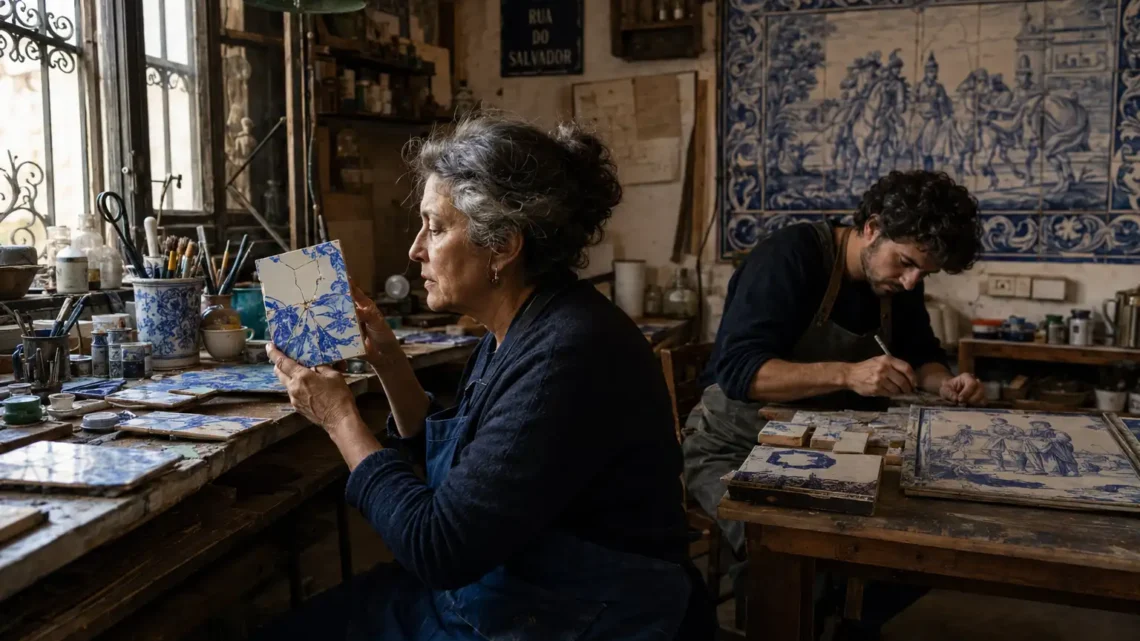
She held the tile six inches from her face, tilting it toward the window where the morning light fell across her workbench in Rua do Salvador.
Trending Now!!:
Somewhere past the crack, the pattern should resolve into the wing of a swallow, one of forty identical swallows that had decorated the facade of a townhouse near the Sé Cathedral since 1907.
She had restored eleven of them already. This one would not cooperate. The edges blurred into each other like wet ink.
Are you going to mix the grout or just stare at it, said Téo Marchetti, not looking up from his own station, where he was scraping decades of soot from a panel of hunting scenes.
I am thinking, Esperança said.




You have been thinking for twenty minutes.
It is a complicated tile.
It was not a complicated tile. She had matched harder patterns blind, or near enough, back when her eyes still did what she told them.
Now the ophthalmologist in Restelo had a name for what was happening to her, something with the word macular in it, and a timeline that involved phrases like progressive and no current intervention.
She had not told Téo. She had not told the client. She had told no one except, in a moment of weakness eight months ago, her sister in Porto, who had cried on the phone for so long that Esperança regretted calling at all.
She set the tile down and pressed two fingers against her eyelids until she saw red static.
Esperança. Téo’s voice had changed register, gone careful. Are you alright?
I am sixty next year. I am allowed to be tired.
You said fifty-nine in March.
Then I am allowed to be tired and confused about my own age.
He laughed, but she heard him set down his scraper, heard the small creak of his stool as he turned to look at her properly.
Téo had apprenticed with her for three years now, ever since he’d shown up at her door with a portfolio of student work and an unbearable amount of confidence for someone who had never repaired a real azulejo in his life. She had almost turned him away.
The workshop barely supported one salary, let alone two, and the commissions for hand-restored tilework had been shrinking for a decade as developers gutted old buildings and replaced facades with reproductions stamped out by machine in Aveiro. But something in the kid’s hands, the way he held a brush like he was already apologizing to it, had made her say yes.
Now he was twenty-six, and good. Genuinely good. Good enough that the thought sitting underneath her ribs for the last eight months had started to feel less like fear and more like arithmetic.
The Sé panel is due in eleven days, he said. Whoever you’re thinking about isn’t going to fix itself by staring.
Make the coffee, she said. I will look again when the light is better.
The light was never better. That was the part she could not explain to him, not yet. The light in the workshop was the same, it had always been, golden and slanted, falling through the wrought-iron window grates the way it had fallen for the eleven years she’d had this space.
It was her that had changed. The world had not dimmed. A door inside her had simply started closing, slowly, the way doors close in old houses when the foundation settles, and there was nothing in any of it to repair.
She went home at six to her apartment above a tasca in Alfama, climbing the impossible stairs that the tourists photographed and the locals cursed, and she sat at her kitchen table with a glass of vinho verde and the case file the ophthalmologist had given her, which she had read so many times the corners had gone soft.
Her phone buzzed. A text from her sister, Mafalda: Did you tell the boy yet?
No, she typed back.
Espe. He deserves to know before it’s too late to plan anything.
There is nothing to plan. I am not dying. I am going blind in one specific way that mostly affects fine detail at close range, which, yes, happens to be my entire profession, but it is hardly a tragedy on the scale you are imagining.
That is exactly a tragedy on the scale I am imagining.
Esperança put the phone face down on the table and looked, instead, at the wall across from her, where a single azulejo panel hung in a frame, the only piece of her own work she had ever kept for herself.
It showed a fisherman hauling a net, the blues gone soft and chalky with age even though she had restored those particular blues herself, twenty years ago, before she understood what she would eventually lose.
She had learned the craft from a man named Senhor Albano, who had learned it from his mother, who had learned it from a workshop in Coimbra that no longer existed.
Each of them had handed the whole of it forward, the chemistry of the glazes, the angle of the brush, the specific stubbornness required to spend four hours matching a blue that would only be seen by pigeons and the occasional curious tourist.
If she stopped now, quietly, without telling anyone why, the line simply ended. Téo would inherit her tools and her client list and none of the conversations that mattered, the ones about failure, about the tiles that could not be saved, about when to walk away from a piece and when to keep fighting it.
She finished the wine and did not finish the case file.
Three days later, Téo found her in the back room past closing, sitting in the dark with the lights off, holding a magnifying lamp she had not turned on.
Esperança.
I am resting my eyes.
With the lamp.
The lamp is decorative, she said, which made no sense, and they both knew it.
He pulled a stool over and sat across from her, close enough that she could see the shape of him even in the dim light, the soft halo where the streetlamp outside caught his hair through the window.
He did not say anything for a long moment. Then: I looked at the Sé panel today. The swallow. I think I see where the original pattern goes.
Show me.
I will, tomorrow, in the light. But Esperança, I need to ask you something and I need you to actually answer it. He paused. Are you sick?
The question hung there longer than she wanted it to.
Define sick, she said finally.
That is not an answer.
No, she agreed. It is not.
She turned the lamp on then, not because she needed it, but because she could not say what she was about to say in the dark, to a half-shape of a person, the way her sister had said hard things to her over the phone for years.
She wanted to see his face when she told him, even if his face was already going soft at the edges the way everything was going soft at the edges now, blurring into something kinder than it might otherwise be.
I am losing my sight, she said. Not all at once. Not completely, maybe not ever completely, the doctor is not certain. But the close work, the detail work, the part of this job that is actually the job. That is going. It has been going for almost a year.
Téo did not say anything for a long time. When he finally spoke, his voice had none of the performance in it that she sometimes heard when he was trying to sound more confident than he was.
Why didn’t you tell me?
Because the moment I told you, I would have to admit it was true.
It’s true whether you tell me or not.
Yes, she said. That is the part I have been avoiding.
He looked down at his hands, the same hands she had watched grow steady and sure over three years, and when he looked back up there was something in his expression that she had not expected. Not pity. Something closer to anger.
You let me think I was still learning from you, he said. Every correction you’ve made on my work for the last eight months, the way you’d point at something and say try again, was that you actually seeing the mistake? Or was it you guessing?
The question landed harder than she expected. She had not thought of it that way, had told herself the corrections still came from forty years of trained instinct, that her hands and her memory of glaze chemistry would compensate for whatever her eyes were failing to provide.
But sitting there under the honest, unkind light of the lamp, she understood that Téo had touched the actual wound underneath the larger one.
Some of both, she admitted. I do not know the ratio anymore. That frightens me more than the diagnosis does.
They worked the Sé panel together over the following week, and for the first time in three years, Esperança let him lead. She sat beside him at the bench, narrating what she remembered of the glaze formulas, the cobalt ratios that gave Lisbon’s blues their particular cold brightness, while his hands did the parts hers could no longer trust. It should have felt like surrender.
Instead, it felt, strangely, like the actual practice of the craft, the part Senhor Albano had tried to teach her decades ago and that she had only half-understood until now: that the knowledge was never really in her hands at all. It had only ever been passing through them.
On the final afternoon, with the swallow’s wing restored and the panel drying in afternoon light, Téo held the tile up the way she had held it weeks earlier, turning it toward the window.
It’s good, he said. Better than good.
You did it.
We did it.
She looked at him, at the soft blur of his face that her eyes gave her now, and found she did not need the sharp version to know exactly what he looked like. She had spent three years memorizing it without realizing that was what she was doing.
Téo, she said. I want to talk to you about the workshop. About what happens to it.
You’re not retiring.
I am not deciding anything today. But I want you to know I am thinking about it honestly now, instead of hiding from it in the dark with a lamp I don’t turn on.
He smiled, and even through the blur she could see it reach his eyes.
Good, he said. Because I already told the client we’d take the chapel commission in Mafra. The one with the eighteenth-century tilework. I told them you’d want to see it before agreeing.
You told them that.
I told them you’d want to see it through someone else’s hands, if that’s what it takes. I didn’t say it like that. But that’s what I meant.
Esperança laughed, the first real laugh she had let herself have in months, and reached out to take the swallow tile from him, turning it not toward the window this time but simply holding it, weightless and whole, between them both.