My 8-Year-Old Daughter Got on the Wrong London Train; Then a Stranger Found Her
The last thing I saw before the train disappeared was my eight-year-old daughter crying through the glass.
She was standing inside a London Underground carriage, both fists pressed against the window, while I ran beside the moving train on the platform. I could see her face. She could see mine. Neither of us could do anything.
Trending Now!!:
It had happened in less than ten seconds.
More than 20 years later, I can still see the face of the man who helped her. I never learned his name.
It was the end of a school trip to London, and I was responsible for a group of middle-school students. My daughter, Chambers, had come along with me. We had been moving around the city all day, doing the ordinary things tourists do when everyone is tired but nobody wants the day to end.
By late afternoon, we were on a crowded Underground platform. It was around 5 p.m., the kind of time when London seems to fill with people all at once. Office workers were heading home. Students were coming back from school. Tourists were trying to work out which train they needed while pretending they knew exactly where they were going.




I was holding Chambers by the hand.
Then I turned away for a moment to count my students.
That was all it took.
Chambers let go of my hand and stepped onto the train.
I did not even understand what had happened at first. The doors began to close. I reached for her, but the gap was already disappearing.
Then the train started moving.
I ran alongside it.
I remember shouting her name, although I do not remember exactly what I said. I remember seeing her through the window. Her face had changed completely. She was no longer the confident eight-year-old who had been travelling around London with a group of students. She was a frightened little girl who suddenly could not find her mother.
I ran until the train was too fast.
Then it was gone.
For a few seconds, I stood on the platform as if my body had forgotten what to do next.
The students were behind me. Someone was saying something. People were walking around us. The station was still operating as if nothing unusual had happened.
That part is difficult to explain.
When something terrible happens to you in a public place, you expect the whole world to stop.
It does not.
The trains keep arriving.
People keep checking their phones.
Someone complains about being late.
Someone else eats a sandwich.
The announcements continue.
I was standing there trying to work out how I was going to find my daughter.
Then one of my students came running toward me.
She was breathless.
She’s back.
I turned around.
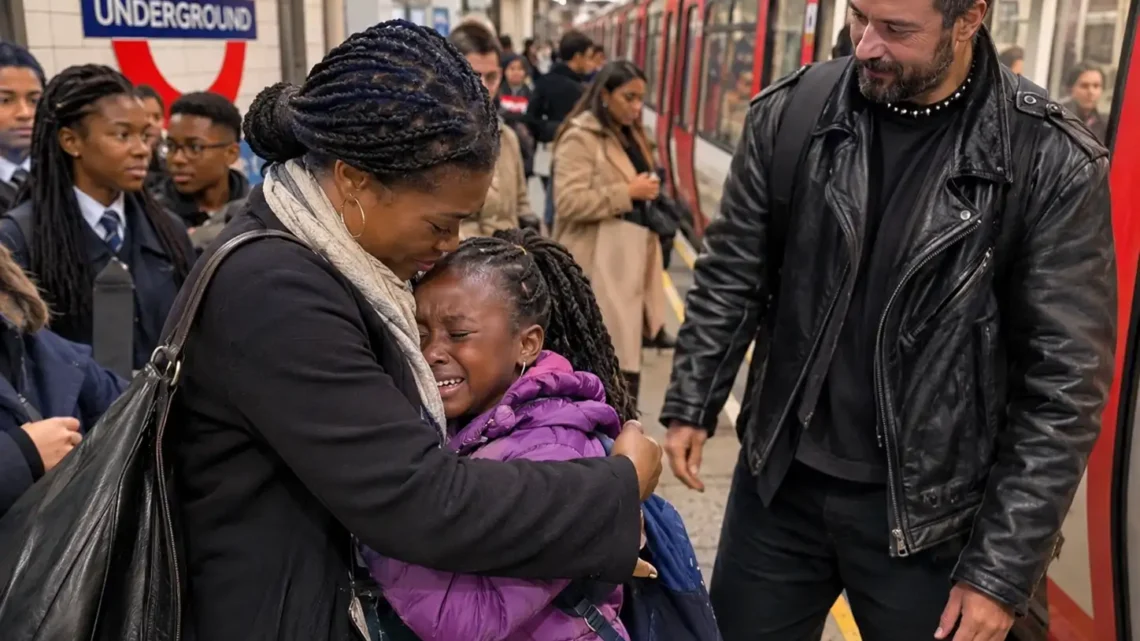
And there was Chambers.
She was crying.
I grabbed her and held her so tightly that for a moment neither of us could speak.
Then I looked around for the person who had brought her back.
That was when I saw him.
He was dressed almost entirely in black. He had a leather jacket and a spiked dog collar around his neck. He looked, at least to me in that moment, exactly like the sort of person I would normally have told my daughter to stay away from.
Yet he was the person who had stayed with her.
After the train left the platform, he had noticed the frightened child inside. He got her off at the next stop and brought her back to us.
He did not know her.
He did not know me.
He had no reason to get involved.
He simply saw a child who was alone and decided that somebody needed to help her.
I remember looking at him and feeling something inside me shift.
Before that day, I had carried around all sorts of assumptions about people.
I thought I was open-minded. Most people probably think they are.
Then a man who looked frightening to me became the person I trusted most in the world for about five minutes.
I wanted to thank him.
I opened my mouth, but I was crying too hard.
When I looked up again, he was gone.
There was no dramatic goodbye. No exchange of phone numbers. No photograph. No promise that we would stay in touch.
He simply disappeared into the crowd.
That was the part that stayed with me.
For weeks afterward, I would suddenly start crying when I thought about what could have happened.
I would be washing dishes and remember the train.
I would be driving and remember Chambers’s face behind the glass.
I would see a child holding a parent’s hand in a supermarket and feel that strange tightening in my chest.
The mind has a cruel habit of showing you the version of an event that did not happen.
I knew my daughter was safe.
I knew she was back with me.
Still, I could not stop thinking about the few seconds when I did not know where she was.
Eventually, life returned to normal.
School started again.
There were lunches to pack and clothes to wash. There were permission slips and homework and all the other small things that make up family life.
London became another memory.
The Underground became just another transport system.
Yet whenever I thought about that afternoon, I thought about the man in the black leather jacket.
I wondered who he was.
I wondered where he lived.
I wondered whether he ever thought about the little girl he helped.
Perhaps he forgot about her almost immediately.
Maybe he went home that evening and told his wife or girlfriend that he had been delayed because he had helped a lost child.
Maybe he never mentioned it at all.
For Chambers, though, he became part of a story she would carry for the rest of her life.
She grew up.
She became an adult.
The little girl on the train became someone who could travel through cities on her own, make decisions for herself and understand how quickly an ordinary moment can change.
I changed too.
I became more careful, obviously.
I also became more suspicious of my own first impressions.
That may be the part of the story that matters most to me now.
The man I initially found intimidating was the person who showed my daughter kindness when she needed it.
He did not look like the kind of person I expected to rescue a frightened child.
That was my mistake.
Years later, I still think about how easily we decide who is safe and who is dangerous. We do it with clothes, faces, accents, hairstyles, age and a hundred other things that tell us almost nothing about what someone will do when another human being needs help.
That afternoon in London, I lost sight of my daughter for a few minutes.
I also lost something else.
I lost the comfortable belief that appearances tell us much about people.
I wish I knew the man’s name.
I wish I could find him and tell him what those few minutes meant to me.
I wish he knew that the little girl he helped was not forgotten.
Maybe he would be surprised to learn that a small decision he made on an ordinary afternoon stayed with a mother for decades.
There was no camera waiting for him.
No award.
No newspaper article.
No one standing nearby to announce that he had done something important.
He simply saw a child who needed help.
And he helped her.