The Croissant Accident That Turned a Tiny Paris Bakery Into an Internet Sensation
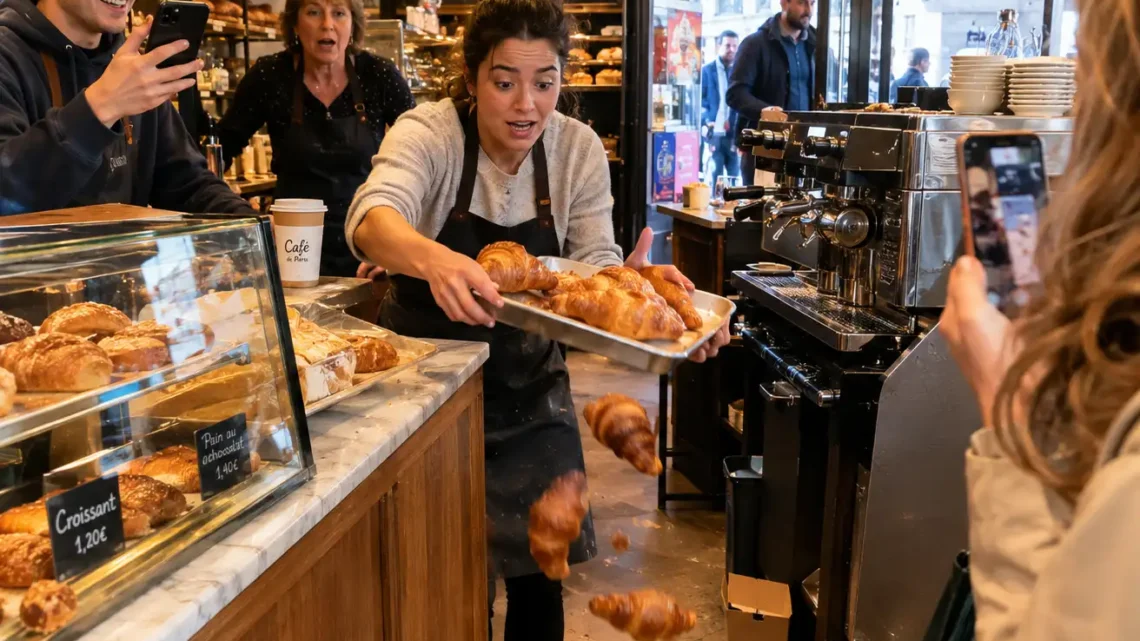
Please move, please move, please move, Nadia whispered as she tried to stop a tray of croissants from sliding off the counter.
One croissant landed on the floor.
Trending Now!!:
Another hit the wall.
The third somehow bounced into a cardboard box meant for takeaway coffee cups.
Nadia stared at the mess for two seconds before saying, I am not posting this.
Her coworker Julien was already holding up his phone.




Too late.
This was Paris in September, and the city had been getting ready for an unusually busy few weeks. The upcoming visit of Pope Leo XIV was bringing huge crowds, with events planned around Notre-Dame, Place de la Concorde and other parts of the city. Restaurants, hotels, transport workers and small shops were already talking about how crowded things might become.
Nobody at the little bakery near Rue de Rivoli expected their own tiny piece of the chaos to become part of it.
The bakery belonged to Claire, a 58-year-old woman who had been running it for almost seventeen years. She had three rules for the staff.
Arrive on time.
Do not burn the butter.
Never, under any circumstances, leave the till open.
The fourth rule had appeared recently.
No filming customers.
That rule existed because of Julien.
Julien was twenty-six, permanently attached to his phone and capable of turning almost anything into a video. A pigeon fighting a sandwich bag could become content. A tourist trying to pronounce a French street name could become content. Once, he filmed himself attempting to carry six coffee cups across the shop at once and dropped five.
Claire made him clean the floor while the video collected 400,000 views.
At least you are famous, Nadia had told him.
Famous and unemployed if she sees me filming again, he had replied.
That morning, Nadia had arrived before seven. She was twenty-nine and had been working at the bakery for nine months. She liked the job because it was close to her apartment and because, unlike some places she had worked before, nobody shouted when the morning rush became difficult.
Usually.
That morning was different.
The first busloads of tourists had already started moving through central Paris. People were dragging suitcases over the pavement. Police barriers had appeared in some areas. Delivery drivers were complaining about road closures. Every few minutes, someone walked into the bakery asking the same question.
Is Notre-Dame this way?
Nadia would point.
Keep going, then turn left.
Five minutes later, another person would ask.
Then another.
By eight thirty, Claire had stopped answering and simply pointed toward the door.
The bakery itself was barely big enough for twenty people.
It had six small tables, a glass display full of pastries and a coffee machine that made a strange clicking sound whenever it got too busy. The smell inside was always the same, butter, coffee, warm bread and whatever perfume had followed the last customer through the door.
That morning, the smell was mixed with panic.
A hotel across the street had sent in a large breakfast order. Someone had accidentally entered the wrong number of croissants into the system. Instead of 80, the bakery was suddenly preparing 180.
Claire discovered the mistake at 8:42.
Who ordered one hundred and eighty?
Nobody answered.
Julien slowly raised his hand.
The hotel.
Claire looked at him.
I know the hotel. I am asking who entered one hundred and eighty.
Julien lowered his hand.
Technically, the computer did.
Claire closed her eyes.
Julien.
Yes.
Do not speak for thirty seconds.
He nodded.
That was when the tray slipped.
Nadia caught the next one with both hands.
I have it.
She did not have it.
The tray tilted.
Croissants slid everywhere.
One rolled underneath the coffee machine.
Another landed beside the till.
Then one stopped perfectly in front of a customer.
The customer looked down.
Then looked at Nadia.
Is this included?
For the first time that morning, everyone laughed.
Even Claire.
The customer ate it.
That should have been the end of it.
Instead, Julien had quietly filmed the moment.
He posted it on TikTok with a simple caption about surviving the morning rush in Paris.
He expected maybe 2,000 views.
By lunchtime, it had 90,000.
By dinner, it had passed 600,000.
The next morning, people started coming into the bakery asking if this was the place from the video.
Nadia thought they were joking.
They were not.
A woman from Lyon asked Julien to recreate the croissant incident.
No, Claire said immediately.
A man visiting from Belgium asked whether he could take a picture with the tray.
No, Claire said.
Two teenagers bought four coffees and stood near the door for ten minutes waiting for something funny to happen.
Nothing did.
That seemed to disappoint them.
Then a local radio station called.
Then a food account posted the video.
Then a travel creator with nearly a million followers walked into the bakery and said, I saw you guys online.
Claire looked at Nadia.
Nadia looked at Julien.
Julien smiled.
Please do not say it, Claire warned.
Say what?
Anything.
For the next three days, the bakery became a strange little tourist attraction.
People still came for coffee and bread, but some came because they wanted to see the place where the croissant had fallen.
One man actually asked Nadia which part of the floor it had touched.
She pointed.
He took a photograph.
That is the floor?
Yes.
Wow.
Nadia stared at him.
It is just a floor.
Not anymore.
By Friday, the bakery had sold more than usual, but the extra money was not as exciting as it sounded.
The cost of butter had gone up again.
Coffee was more expensive.
The landlord had raised the rent earlier in the year.
The electricity bill had become something Claire opened only when she was sitting down.
The viral video had brought customers, but it had not magically turned the bakery into a profitable business.
Claire kept saying that.
People think views pay the bills.
Nadia laughed.
They should.
If views paid bills, Julien would own this building.
Julien looked up from his phone.
I am working on it.
The funny part was that Julien had started thinking seriously about leaving.
He had been trying to build an online income for almost a year. He made short videos, edited clips for small businesses and sometimes helped restaurants with social media. The bakery video had shown him something he had been trying not to admit.
Maybe he was better at the internet than he was at the bakery.
He told Nadia this one evening while they were closing.
I think I can make this work.
She was wiping flour from the counter.
The videos?
Everything.
She looked at him.
You have said that before.
This time is different.
Why?
He turned his phone toward her.
A message from a small media company was on the screen. They wanted to talk about hiring him.
Nadia read it.
That sounds good.
It is.
Then why do you look scared?
Julien shrugged.
Because if I leave, and it fails, I will have left a real job for something that lives inside my phone.
That stayed with her.
The following Monday, Julien told Claire he was leaving.
She did not get angry.
She simply asked when.
End of the month.
Claire nodded.
Okay.
Then she handed him a box of pastries.
Take these home.
He smiled.
Are you firing me with croissants?
No. I am sending you away before you become too expensive.
He laughed.
The next morning, another video appeared.
Someone had filmed the bakery from outside while a crowd waited to get in. The clip made it look as if the little shop had become one of the biggest attractions in Paris.
It was not.
Inside, Nadia was arguing with the coffee machine.
Claire was counting coins.
A delivery driver was asking where to park.
A customer wanted oat milk.
Someone had dropped sugar on the floor.
Life had returned to normal, even though the internet had not.
Then Julien came running through the door.
You need to see this.
He showed them his phone.
The original croissant video had passed three million views.
Claire stared at the number.
Then she looked around the bakery.
Does that mean three million people know where we are?
Basically.
She thought about it.
Then we should probably clean the windows.
Nobody laughed.
They all looked at the windows.
They were filthy.
Nadia picked up a cloth.
She is right.
Julien laughed so hard he had to sit down.
Later that afternoon, a tourist came in and pointed toward the display.
Which one is the famous croissant?
Nadia picked one up.
For a second, she considered making a joke.
Instead, she handed it over.
This one.
The woman smiled, paid, and walked outside.
There was nothing special about the croissant.
It was warm, flaky and slightly too buttery.
Outside, Paris kept moving. Tourists followed maps on their phones. Police prepared for the crowds expected around the coming papal visit. The metro filled and emptied. Someone played music near the street. A delivery scooter squeezed through a gap that did not really exist.
Inside the bakery, Claire was already complaining about the price of butter.
Julien was editing another video.
Nadia was making coffee.
The famous croissant was gone.
Nobody knew exactly why millions of people had cared about that tiny accident, and by the following month they probably would not.
That was the strange thing about the internet.
It could take one croissant, one bad morning and one careless video, then carry the whole thing around the world before lunch.
And sometimes, when life got unexpectedly loud, the best thing a person could do was simply keep making coffee.