São Paulo’s Secret Art of Couture Wigs After Hair Loss
In a small studio above a pharmacy on Rua Augusta, a master wig artisan rebuilds more than hairlines for women facing alopecia and hair loss. One client’s appointment becomes an unexpected reckoning with grief, inheritance, and what it really means to wear a crown you chose yourself.
The needle went through her own scalp before it ever touched the lace.
Carolina Bittencourt had learned that trick from a Korean wig technician on Rua José Paulino who swore the pain kept your hands honest, made you remember the wig you were building wasn’t just hair, it was a head that would have to live in the world again.
Trending Now!!:
Carolina had been doing this for eleven years now, in a studio above a pharmacy on Rua Augusta, the kind of street that smelled like exhaust and grilled corn and, faintly, always, of acetone.
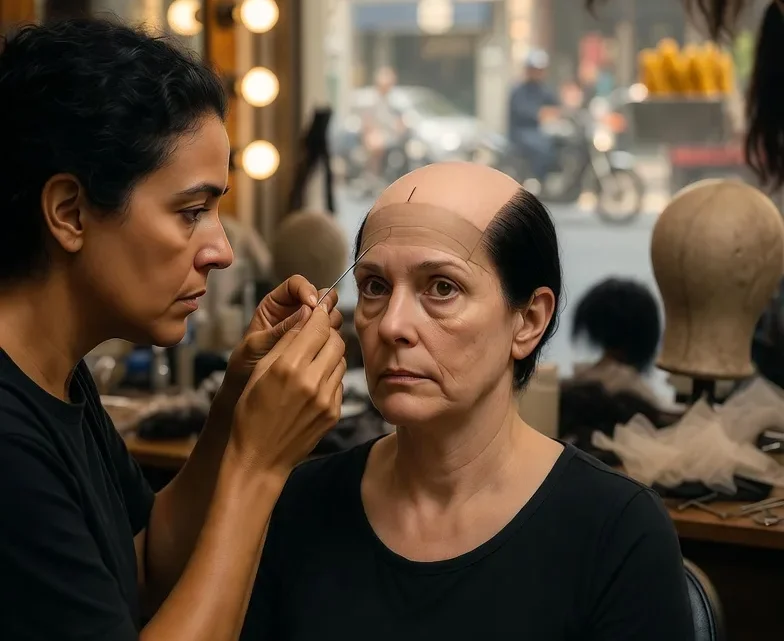
Her client that morning was Marisa Andrade, forty-six, a court stenographer from Tatuapé who had been bald since March. Marisa sat very straight in the chair, hands folded in her lap like she was waiting to be sentenced rather than transformed.
You don’t have to talk if you don’t want to, Carolina said, threading a strand of remy hair through the lace front with a tool no bigger than a sewing needle. Some people like quiet. Some people tell me their whole life.
I haven’t told anyone my whole life, Marisa said. Why would I start with you.




Because I’m not going to see you on the street tomorrow.
Marisa almost laughed. It came out as something closer to a cough.
The studio was small, four chairs, mirrors with bulbs around them like an old theatre dressing room, and along one wall, blocks of wig heads in various states of construction, some bald, some half finished, a few crowned in human hair so glossy it looked wet.
Carolina sourced most of her hair from Brazil’s own south, from women in small towns who sold their ponytails for rent money, and some from India, processed through brokers in Chennai before it ever touched her hands. She didn’t love thinking about where it came from, the economics of it, but she respected it. Every strand had belonged to somebody.
Marisa had been a stenographer for nineteen years, sat behind glass in courtrooms typing testimony of murders and divorces and corporate fraud in a kind of furious silence, and then in February she’d noticed the part in her hair widening, just slightly, the way a road widens before a landslide.
By March, clumps came away in the shower drain. The dermatologist called it alopecia areata, said it could be stress, could be autoimmune, could be nothing they’d ever properly explain.
My husband says it’s not a big deal, Marisa said, watching Carolina’s hands move. He says, you have your health, you have your job, hair is hair.
Is he wrong?
He’s not wrong. He’s just never had people stop looking at him when he walks into a room.
Carolina kept ventilating the lace, knot after knot, a process that for a full unit could take her thirty, forty hours across a week. This was couture work, not the synthetic lace front wigs sold by the dozen in the shops down on 25 de Março, the kind tourists bought for costume parties.
This was bespoke human hair wig construction, full lace, hand-tied, baby hairs placed one by one along the hairline to mimic the soft fuzz of a natural scalp. Clients flew in from Brasília, from Curitiba, occasionally from Lisbon, because word had gotten around that Carolina didn’t just make wigs, she rebuilt faces, rebuilt the angle at which a woman was willing to meet her own reflection.
I used to have hair down to here, Marisa said, gesturing somewhere near her ribs. My mother used to braid it every Sunday before mass. Now she can’t even look at me without crying, so I stopped visiting on Sundays.
Carolina paused, needle suspended.
That’s the part that should make you angry, she said. Not the hair. Your mother making this about her grief instead of your healing.
You’re not very gentle, are you.
I’m gentle with the lace. I’m not paid to be gentle with the truth.
By the third hour, the hairline was taking shape, a soft widow’s peak Marisa had specifically requested because, she admitted quietly, her grandmother had one, and she’d always loved it, had wanted one her whole life and never had it, and now, cruelly, this was the only way she’d get it. Carolina found something almost holy in that, the way loss sometimes handed people a door they’d never have found otherwise.
Outside, Rua Augusta did what it always did at midday, motoboys weaving between stalled cars, the smell of pão de queijo drifting up from the bakery below, a busker playing forró on an accordion that wheezed more than it sang. Inside, the only sound was the soft click of Carolina’s tool and, eventually, Marisa’s voice again, smaller now.
Will people know? she asked. Will they look at me and know it’s not real?
Carolina set down the needle and turned the chair so Marisa faced the mirror fully, the wig still pinned, half finished, one side of her scalp still bare lace and the other already softened by hair that caught the light like it had never known a comb that wasn’t kind.
Real is a strange word to use about hair, Carolina said. Nobody’s hair is really theirs. It’s keratin, it’s dead cells, it’s something your body grew without asking you. This is just hair somebody else’s body grew, that I’m giving to you on purpose. I’d argue this is more yours than the hair you lost ever was, because you chose every single strand of it.
Marisa didn’t answer right away. She reached up, careful, and touched the half-finished hairline, the new widow’s peak, the place where her grandmother’s face and her own seemed, for a second, to overlap.
My grandmother used to say a woman’s crown is never really gone, she said. I thought she meant it was permanent. I think now she meant it just changes hands.
Carolina picked the needle back up, and for the rest of the afternoon they worked in something that wasn’t quite silence and wasn’t quite conversation, somewhere in between, the way the best hours in that studio always went, two women in a room above a pharmacy on Rua Augusta, building a crown out of strangers’ hair and one woman’s grief, until it looked, impossibly, like it had grown there all along.