She Joined Our Losing Football Team With Her Ex’s Boots, Then Everything Changed
The first time Mereani saved a penalty, she was holding a half-eaten meat pie in her left hand.
Nobody had told her the match had started. Nobody had even told her she was the goalkeeper. She had come to the field in Suva, Fiji, to return a pair of borrowed boots, and somehow, fifteen minutes later, she was standing between two plastic cones while eleven people shouted at her from different directions.
Trending Now!!:
The ball struck her shin, bounced off her knee, and rolled harmlessly into the grass.
For a second, everyone went quiet.
Then Jone, our captain, screamed like we had won the World Cup.
She saved it! Somebody write this down! We have a goalkeeper!




Mereani looked at the pie in her hand.
Can I finish eating now?
That was how the most embarrassing football team in our part of Suva found the person who would eventually give us the strangest six months of our lives.
Before Mereani arrived, we had lost eleven matches in a row.
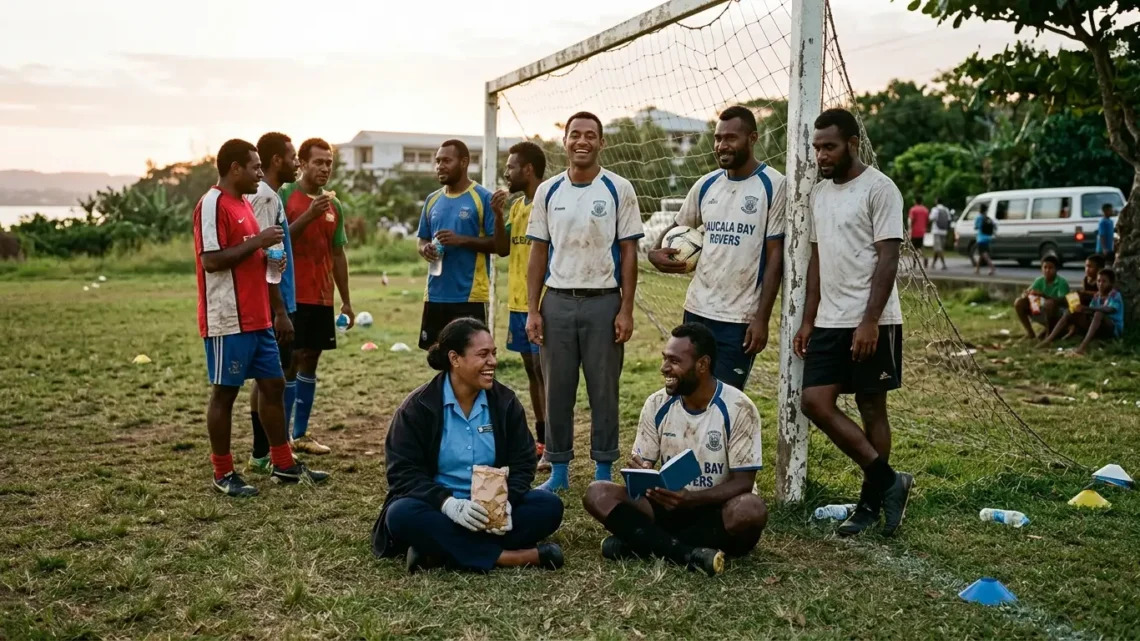
We were called the Laucala Bay Rovers, although nobody could agree on who had originally given us the name. We played on a rough community field not far from the University of the South Pacific. The grass was uneven, the goalposts had peeling white paint, and one corner of the field flooded whenever the rain became serious.
Our footballs were usually donated by somebody who had stopped playing. Our jerseys came from three different batches, which meant our team looked like a group of strangers who had accidentally arrived at the same birthday party.
We trained twice a week, mostly on Tuesday and Thursday evenings. Some players arrived straight from work. Others came after classes. One man regularly turned up wearing office trousers because he had forgotten to bring his shorts.
His name was Peni, and he was also our worst defender.
Nobody wanted to tell him.
I was twenty-nine at the time, working at a small printing shop near Suva’s central business district. My job involved making photocopies, printing school assignments, and explaining to customers why sending a blurry photograph of a document through WhatsApp did not magically improve its quality.
Football was the one thing I did without needing to be paid.
That was what I told people, anyway.
The truth was that I had spent most of my twenties being average at everything. I had an ordinary job, an ordinary room in a shared house, and a phone whose battery had to be charged twice a day. Football gave me somewhere to be expected.
Even if all we expected was another defeat.
Our manager, Jone, was thirty-six and worked as a minibus driver. He took the team seriously in a way that made the rest of us uncomfortable. He kept a notebook containing our match results, our training attendance, and the names of players who owed him money for water.
He had bought the notebook himself.
After our eighth consecutive loss, he gathered us beside the field and announced that things had to change.
We cannot keep playing like this, he said.
Peni was sitting on the grass, removing a stone from his boot.
We can. We have been doing it for two months.
Nobody laughed because Jone was holding his notebook open.
Our next three matches went exactly as expected. We lost by four goals, then two, then five. In the last game, our striker missed an open goal so badly that the ball went out for a throw-in.
The opposing goalkeeper walked over and shook his hand.
That was the moment I began wondering whether our team had become a form of public entertainment.
People had started coming to watch us lose. Children from nearby houses gathered along the edge of the field. A group of university students sometimes sat beneath a tree with packets of chips, commenting on our mistakes as if they were professional analysts.
One boy, perhaps twelve years old, became particularly interested in Peni.
Uncle, why do you always kick it to the other team?
Peni stopped moving.
Because they are also playing football.
The boy thought about this.
Yes, but you are supposed to be helping us.
Peni turned away and adjusted his socks.
The following week, he arrived early for training.
He had watched three videos about defending on YouTube.
Unfortunately, the videos involved players in the English Premier League, and Peni had decided that the secret to defending was sliding tackles. During our practice session, he attempted one on a teammate who was standing still.
Both men fell over.
Jone closed his notebook.
Tomorrow, we are practising passing.
Nobody argued.
The thing about our team was that we did not lose because we were lazy. We lost because most of us were trying to solve different problems at the same time.
Our striker wanted to shoot from everywhere because he believed goals attracted attention. Our midfielders passed the ball to whoever shouted loudest. Our defenders chased opponents as if they had personal arguments to settle.
Nobody listened to anybody else.
Then came the Thursday when Mereani showed up with the boots.
She was thirty-one, worked at a small pharmacy, and lived with her older sister in a neighbourhood where the sound of passing minibuses could be heard from almost every street. She had been dating one of our former players, Samu, until they separated three months earlier.
The breakup had been unpleasant enough that Samu had stopped coming to training.
Mereani explained that she had found his football boots beneath her bed while cleaning her room.
She wanted them gone.
He said he would collect them, she told me, standing near the sideline. That was six weeks ago.
I recognised the boots. They were old, black, and missing a small piece of material near the right heel.
You could leave them at his house.
I did. His mother gave them back to me.
She said this without smiling.
I was still trying to decide what response would be appropriate when Jone approached us.
He looked at the boots, then at Mereani, then at the field.
Do you play?
Not really.
Can you stand in goal?
I suppose.
That was all the discussion required.
We were short of players, our usual goalkeeper had injured his wrist, and Jone had recently announced that nobody would be allowed to miss training without providing a written explanation.
Mereani put the boots on. They were slightly too large.
She borrowed a pair of socks from me, ate the last of her meat pie, and walked into the goal.
Her first save was an accident.
Her second was not.
By the end of the session, she had stopped three shots that would normally have ended up behind our goal or in somebody’s garden.
How did you learn to do that? I asked.
She shrugged.
I used to play with my cousins when I was younger. They always made me the goalkeeper because I was the smallest.
That makes no sense.
They said I would fit between the posts.
Jone wrote something in his notebook.
The following Tuesday, Mereani returned.
She came straight from work, still wearing her pharmacy uniform beneath a loose jacket. She had brought her own gloves, which she said she had purchased from a secondhand sports shop for twelve dollars.
She also brought a small bottle of water.
She did not ask whether she could join the team.
She simply changed her shoes and began warming up.
Nobody objected.
For the first time in months, our training sessions began to look organised. Mereani shouted instructions from the goal. She told defenders when to move forward, when to stop chasing the ball, and when to leave an opponent alone.
She was not particularly loud, but she had a way of saying things that made people listen.
Peni, stay there.
Peni stayed there.
Peni, I said stay there, not stand in the middle of the road.
Peni moved.
After two weeks, our defenders had stopped running toward every ball. Our midfielders began looking up before passing. Even our striker, Ratu, started attempting fewer shots from impossible distances.
We lost our next match by one goal.
It was the closest we had come to winning anything in months.
After the final whistle, Jone bought everyone a bottle of water. He did not mention the notebook.
For several minutes, we sat on the grass discussing the match. Someone had brought cassava chips from a roadside stall. A player who had been arguing with Peni for three weeks offered him some.
Peni accepted.
Nobody apologised.
The next match ended in a draw.
Our opponents scored first, and we spent the second half chasing an equaliser. With five minutes remaining, Ratu finally passed the ball instead of shooting. The ball reached our midfielder, Saki, who crossed it into the penalty area.
I was standing near the far post.
I had enough time to think about three things. First, the ball was coming toward me. Second, I had not scored a goal since school. Third, if I missed, the boys beneath the tree would probably remember it for the rest of my life.
I kicked it.
The ball struck the inside of the post and went in.
For a moment, I did not understand what had happened.
Then Mereani came running from the other end of the field, waving both arms above her head. Jone nearly dropped his notebook. Peni grabbed me around the shoulders and shouted directly into my ear.
We had not won.
The match ended one-all.
Still, that evening, I walked home through Suva with the kind of happiness that makes ordinary things look unusually clear. I noticed the smell of frying fish outside a roadside shop. I noticed a little girl trying to persuade her father to buy her an ice cream. I noticed that my right shoe had developed a hole near the toe.
I had not thought about the hole all day.
The next morning, I repaired it with glue.
We won our first match two weeks later.
The score was two-one, and our second goal came from a corner that Jone had made us practise so often that we could perform it half asleep. Nobody rushed to buy celebratory drinks. Most of us had work the next morning, and money was tight for nearly everyone.
We stood together for a photograph instead.
Mereani was in the centre, wearing her pharmacy jacket because she had forgotten her jersey at home.
The photograph appeared on our team Facebook page that night. Someone added the caption, Our first win. We are finally learning.
It received seventeen likes.
One of them came from Samu.
I knew because Mereani showed me the screen while we were waiting for a minibus after training.
She stared at the like for a while.
Do you think he wants to come back? she asked.
I did not know what to say.
Samu had been a decent player before leaving. He had also been the sort of boyfriend who disappeared whenever a conversation became uncomfortable, then returned with food and acted as though the problem had been solved.
Mereani had once told me she spent nearly a year believing that was normal.
Maybe he just likes the photograph, I said.
She locked her phone.
Yes. Maybe.
She did not mention him again for several weeks.
By then, our team had become something we had not planned. People who had previously arrived late were turning up early. Players brought extra water. Someone donated a new football. A woman who sold fruit near the bus stop began asking us about our results.
Our losing streak had become a joke we could tell without feeling ashamed.
There were still arguments. Peni still attempted unnecessary tackles. Ratu still believed he should take every free kick, even when the ball was closer to the corner flag than the goal.
Jone still recorded everything in his notebook.
The difference was that we had stopped expecting someone else to fix us.
Then, one Thursday evening, Samu came back.
He stood beside the field wearing the old black boots. The missing piece near the right heel had been repaired with dark glue.
Mereani saw him before the rest of us did.
She was tightening the straps on her gloves when he approached.
Can we talk? he asked.
She looked toward the field, where Jone was arranging cones.
About what?
Us.
She stood up.
There is no us, Samu*.*
He rubbed the back of his neck.
I know I made mistakes.
You always know after a while.
He glanced at me. I immediately became interested in a patch of grass near my shoe.
Samu had not come to ask for his boots. He had come to ask for his place on the team.
His new job had reduced his free time, he explained. He had been watching our matches online and thought he could help us improve. He missed the team. He missed playing.
He also missed Mereani.
He said all of this while standing in front of her, with the rest of us pretending not to listen.
Mereani let him finish.
You can ask Jone about joining the team, she said. You cannot use football to come back into my life.
Samu nodded.
I understand.
She looked at him for another moment.
I hope you do.
Then she picked up her gloves and walked toward the goal.
That evening, Jone allowed Samu to train with us. Nobody celebrated his return. Nobody told him to leave. He completed the drills, passed the ball when asked, and went home before the rest of us.
For the next month, he kept coming.
He played well. He worked hard. He did not approach Mereani again, at least not where I could see him.
We eventually reached the final of a small local competition. The prize was modest, and the trophy looked as though it had been purchased from a shop that sold school awards and office decorations. Still, we had never played in a final before.
Our opponents were better organised and had a striker who could score from outside the penalty area. We spent most of the match defending.
With ten minutes remaining, they won a penalty.
I remember the silence more than anything else.
The striker placed the ball on the spot. Mereani adjusted her gloves and moved along the goal line. The crowd shifted forward. Somewhere behind me, a child was crying because his father had refused to buy him a drink.
The referee blew his whistle.
The striker ran up and kicked the ball toward the bottom corner.
Mereani dived.
She got both hands to it.
The ball struck her palms, bounced off the post, and rolled away from goal. Peni cleared it so hard that it nearly reached the road.
We survived the attack.
The match eventually ended in a draw, and we lost on penalties.
There was no dramatic collapse. Nobody threw a bottle. Jone wrote the result in his notebook while the players shook hands. Our opponents took their photograph with the trophy, and we waited until they had finished before packing our bags.
Mereani sat on the grass, removing her gloves one finger at a time.
Samu approached her.
You were brilliant today, he said.
She nodded.
Thank you.
He waited, perhaps hoping she would say something else.
She did not.
A few minutes later, she walked over to us and asked whether anyone had spare money for a minibus fare. Her purse was missing, and she thought she might have left it at the pharmacy.
I gave her three dollars.
She promised to return it the next day.
I told her not to worry about it.
She insisted on paying me back.
The following afternoon, she sent the money through mobile banking, along with a message asking whether I had remembered to repair my shoe properly.
I had not.
We continued playing after the competition ended. The team never became famous. Nobody offered us sponsorship. We did not suddenly start winning every match.
Some weeks, we lost badly. Other weeks, we played well enough to surprise ourselves.
Samu remained on the team, although he and Mereani never got back together. They were civil with each other, which sometimes looked more uncomfortable than arguing.
One evening, several months later, I asked Mereani whether she regretted letting him return.
She was sitting beside the field, eating cassava chips from a paper bag. She watched Peni attempt a pass that went directly into the bushes.
Why would I regret it? she asked.
You could have told him to leave.
She considered this while chewing.
He was part of the team before he was part of my life. I don’t own the field.
I thought about that for a while.
Then she added that she still did not trust him, and that being polite did not mean she had forgiven everything.
She folded the top of the paper bag and handed me the remaining chips.
People think every ending needs somebody to be thrown out, she said. Sometimes you just stop giving them the part of you they used to have.
The following week, Jone brought a new notebook to training.
The old one had become swollen from the rain, and several pages had stuck together. He had written our latest results on the first page of the new one.
We had played thirty-two matches since Mereani joined.
We had won nine, drawn seven, and lost sixteen.
Our record was still terrible.
Jone showed us the numbers as if he were presenting the accounts of a successful business. Peni suggested that we should stop counting the losses. Ratu argued that the draws should count as half a win. Nobody agreed on the mathematics.
Mereani was laughing so hard that she had to sit down.
I looked around the field. The grass needed cutting. One of the goalposts leaned slightly to the left. A minibus passed on the road, its driver sounding the horn at somebody who had stepped too close to the curb.
We had spent months trying to become a team worth watching.
Somewhere along the way, we had become a team worth returning to.
I still think about that sometimes, especially when I see Samu passing the ball to Mereani during training, or when Peni makes a mistake and the rest of us laugh before helping him get back on his feet.
We never lifted that trophy.
The photograph from the final is still on my phone. Everyone looks tired. Mereani is holding her gloves. Jone has his notebook tucked beneath one arm, and Peni is standing at the back with his eyes closed.
I have never deleted it.
Sometimes the people who help you change your life are not the people you choose to keep in it.