She Let Me Use Her Washing Machine For Free… Until I Got This Message
The woman in apartment 4B had been borrowing my washing machine for eleven months when I discovered what she had been doing with my clothes.
I found out on a Sunday afternoon in Kraków, Poland, while eating cold pierogi over the kitchen sink because I had forgotten to buy plates for my new flat.
Trending Now!!:
The discovery was not dramatic. There was no shouting, no broken glass, no furious knocking on doors. There was just a photograph on my phone, a message from a stranger, and a pair of blue socks I had never seen before.
My name is Marek, and at thirty-four, I had reached the stage of adulthood where a person could spend an entire Saturday comparing the prices of laundry detergent and still feel irresponsible for buying the more expensive one.
I worked in the accounts department of a furniture wholesaler near Zabłocie. My salary arrived on the twenty-fifth of each month, and by the third, I was already calculating how much food I could buy without touching the money reserved for rent.
Kraków was beautiful in the way cities are beautiful when you are visiting them. Living there meant crowded trams, rising electricity bills, and pretending that a damp patch beside your bedroom window was a temporary problem.




My apartment was on the fourth floor of an old building off Starowiślna Street. The staircase smelled of cabbage, wet coats, and the lemon cleaner the caretaker used every Wednesday. The lift had been broken since February, which meant that carrying groceries home became a small athletic event.
Apartment 4B belonged to Ewa, a fifty-eight-year-old woman who lived alone and had the extraordinary ability to make a person feel guilty simply by looking at them.
She had short grey hair, narrow glasses, and a habit of opening her door before anyone finished knocking. She wore knitted slippers in winter and plastic sandals in summer. Every morning, she swept the corridor outside her apartment, including the part directly in front of my door, although I had never asked her to do it.
The first time we spoke, I had dropped a bag of potatoes on the stairs. They rolled in different directions, and one disappeared beneath a radiator.
Ewa came out holding a mug of tea.
You should have bought the smaller bag, she said.
The smaller bag costs more per kilo.
She considered this.
Then the potatoes are winning.
That was how our friendship began, although neither of us would have used that word.
Three months later, my washing machine broke.
The repairman examined it for less than five minutes before informing me that the motor needed replacing. His estimate was 850 złoty, and the machine itself had cost me 900 złoty when I bought it secondhand. I thanked him, watched him leave, and spent the next twenty minutes searching online for washing machines I could not afford.
That evening, I carried a basket of clothes into the corridor and knocked on Ewa’s door.
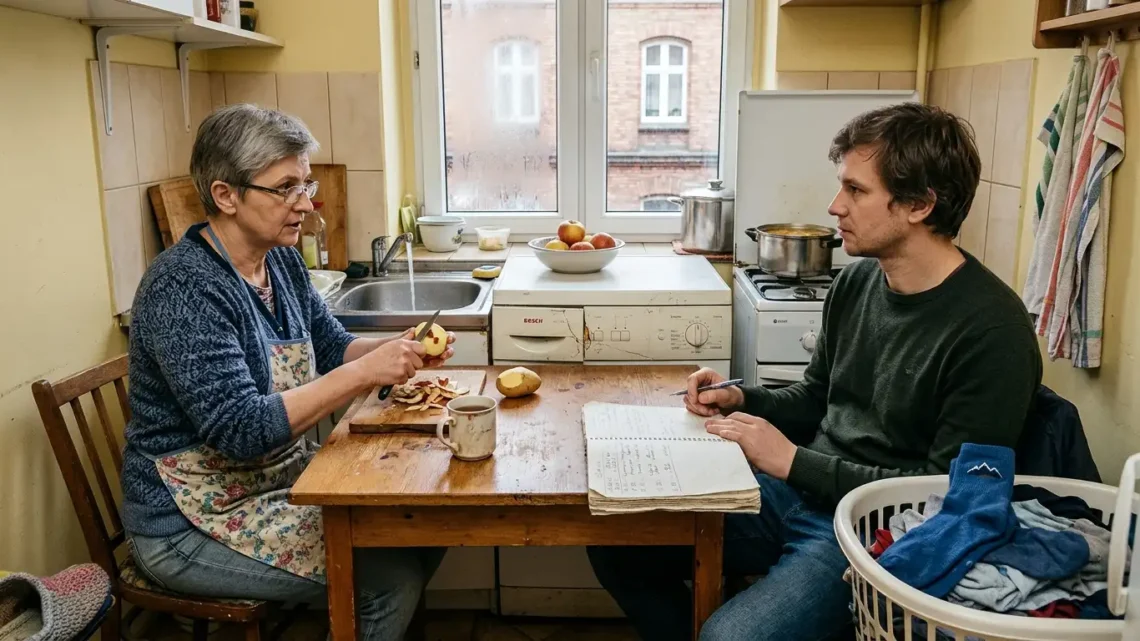
She listened to my explanation while peeling an apple over the kitchen sink.
Use mine, she said.
Are you sure?
No, I offered because I enjoy watching people carry wet clothes up and down stairs.
She showed me the machine in her bathroom. It was an old Bosch model with a scratched control panel and a small crack in the detergent drawer. It worked perfectly.
The arrangement was supposed to last two weeks.
I brought my washing powder. I cleaned the rubber seal after each load. I never left clothes inside overnight. When I finished, I wiped the machine dry and returned the bathroom key she had given me.
After the first month, Ewa stopped asking when I expected to get mine repaired.
After the second, she began leaving a small basket beside the machine for my clean clothes.
By the fourth month, I was buying her washing powder whenever it was on sale.
She always complained that I was spending too much.
I have lived here for thirty years, she told me one evening. I know how much things cost.
Then you know I got a good deal.
You got a deal because you have no sense.
She said this while putting two slices of homemade apple cake into a container for me to take upstairs.
My own mother lived in Tarnów, about an hour away by train. She called every Sunday to ask whether I was eating properly and whether I had met anyone. I told her the same things every week. Work was fine. The apartment was fine. I was eating properly.
The truth was that I was lonely in a very ordinary way.
I had friends, but most of them were busy building lives that seemed to move faster than mine. One had bought a flat with his girlfriend. Another had moved to Berlin. A third had a baby and now communicated almost entirely through photographs of a small person wearing different hats.
I had a desk, a mattress, a kettle, and a refrigerator that made a clicking sound every eleven minutes.
Sometimes, I went downstairs to buy bread even when I had enough at home, simply because the woman at the bakery on Starowiślna recognized me and asked how my week was going.
Ewa became part of that routine.
I carried her rubbish downstairs when her knee hurt. She left soup outside my door when she made too much. We exchanged complaints about the building’s heating system, which worked best during the months when nobody needed it.
Once, when my mother visited, Ewa appeared at my door holding a bowl of mushroom soup.
You never told me your mother was coming, she said.
I didn’t know until yesterday.
She looked past me at my mother.
He eats too much bread and not enough vegetables.
My mother immediately liked her.
After that, they began greeting each other in the corridor like two women who had known each other for years. When my mother left, she told me I should check on Ewa more often.
She looks after you, she said.
I told her we looked after each other.
I believed that was true.
The first strange thing happened in September.
I had washed a load of clothes at Ewa’s apartment before leaving for work. When I returned that evening, I noticed a black T-shirt in my laundry basket that did not belong to me.
It was a medium, with a small faded logo near the chest.
I assumed it had been mixed in with someone else’s laundry at some point. The building had a shared drying room in the basement, and people sometimes left things behind. I folded the shirt and placed it on a shelf near the stairs, intending to ask around.
Two days later, it was gone.
I forgot about it.
The second strange thing happened the following week. A pair of blue socks appeared among my clean clothes. They were thick, expensive-looking socks with a tiny white mountain stitched near the ankle.
I did not own anything like them.
I took them to Ewa.
Are these yours?
She glanced at them and continued stirring a pot on the stove.
No.
Maybe someone left them in the machine.
Maybe.
She sounded distracted. Her phone was on the table, vibrating every few seconds. She kept looking at it, then turning it face down.
I left the socks on her kitchen counter.
The next time I did laundry, they were gone.
By October, I had stopped thinking about the strange clothes. I was more concerned with the fact that my landlord had announced a rent increase for January, and my employer had delayed our annual salary review until the following quarter.
I spent my lunch breaks looking at smaller apartments farther from the city centre. Most were not much cheaper. Some had shared bathrooms. One had a kitchen so narrow that the refrigerator stood in the hallway.
I began saving money wherever I could. I stopped buying coffee before work and carried it in a thermos. I walked home from the office when the weather was dry. I bought discounted bread at the end of the day and froze whatever I could not finish.
The washing machine remained a small kindness in a month full of calculations.
Then came the Sunday afternoon when everything changed.
I was standing in my kitchen, eating leftover pierogi, when a message arrived on Facebook from a woman named Kasia.
I did not recognize her.
Her message was polite.
Hello, sorry to bother you. Do you live in the building on Starowiślna Street?
I replied that I did.
She sent a photograph.
It showed a small room with pale yellow walls, a folding table, and a white drying rack crowded with clothes. On the table sat a black T-shirt with a faded logo.
The same shirt I had found in my laundry basket.
Beneath the photograph, Kasia had written:
My mother says she has been helping you with your washing. She asked me to contact you because she wants to know if you are planning to pay her.
I read the message twice.
Then I looked at the photograph again.
The blue socks were hanging from the drying rack.
I called Kasia.
She answered after the fourth ring. She sounded tired, as if she had been expecting the call all day.
I think there has been a misunderstanding, I said.
That is what I thought too.
She explained that her mother, Ewa, had recently begun telling relatives that she was earning a little money by doing laundry for a young neighbour. She had mentioned the work several times during family calls. According to Kasia, she said I brought her clothes every week and that she charged less than a commercial laundry service.
I sat down.
I have never paid her to wash my clothes.
There was a pause.
She said you gave her money.
I remembered the washing powder. The cake. The groceries I sometimes carried upstairs when she said she had run out of milk.
None of those things had been payments.
I bring my own detergent, I said. I use her machine because mine is broken.
Kasia went quiet.
Then she asked something that made me stop breathing for a moment.
Do you know how many loads she has been doing every week?
I did not.
She told me that her mother had been washing clothes for several people in the building, including me, and had been keeping notes in a small notebook. She had recently asked Kasia to help her calculate how much money she was owed.
My name was on the list.
The amount beside it was 1,200 złoty.
I looked around my kitchen. The unopened washing powder sat beside the refrigerator. A small container of apple cake was still in the cupboard. I had been treating the arrangement as a favour between neighbours.
Somewhere along the way, Ewa had started treating it as a job.
I don’t understand, I said. Why didn’t she tell me?
I don’t know, Kasia replied. She says people should pay for services. She says you are taking advantage of her because she is older.
I almost laughed, but there was nothing funny about it.
I never asked her to wash my clothes.
I know.
That was the strange part. Kasia seemed to believe me, but she also sounded embarrassed, as if she were apologizing for a problem she had inherited.
We ended the call without resolving anything.
For the next hour, I walked around my apartment doing small tasks I did not need to do. I washed a cup. I wiped the kitchen counter. I checked my bank account and calculated how much money I would have left if I paid the amount in the notebook.
The answer was unpleasant.
I could pay it, but doing so would mean postponing a bill and using part of the money I had saved for the rent increase.
I could also refuse.
I had never agreed to a price. I had never been told that I was receiving a paid service. I had cleaned the machine after every use, supplied the detergent, and occasionally bought groceries. Ewa had offered the arrangement herself.
Still, I thought about her knee, the stairs, and the way she sometimes gripped the railing when carrying shopping bags.
I thought about the cake she had brought my mother.
I thought about the fact that I had been enjoying something that saved me money without ever asking whether it was costing her anything.
At six, I went downstairs.
Ewa opened her door wearing a blue cardigan. Behind her, a television presenter was speaking loudly about the weather.
You spoke to my daughter, she said.
It was not a question.
Yes.
She stepped aside to let me in.
Her kitchen smelled of fried onions and boiled potatoes. A small notebook lay beside the sugar bowl. My name was written on one page, followed by dates and amounts.
I recognized the dates. They were the days I had done laundry.
Why didn’t you tell me you wanted money? I asked.
Ewa sat down.
You are a grown man. You know that electricity costs money.
I know that. You offered to let me use the machine.
I offered because I thought you would understand.
Understand what?
She looked at me as if I had deliberately misunderstood something obvious.
That nothing is free.
I felt my face getting hot.
You could have said that.
Then you would have stopped coming.
I had no answer.
She turned a page in the notebook.
I am not asking for much. The laundry shop charges more. I thought we could help each other.
You never told me you were charging me.
You never asked.
That was when I became angry.
Not because of the money, although the money mattered. I was angry because she had let me believe I was part of a small, decent arrangement between two people who lived alone. She had accepted my detergent and my little bags of groceries, then quietly counted every wash as a debt.
I told her I would pay for the electricity I had used, but I would not pay a bill I had never agreed to.
She looked down at the notebook.
Fine.
The word was so quiet that I nearly wished she had shouted.
I returned to my apartment and spent the evening feeling both right and terrible.
For three days, we did not speak.
I heard her sweeping the corridor each morning. I heard her television through the wall. Once, I saw her carrying two shopping bags up the stairs, and I almost offered to help. She looked at me, then turned away.
On Thursday, Kasia sent me another message.
She said her mother had been doing laundry for several neighbours because her pension barely covered her expenses. The work had begun when another resident offered to pay her to wash bedding. Soon, other people asked for help. Ewa had not told everyone the same arrangement, and some residents had apparently paid her without being asked.
Kasia also said her mother had become ashamed of needing the money.
She thought you would understand, she wrote.
I stared at the screen.
The sentence irritated me more than it should have. I had been the person who was supposed to understand, even though nobody had trusted me enough to tell me the truth.
I asked Kasia whether her mother had explained why she put my name in the notebook without discussing payment.
She replied that Ewa believed I would eventually offer money on my own.
I closed the conversation.
That evening, I bought a secondhand washing machine from a man in Podgórze. It was a small Samsung model with a dent on the side, but it worked. I paid 480 złoty and carried it upstairs with the help of a delivery driver who complained about the lift for the entire journey.
The following Saturday, I washed my clothes in my own bathroom.
The machine rattled during the spin cycle. The detergent drawer stuck when I tried to open it. I had to lean against the wall to stop it from moving across the floor.
I had never been so pleased to hear a machine working.
When the cycle finished, I carried the clothes to the drying rack and stood there sorting socks.
One blue sock fell out of a trouser leg.
It was the same kind with the tiny white mountain stitched near the ankle.
I held it for a moment.
I could have taken it downstairs. I could have knocked on Ewa’s door and placed it in her hand. I could have asked her whether she had mixed up our clothes deliberately or whether the whole thing had been an awkward misunderstanding that had grown too large to admit.
Instead, I put it in the drawer with my own socks.
Two weeks passed.
My mother called and asked whether I had spoken to the neighbour.
I told her what had happened.
She listened without interrupting, which was unusual for her.
When I finished, she asked whether Ewa had ever asked me for money before.
I said no.
My mother sighed.
Then you were not supposed to guess.
I felt relieved for about five seconds.
Then she added that she hoped I would not let a disagreement over money erase everything good that had happened between us.
I told her it was not about the money anymore.
I was not sure that was true.
In November, the caretaker announced that the heating would be turned off for two days because of a repair. Everyone complained in the corridor. Someone left a note on the entrance door accusing the building management of incompetence. Another resident replied beneath it that at least the repair was happening before Christmas.
I came home one evening with cold hands and found a small container outside my apartment.
There was a piece of apple cake inside.
No note. No name.
I knew who had made it.
I stood in the corridor for a long time, listening to the television behind Ewa’s door. I could hear her laughing at something. It was a familiar sound, and I hated how quickly it made me want to forgive her.
I took the container upstairs.
The next morning, I washed it and placed it outside her door.
I did not knock.
For several weeks, we continued like that. We passed each other on the stairs and exchanged brief greetings. She stopped sweeping in front of my apartment, and I stopped buying extra groceries when I went to the shop.
The distance between us was not large enough to call a feud. It was simply the absence of all the small things that had made the building feel less lonely.
In December, my salary review finally happened. I received a modest increase, not enough to change my life but enough to stop checking my bank account every morning. I bought a proper drying rack and replaced the broken kitchen light.
One Sunday, I found Ewa sitting on the stairs between the third and fourth floors. Her shopping bag rested beside her, and she was rubbing her right knee.
I put down my own bag.
Are you all right?
I am old, not dead.
I smiled despite myself.
I carried her shopping upstairs. She did not thank me, but she did not refuse either.
At her door, she took the bag and looked at me.
The machine is working?
Most of the time.
You bought a bad one.
It was cheap.
She nodded as if I had confirmed something she already knew.
For a moment, I thought she might apologize. I nearly apologized myself, though I could not decide what for.
Neither of us said anything.
She opened her door.
I made too much soup, she said.
I followed her inside.
We ate at the kitchen table, with the television turned low and the window fogged from the heat. She complained about the price of potatoes. I told her my washing machine had started making a new noise. She asked whether my mother was coming for Christmas.
We spoke for nearly an hour.
The notebook was still on the shelf beside the sugar bowl. I saw it when she stood up to fetch more bread. My name was no longer on the open page.
I wanted to ask whether she had crossed it out.
I wanted to tell her that I had never intended to take advantage of her.
I wanted her to admit that she had made a mistake.
Instead, I finished my soup and washed my bowl.
At the door, she handed me a container of leftovers.
Bring it back when you can, she said.
I took it upstairs.
The following week, I bought two bags of washing powder because they were on sale. I left one outside her door, with no note and no explanation.
By the time I returned from work, it was gone.
We still greet each other in the corridor. Sometimes she asks whether my mother is well. Sometimes I carry her shopping upstairs. Neither of us has mentioned the notebook again.
I have thought about paying her the 1,200 złoty more times than I care to admit. Part of me believes that money would have settled the matter. Another part believes it would have turned every kindness between us into a transaction after the fact.
I still do not know which part of me is right.
The blue sock is in my drawer. I have never found its pair.
Sometimes, the hardest debt to settle is the one nobody agreed to owe.