Soft Spots, Wrong Cuts, and the Best Decision I Ever Made
I still remember the smell.
Not the fresh-paint, new-beginning kind of smell you read about in lifestyle magazines. This was something older and more honest.
Trending Now!!:
Dust layered over decades of other people’s lives, a faint whisper of mildew behind the kitchen wall, and beneath all of that, something almost sweet, like old wood holding a secret. I stood in the doorway of the house I had just bought and I breathed it all in.
I was 31 years old. I had spent eleven years watching YouTube tutorials, reading home renovation forums at midnight, and dog-earing pages in thick library books about flooring installation and cabinet refacing.
I had zero professional experience and an enormous, stupid amount of confidence. My toolbox was second-hand. My budget was tight. My plan was almost nonexistent.
But the house was mine.




It was a 1960s colonial in central Connecticut, three bedrooms, one and a half baths, a kitchen that looked like it had given up on life sometime around 1987, and a backyard that was less a yard and more a philosophical question about what grass could become if left entirely alone.
The home inspector, a calm and quietly terrifying man named Gerald, had handed me a fourteen-page report and said, with the tone of a doctor delivering a diagnosis, “She’s got good bones. Everything else is a conversation.”
I had laughed. I should not have laughed.
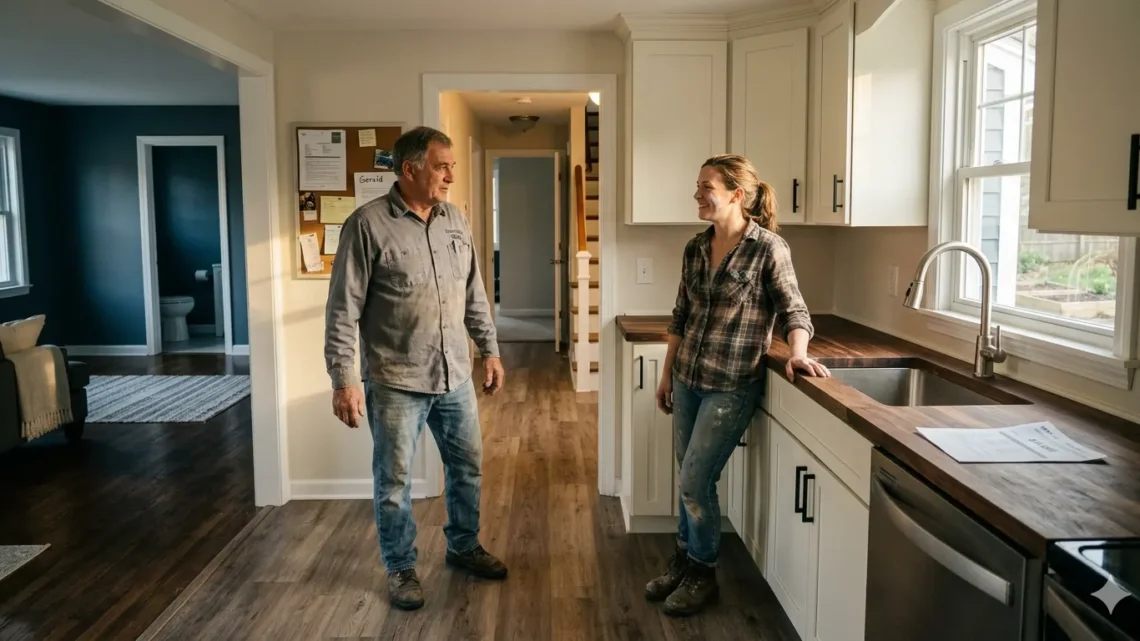
My neighbor from across the street, a retired contractor named Frank, walked over on my first weekend there and watched me drag a circular saw out of my truck like I knew exactly what I was going to do with it.
“First house?” he asked.
“Is it that obvious?” I said.
He looked at the saw, then at my hands, then back at the saw. “Little bit.”
Frank became something I did not ask for and could not have survived without: a translator between my ambition and reality. He was sixty-three, built like a man who had spent four decades arguing with walls and usually winning. He had renovated over forty homes in his life, not as a flipper chasing profit but as someone who genuinely believed that improving a home was one of the most honest things a person could do with their time.
The kitchen was where I started, because every first-time DIY homeowner starts in the kitchen and every experienced contractor will tell you that is exactly the wrong place to start. But the kitchen was the thing that had made me wince the hardest during the walkthrough.
The laminate countertops were warped at the edges. The cabinet doors hung at different angles, two of them swinging open on their own like something in a haunted house. The linoleum floor had a crack running diagonally across it that looked like a fault line, which felt appropriate because the entire room felt unstable.
I had a budget of roughly $4,500 for the kitchen renovation. I had watched enough home improvement content to believe that was workable. I had not yet learned the first great lesson of DIY home improvement: whatever number you say out loud, the house hears it and laughs.
My plan was to reface the cabinets rather than replace them, install new butcher block countertops, lay peel-and-stick vinyl plank flooring, and repaint everything in a warm white that a design blog had called “the color of fresh possibility.” I had the supplies stacked in the living room. I had a weekend free. I had snacks.
What I did not have was patience.
I started pulling up the old linoleum on a Saturday morning with a floor scraper and a recklessness that is still embarrassing to describe.
The linoleum came up in strips, sometimes in large satisfying sheets, sometimes in small maddening pieces that left adhesive residue behind like a grudge. Three hours in, I had half the floor stripped and a blister forming on my right palm that felt like a small, personal punishment.
And then I found the subfloor.
Specifically, I found a soft spot in the subfloor, a section about two feet wide near the base of the sink cabinet where the wood had absorbed moisture long enough to begin its quiet journey toward rot. I pressed my boot down onto it and felt it give in a way that floors absolutely should not give.
I sat down on the kitchen floor, right there in the middle of the half-stripped linoleum, and I stared at the ceiling. The ceiling, for what it was worth, looked fine.
Frank came over that afternoon and crouched down over the soft spot the way experienced people crouch, slowly, deliberately, without drama. He pressed his knuckles into it. He made a sound that was not quite a word.
“How bad?” I asked.
“Could be worse,” he said. “Seen worse. Much worse. But you’re going to need to sister those joists before you put anything new down.”
“How much does that add?” I asked, meaning money.
“Couple hundred in materials if you do it yourself. More if you call someone.”
I did it myself. It took two weekends, three trips to the hardware store, and one moment on a Sunday evening where I sat in the crawl space beneath the kitchen with a headlamp on my head and my back pressed against a cold beam and thought seriously about calling a contractor to finish the whole thing. The crawl space smelled like 1961. There were spider webs I tried not to think about. My knees hurt.
But I sistered those joists. I lay flat on my stomach in the dark and I drilled lag screws through fresh lumber into rotting wood until the floor above me stopped moving, and when I climbed back out and walked across the kitchen and felt nothing give beneath my feet, I felt something I had not expected to feel: pride. Not the loud kind. The quiet, slightly embarrassed kind that comes from doing something genuinely hard.
The subfloor repair taught me the second great lesson of DIY home improvement: the job you can see is never the only job. Every weekend DIY project has a hidden project inside it, a smaller, uglier, more honest renovation that has to happen before the beautiful one can begin.
The home improvement content I had consumed for years rarely showed that part. Nobody films themselves in a crawl space at 7 PM on a Sunday.
The countertop installation was where I nearly lost my mind completely.
I had ordered a butcher block countertop, a beautiful piece of walnut that had arrived wrapped in moving blankets and cost more than I wanted to admit. Butcher block countertops are SEO gold, as any home design publication will tell you, because they photograph beautifully, they are genuinely warm and livable, and they add real home value when installed correctly. What those publications occasionally forget to mention is that cutting them requires precision I had not yet developed.
I measured twice. I cut once. The cut was off by three-eighths of an inch.
I stood in the kitchen holding my measuring tape and stared at the gap between the countertop and the wall for a long time. A very long time.
“You know,” Frank said from the doorway, where he had materialized the way retired contractors always materialize, quietly and at the worst possible moment, “three-eighths of an inch is a trim piece. That’s not a disaster. That’s a detail.”
“It doesn’t look right,” I said.
“It doesn’t look right yet,” he said. “There’s a difference.”
He helped me route a clean edge and install a thin strip of matching walnut trim against the wall. When we were done, and I stepped back, the gap was gone. The countertop looked like it had always been there, patient and handsome, waiting for the rest of the kitchen to catch up.
The cabinet refacing was, unexpectedly, the part I enjoyed most. There is something deeply satisfying about cabinet painting when you do it right, which means cleaning, sanding, priming, sanding again, and then applying paint in thin coats with a foam roller rather than slapping it on with a brush and calling it good.
I used a satin finish in an off-white that sat somewhere between crisp and warm. I replaced all the old hardware with matte black pulls I found on sale, the kind of interior design swap that costs under $80 and makes everyone who visits your kitchen say, “Did you renovate in here?”
The answer, technically, was yes. The answer, more honestly, was that I had been renovating for eleven weekends and I was tired in a way that felt productive.
By the time the new vinyl plank flooring was down, the walls were painted, the new energy-efficient LED lighting was installed under the cabinets, and the old faucet had been replaced with a brushed nickel pull-down sprayer I’d installed myself after watching a plumbing tutorial three times back to back, the kitchen looked like a completely different room. It was bright. It smelled like fresh paint and lemon wood oil. The floor clicked satisfyingly underfoot.
My total cost came in at $6,200. I had gone over budget by $1,700, which in the world of home renovation is practically a miracle.
Frank walked through the finished kitchen the Sunday evening I declared it done. He ran his hand along the countertop. He opened and closed three cabinet doors. He looked at the floor and then at the lighting and then at me.
“You did good,” he said.
That was it. No speech, no flourish. Just four words from a man who had spent four decades inside kitchens, bathrooms, basements, and living rooms, who had seen everything done right and everything done wrong and who had somehow ended up as the person I measured myself against.
I shook his hand in the middle of my new kitchen floor and felt something settle in my chest, something that had been unsettled for the eleven months since I had signed the mortgage papers.
The house and I had come to an understanding.
Over the next two years, I kept going. The bathroom remodel came next, a modest but deeply satisfying project that involved retiling the shower surround, replacing the vanity, installing a new toilet, and painting the walls a deep slate blue that made the small space feel like a room worth spending time in.
I learned to cut tile. I ruined four tiles learning to cut tile, but the ones on the wall are straight and I grout them myself and they have been dry and sealed for sixteen months without a single crack.
After the bathroom, I tackled the master bedroom flooring, pulling up carpet that had been there since the Clinton administration and discovering beautiful original hardwood underneath that just needed refinishing.
The hardwood floor refinishing project was two weeks of noise and dust and the specific madness of living without furniture in half your house, but the finished floors glowed like something recovered rather than built, which is exactly what they were.
I added insulation to the attic for energy efficiency. I weatherstripped every exterior door. I replaced the single-pane windows in the living room with double-pane units that cut my heating bill by 22 percent the following winter.
I built a raised garden bed in the backyard that my mother cried about, which I choose to interpret as a compliment. I painted the exterior trim and replaced the front door with a solid wood craftsman-style door in a deep forest green that transformed the curb appeal so dramatically that two different neighbors asked if I had put the house on the market.
I had not. I was not going anywhere.
Last spring, I had a home appraisal done for a refinancing application. The appraiser, a brisk and efficient woman named Sandra, walked through every room with a clipboard and said very little. When she finished, she stood in the kitchen and looked around with the studied neutrality of someone paid to be objective.
“Significant improvements,” she said. “Did you hire this work out?”
“Most of it I did myself,” I said.
She looked at me the way Gerald the inspector had looked at me three years earlier, but this time the expression was different. This time it was something closer to respect.
The appraisal came back $74,000 above what I had paid for the house.
I called Frank when I got the number.
“Seventy-four,” I said.
A pause.
“Not bad,” he said, “for a man who didn’t know how to hold a circular saw.”
I laughed. This time, the laugh was the right kind.
Here is what eleven years of reading about home improvement and three years of actually doing it have taught me, the things that no tutorial packages cleanly: the house will always find a new way to surprise you, and the surprises are rarely pleasant, but they are always instructive.
Budget renovation projects blow budgets because the house has its own budget in mind and does not particularly care about yours. The difference between a DIY homeowner who gives up and one who keeps going is almost never skill. It is almost always the willingness to sit in a crawl space at 7 PM on a Sunday and keep drilling.
Kitchen renovations add more to home value than almost any other interior improvement, and bathroom remodels follow closely behind. Energy-efficient home upgrades, from smart thermostats to better insulation to LED lighting, pay back their costs faster than people expect.
Curb appeal, which sounds like a real estate cliché, is real: the door, the trim, the front path, these are the things that make a house feel cared for before anyone steps inside.
But none of that is the thing I would tell you first.
The thing I would tell you first is this: the moment you press your knuckles into a soft spot in your kitchen subfloor and decide to fix it rather than cover it up, something changes between you and the house. You stop being a person who lives in a building, and you become someone with a claim on it, not legal, not financial, but something older and more personal. You become the person who knows where the pipes run and what the joists sound like when they’re solid and where the light falls on a Tuesday afternoon in October.
The house is mine because I paid for it. But it is also mine because I know it.
That, I think, is the whole point.