Someone Paid Off My Loan in Cash and the Teller Said He Was Very Rude
The app said zero. Dilnoza Rakhimova held her phone closer to the window of the minibus and read the screen again. Amount due this month: 0 som.
Yesterday it had said 1,850,000. She had been dreading that number since the 25th, the way you dread a dentist.
Trending Now!!:
She was thirty-one, a loan officer at a bank branch on Amir Temur Avenue, and the joke was not lost on her. She spent her days approving other people’s debt while drowning in her own. Two years ago she had borrowed money to pay for her younger brother Sardor’s wedding in Chilanzar. Three hundred guests, two roasted sheep, a singer from Yulduz TV. Everyone cried and ate plov. Nobody offered to help with the bill.
Her salary was 4,200,000 a month. Rent on the flat she shared with her mother took a third. The loan took almost half of what remained. She did the maths on the back of her hand most nights and the answer was always the same: a life with no room in it.
She had stopped sleeping properly in spring. At work she smiled at customers while her chest felt tight, like a shirt washed too hot. In September she wrote a resignation letter and kept it in her bag for three weeks. Quitting a stable job in a city where a stable job was gold sounded insane, even to her.
Now the app said zero.



She called her brother from the stairwell of the branch. Did you pay something? she asked. Sardor laughed. With what money? I can barely pay for petrol.
She called her mother. Absolutely not, her mother said. I would have told you so you could thank me properly.
She called Madina, her friend at the head office, who could see the payment trail. Madina went quiet for a minute, then came back on the line. Cash deposit. Yesterday at the Chilanzar branch. A man brought it in an envelope. The teller remembers because he was very old and very rude.
Rude how? asked Dilnoza.
He told her she counted too slowly.
Dilnoza knew exactly one man who would say that.
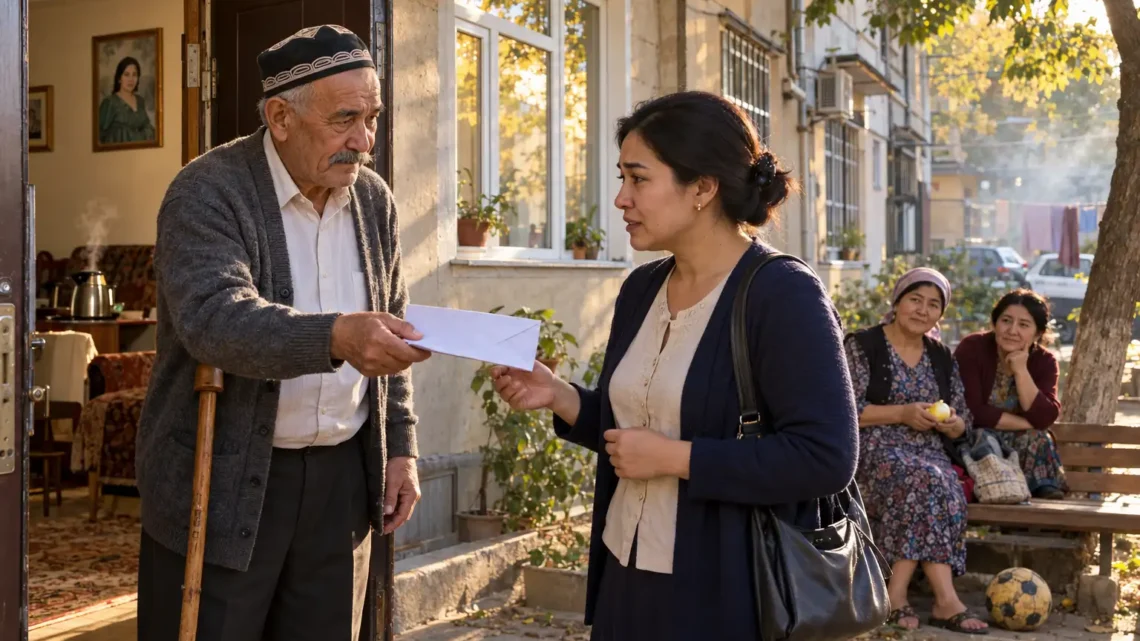
His name was Rustam Karimov, and he lived on the ground floor of her building, flat 4. He was seventy-four, a retired bus mechanic with a moustache like a brush and a permanent frown. In the courtyard he kept a wooden stick, and when children kicked a football near his window he banged it on the railing and shouted. The kids called him “the Sheriff”. The women on the benches called him worse. In nine years, Dilnoza had never heard him say good morning to anyone.
She stood outside his door that evening with a plate of her mother’s samsa as an excuse. Her heart was going faster than it had at her own job interview.
He opened the door a hand’s width. No salesmen, he said.
I live upstairs, she said. Flat 12.
I know where you live. Your mother’s slippers make a noise on the stairs. He looked at the samsa. What is that for?
Someone paid my loan, she said. The bank says an old man did it.
He stared at her for a long time. Then he took the plate. Many old men in Tashkent, he said. Try a different one. The door closed.
She stood there, plate gone, no answer, and the smell of boiled cabbage drifting into the hallway.
She should have let it go. A smarter person would have said thank you to the universe and moved on. Instead she did what she did best at work: she asked questions. On Saturday she sat on the courtyard bench next to Gulchehra, a neighbour who knew every secret in the building.
Why does he shout at the children? Dilnoza asked.
Gulchehra snorted. Because he is a bitter man. His wife died, his daughter moved to Moscow and never calls. He has nothing else to do.
Funny thing, said another woman, Zebo, peeling an apple. Last winter the football broke my kitchen window. I was going to complain to the management company. Next morning there was new glass already fitted. Nobody knew who did it.
Mine too, said Gulchehra slowly. Two summers ago. I thought the management was finally doing its job.
They looked at each other. Then, without anyone saying a word, they both looked at flat 4.
Dilnoza went back that night. This time she did not bring food. She knocked and waited.
He opened the door fully. Behind him she could see a small, spotless room, one armchair, a framed photograph of a woman in a green dress, and a kettle already whistling.
Why? she said. You do not even like me.
I do not like anyone, he said. This is well known.
You paid one million eight hundred and fifty thousand som.
I paid nothing. He turned and poured tea into one glass, then, after a pause, into a second. Sit if you are going to stand there making the corridor cold.
She sat. The tea was too strong. He did not look at her.
I fixed buses for forty-one years, he said eventually. You know what I learned? A small problem ignored becomes a large problem. A cracked pipe. A loose bolt. A young woman who comes down the stairs every morning looking like she is walking to her own funeral.
You noticed that?
I notice everything. I have no television.
She laughed, and it came out wet. She wiped her face with her sleeve, annoyed at herself.
Where did you get the money? she asked.
His eyes went to the photograph. It was only a second, but she saw it. Later, in her own flat, she would remember that the woman in the picture wore a thick gold bracelet, and that the wrist of the woman in the photograph was the only part of the picture that looked bare.
I do not discuss finances, he said.
I cannot accept this, she said. It is too much. I will pay you back, a little each month.
You will do no such thing. His voice rose, the courtyard voice. If you insult me with a repayment plan I will bang the stick on your door.
She took her tea home and sat on her bed. Her mother was snoring in the next room. The resignation letter was still in her bag, folded in four.
By Monday morning, she had two choices and both felt wrong. She could keep the job, keep the money, and let a lonely old man quietly carry weight that was not his to carry. Or she could quit as planned, hand back the envelope she did not have, and leave him to think his gift had been wasted.
Next month’s instalment came due on the 25th. She checked the app every day until then, thumb hovering.
On the 24th, there was a knock on her door. Rustam Karimov stood in the hallway holding a thick white envelope, the same kind they give out at the Chilanzar branch, and he held it out without a word.
She looked at the envelope. She looked at the stick under his arm, and the bare place on the wrist in the photograph.
Her hand was already moving, and even she did not know yet which way it was going.
Some debts are never written down, and those are the ones you spend your whole life paying.