The $40 Tip I Left a Stranger and Why It Still Haunts Me
I did not plan to learn anything that afternoon. I just needed my car fixed.
It was a Thursday in early March, and I was stranded on the side of a two-lane road outside Columbus, Ohio, in a rental car that had decided, with magnificent timing, to stop working approximately eleven miles from the airport.
Trending Now!!:
My flight back to Denver was in three hours. My phone was at forty-one percent. And the nearest auto shop, according to the map, was a place called Harlow’s Garage, which had a 3.8-star rating and a profile photo that appeared to have been taken in 2009.
I called a tow. The tow cost $95 and arrived in forty minutes.
The driver’s name was Curtis, and he was a large, unhurried man who loaded the car onto his flatbed with the practiced calm of someone who had never once felt rushed by another person’s emergency.
He did not ask me what had happened. He did not offer theories. He simply chained the car, climbed into the cab, and pulled onto the road.



“You from here?” he asked about five minutes in.
“No. Denver.”
“Vacation?”
“Work. Client visit.”
He nodded like that explained everything about me and did not ask another question for the rest of the drive.
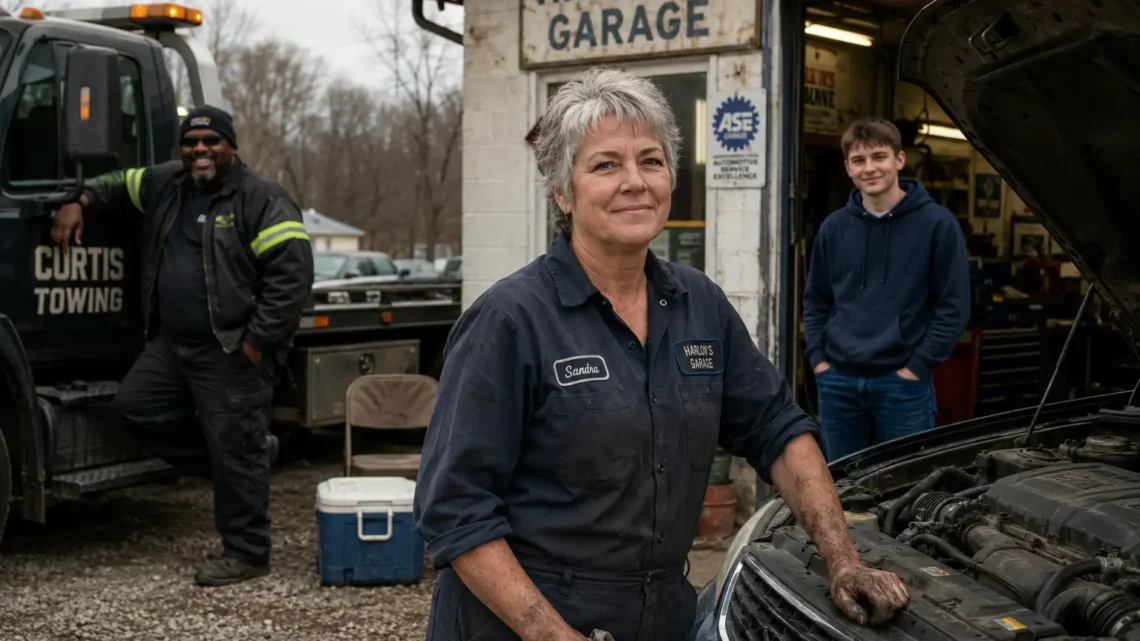
Harlow’s Garage was a single-bay operation set back from the road behind a gravel lot, with two older-model trucks parked outside and a hand-painted sign above the door that had probably been repainted once in the last twenty years. There was a folding chair outside the bay door and an open cooler on the ground next to it with what appeared to be canned iced tea inside.
The mechanic who came out to meet the tow was a woman named Sandra Harlow. She was probably fifty-five, maybe sixty, with short silver hair and oil on her forearms that had been there long enough to look like it lived there. She looked at the car the way a doctor looks at an X-ray, quickly and without drama.
“Pop the hood,” she said. Not to me. To the car, apparently.
I popped the hood.
She looked at the engine for about forty-five seconds, tilted her head slightly, and said, “Fuel pump relay. Could also be the fuel pump itself. I’ll know in ten minutes.”
I told her about the flight. She looked at me for a moment before responding.
“I heard you,” she said, and went back to looking at the engine.
There was a plastic chair inside the bay and I sat in it. The garage smelled like motor oil and old concrete and something faintly metallic that was not unpleasant. A radio in the corner was playing a country station at low volume.
On the wall there was a framed photo of a much younger Sandra standing next to a man in front of this same garage, both of them squinting into what looked like a bright summer afternoon. Beside it, a printed certificate from an ASE certification program dated 1994.
She had been doing this for thirty years.
I watched her work for a few minutes. There was something almost meditative about it, the way she moved from one point to another without wasted motion, the way she seemed to know exactly where her hands needed to be before her eyes had finished looking.
She did not consult her phone. She did not talk through what she was doing. She simply did it.
“Relay,” she said eventually, standing up straight. “Not the pump. You’re lucky.”
“How long?”
She looked at the clock on the wall. “Forty minutes if I have the part. Which I do.”
She walked to a metal shelf along the back wall and found what she needed without searching. I watched her replace the component with the same unhurried efficiency she had applied to everything else. No theater. No commentary about how complicated it was or how fortunate I was that she happened to have the part. She simply worked.
I had twenty minutes before I needed to leave for the airport.
When she was done, she wiped her hands on a cloth and told me the total. It was less than I expected. Significantly less.
“That seems low,” I said.
She looked at me with an expression that was not quite amusement but was close to it. “It’s what it costs,” she said.
I paid. I added forty dollars because I genuinely did not know how else to respond to the situation. She accepted it without comment.
Curtis was outside loading a different car. I asked him to call me a cab to the airport.
“No need,” Sandra said from behind me. “My nephew drives. He’ll take you.”
The nephew’s name was Joel. He was nineteen and had the energy of someone who had just finished an energy drink and was looking for something to do. He put my bag in the trunk and pulled onto the road before I had fully closed the door.
“Aunt Sandra fix the car?” he asked.
“Yes.”
“She can fix anything,” he said, with a conviction that suggested this was not an exaggeration.
We made the airport with eleven minutes before boarding. I got on the plane, found my seat, and sat down in the particular way you sit when you have narrowly avoided something. The kind of sitting that is also a long exhale.
I thought about Sandra Harlow for most of that flight. Not in a sentimental way, exactly. More in the way you think about something that has quietly rearranged a small part of how you see things.
She did not know me. She had no reason to work quickly on my behalf, no reason to charge fairly, no reason to send her nephew forty minutes out of his afternoon to get a stranger to an airport.
None of those things were required. None of them were in whatever unspoken agreement existed between a stranded customer and a roadside mechanic.
She did them because that was how she did things.
I have thought about that a lot since then. About how much of the world runs on people who simply do what they do with honesty and without performance, people who are not waiting to be recognized for it, who would probably find it strange if you tried to make a point of it.
Sandra Harlow would find this story strange. She fixed a relay. She sent her nephew. She charged what it cost.
But I landed back in Denver knowing something I had not known clearly before, which is that competence and decency, when they live in the same person, are a kind of quiet grace that most of us walk past without ever stopping to name.
I have been trying to name it since.