The Last Letter From a Soldier That Reached His Family 30 Years Later
Is this Emir Hadžić? Son of Adnan Hadžić?
The woman on the phone said my father’s name slowly, as if she was checking whether it still worked. I was standing in a queue at a bakery on Titova Street in Sarajevo, holding a paper bag of warm burek for my mother. Nobody had said that name to me in years. In my building, I am Emir, Senad’s boy. On paper I am Adnan’s son.
Trending Now!!:
Yes, I said. Who is this?
My name is Lejla Begić. I work for the post office in Zenica. I think I have something that belongs to your family.
She talked fast, like someone who had rehearsed in the car. The old sorting depot was being emptied before the roof came down. Behind a shelf, she had found a mailbag from the summer of 1995, army field post, never opened, never sorted. Two hundred and twelve letters. She had been matching names in the evenings after her shift, with a flask of tea and a husband complaining about dinner.


One envelope was addressed to Hasiba Hadžić, Hrasno, with a building number and a floor. Lejla typed the name into Facebook and found nothing. Then she tried a group called “Sarajevo Nekad i Sad” and found my mother in a photo from a cousin’s wedding, with me tagged beside her, holding a plate of baklava I do not remember eating.
The envelope is open at one corner, Lejla said. There is something inside. I did not touch it. I wanted to say that before you decide anything.
The girl behind the counter was holding out my change. I took the coins without counting them.
I did not tell my mother that night. I put the bag on the kitchen table and said the queue had been long. She asked why I was chewing the inside of my cheek. I said work. We watched the news, and she corrected the weather presenter out loud, as she does every evening.
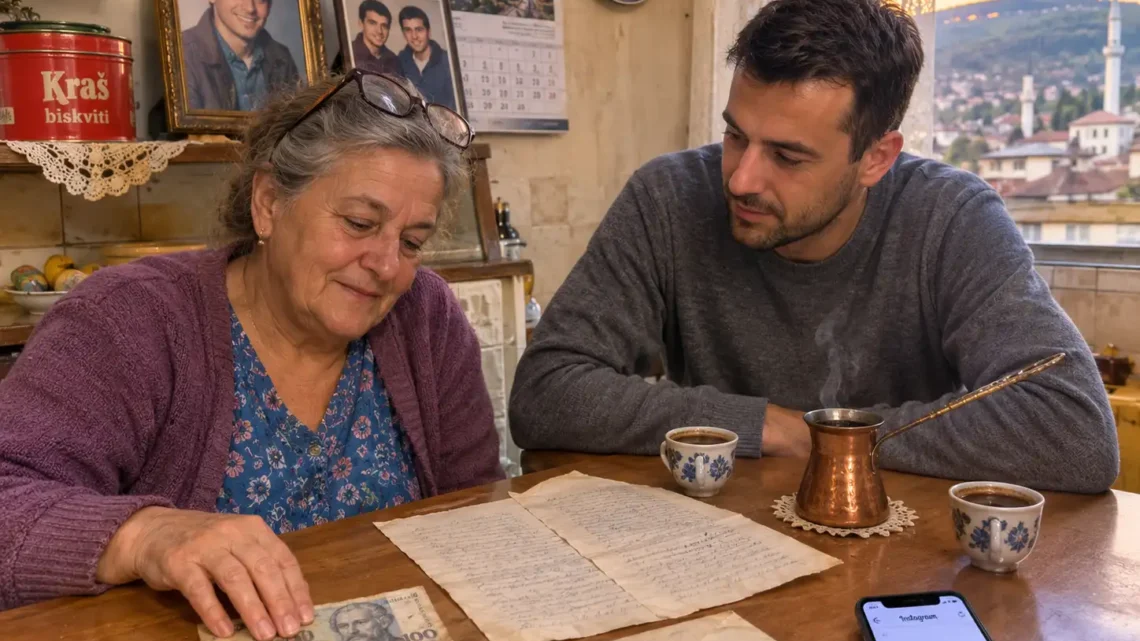
The next morning I met Lejla at a café near the Vijećnica. She wore a puffer jacket and kept both hands around a Coca-Cola she was not drinking. The air smelled of Sarajevo coffee and wet pigeons. She slid the envelope across the table.
It was grey army paper, soft at the edges. My mother’s address was written in pencil, the letters leaning right. I knew that hand. I own exactly one example of it, on the back of a photo of me at four years old: Za Emira.
Inside were two sheets and a hundred-mark note folded in four, soft as cloth. Lejla looked at the pigeons while I opened it all.
I counted nothing, she said.
Hasiba, my soul. I am coming down on Friday if the road stays quiet. Do not make coffee until you see me. I could not stand the smell if it turned out not to be true.
I have to tell you something before I see your face. The 400 marks from the tin are gone. Hamza’s mother in Dobrinja had nothing to bury him with, and I gave her all of it. Do not be angry yet. Be angry on Friday, in the kitchen, with me, and I will stand there and take it.
Here is a hundred I got back from Zijad for the boots. It is all I have. Kiss the boy. Tell Mirza I am sorry I shouted about the flat key.
He was killed nine days after he wrote it, on the Igman road. Friday never came.
Every person in my family knows the story of the tin. It was a Kraš biscuit tin under my parents’ bed, with four hundred Deutschmarks saved over two winters of selling cigarettes and fixing radios. In a besieged city, where a loaf of bread could cost a day’s wages, that money was the difference between us eating and not eating. After the funeral, my mother pulled the tin out and found it empty.
Only one other person had a key to the flat. Mirza, my father’s younger brother, had been asked to check on us while Adnan was at the front. My mother said what she thought out loud at the forty-day gathering, in front of forty relatives and a tray of tufahije. Mirza swore on his own children. Nobody spoke to him after that.
He took a bus out the first spring the roads opened and ended up in Malmö. He sent me a birthday card every year until I turned eighteen. My mother put every one of them in the stove before I saw them, and I only learned about it from a cousin at a wedding. Mirza died of a heart attack in 2019. My mother said the dead do not need our visits, and I did not go. I was twenty-eight years old, and I let her decide for me.
People say a letter like this gives you closure. I did not feel closed. I felt like someone had opened every door in the flat at once.
I took it home. My mother was at the stove with the džezva, her back to me, humming something from the radio. I put the pages on the table next to her cup and said she should sit down.
She read with her glasses pushed up on her forehead. Her lips moved at the line about the coffee. She read it a second time. The kitchen got very quiet, and I could hear the neighbour’s television through the wall.
He gave it to a stranger, she said at last.
To a mother burying her son, I said.
To a stranger, she said again, louder. With you four years old and the two of us eating flour and water.
I let her say it. She had earned the anger, even if it arrived at the wrong address.
Then she picked up the page again and held it closer to the light. Mirza never had it, she said. She was not asking me anything.
No, I said.
I said it in front of everyone. Forty people. Her hand moved to the hundred-mark note and rested on it flat, like she was checking for a pulse. Lejla had told me the central bank would still exchange it, about fifty euros. My mother laughed once, a short dry sound.
Four hundred he gave away, she said. Fifty he sends me.
For thirty years she had someone to be angry at. A man with a key, a face she could picture, a name she could say with her mouth shut tight. Now the only name left on the page belonged to my father, and he was the one person she could not shout at in a kitchen.
She went to lie down without finishing her coffee.
That night I opened Instagram. Amra, Mirza’s daughter, is twenty-nine and lives in Malmö, and she has followed me for six years. She liked one of my photos once, a picture of the Miljacka in the snow, and never wrote a word. I had never written either.
I photographed the second page of the letter and typed under it. Amra, this is Emir. Your father did not take it. I deleted that. I typed it again, shorter. I deleted that too.
My mother was standing in the doorway in her dressing gown. I had not heard her come in.
Send it if you want, she said. Think about who it is for. Maybe she knows nothing about it. Then you are the one telling her what we did to him.
Maybe she has known her whole life, I said.
My mother did not answer. She went back to the kitchen, and I heard the džezva scrape the stove. A minute later she came back with two small cups and put one down next to my phone.
She had made the coffee before she knew whether it was true.
My thumb stayed over the send button until the screen went dark.
The dead kept every promise they made us, and it was the living who ran out of time.