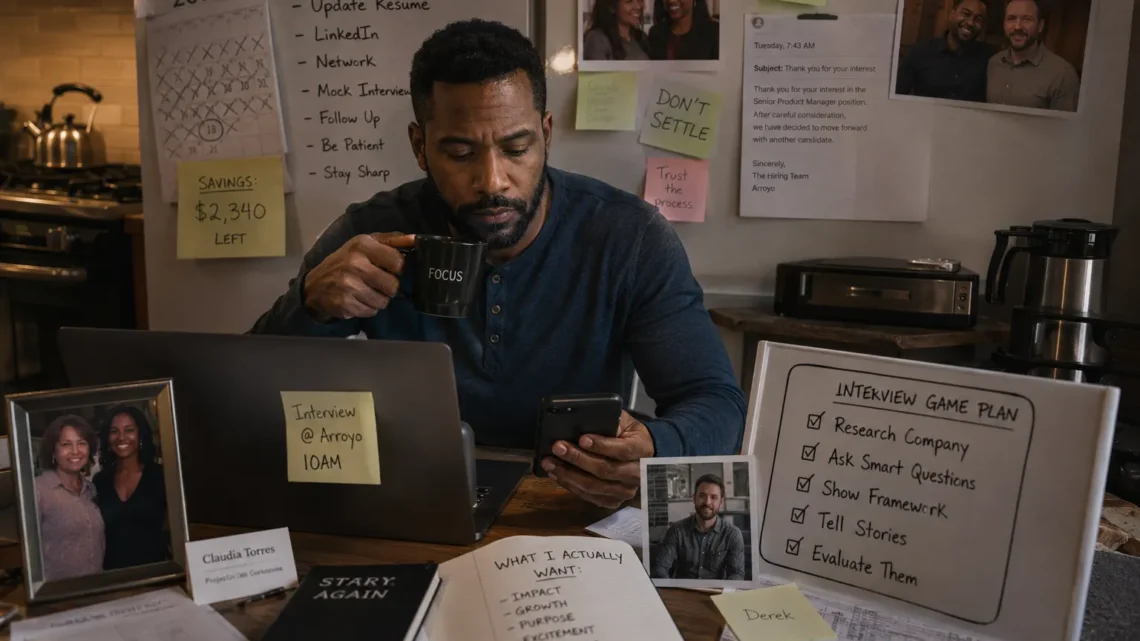
What Nobody Tells You About Looking for Work
The rejection came at 7:43 on a Tuesday morning.
I know the exact time because I had been staring at my phone since 6:15, refreshing my inbox like a man waiting for a verdict. Three rounds of interviews.
Trending Now!!:
Two months of follow-up emails written with the careful politeness of someone who had been told since childhood that desperation is the ugliest thing you can show a stranger. A final conversation with the hiring manager that ended with the words, “We’ll be in touch very soon.”
They were in touch. Very soon turned out to be eleven days.
“Thank you for your interest in the Senior Product Manager position. After careful consideration, we have decided to move forward with another candidate.”
I put my phone face-down on the kitchen counter and made coffee I did not drink.




This was 2014. I was thirty-one years old, seven months unemployed, and living in a one-bedroom apartment in Chicago where the radiator knocked every night like a polite ghost.
My savings account had exactly $2,340 left in it. I had a master’s degree in business administration, four years of mid-level marketing experience, and a LinkedIn profile I had rewritten so many times it no longer sounded like me. It sounded like a job posting for a version of me that was more confident, more accomplished, and, above all, more hireable.
The job search had started with optimism. It always does.
Back in January, when I first handed in my resignation from a company that was quietly collapsing, I had told my older sister Renee that I was going to use the time wisely. Polish the resume. Build my personal brand. Network strategically.
She had looked at me the way older sisters look at you when they already know what is going to happen, and said, “Make sure you have a backup plan, Marcus.”
I told her I was the backup plan.
Seven months later, I was eating cereal for dinner and Googling things like “how to explain a career gap in a job interview” at 1 a.m.
The modern job search is a strange and quietly bruising experience. You upload your resume to an applicant tracking system that has been designed, it seems, to make human beings feel like failed search queries. You tailor your cover letter to each role, following the advice of every career coach on the internet, and then you send it into a silence so complete you start to wonder if the email even landed.
You network, which means you reach out to people you haven’t spoken to in years and try to make it sound casual, which it never is. You research salary ranges and practice behavioral interview questions in the mirror, answering prompts like “Tell me about a time you demonstrated leadership under pressure” to your own reflection like a man going slightly mad.
My former colleague Derek called me one afternoon around month four. He had survived the layoffs at our old company, and he called the way survivors sometimes call, carrying a low frequency of guilt.
“How’s the search going?” he asked.
“Good,” I said. “Progressing.”
“You lying to me right now?”
I laughed. “Absolutely.”
He told me about a recruiter he knew, a woman named Claudia Torres who specialized in placing mid-career professionals in tech-adjacent marketing roles. He said she was sharp, no-nonsense, and actually returned calls, which he framed as a near-miraculous quality in the staffing industry. I wrote her name down on the back of an electricity bill and called her the next morning.
She picked up on the second ring.
“Marcus,” she said, like she already knew me. “Derek told me you might call. Send me your resume today, not tomorrow, and be honest with me about what you actually want. Not what you think I want to hear. What you want.”
No one in the entire job search process had asked me that question.
I sent the resume. Then I sat down and wrote her a separate email, outside the formal application, and I told her what I actually wanted.
I wanted to work somewhere that made something real. I wanted a role where I could see the effect of my decisions within a quarter, not three years down the line. I wanted to stop feeling like a tiny, replaceable component in a machine I didn’t understand. I wanted, if I was being completely honest, to feel like I was good at something again.
She called me back within an hour.
“Okay,” she said. “I think I have something. But I want you to go in differently this time.”
I asked her what she meant.
“You’ve been interviewing like someone who needs a job,” she said. “Which, I understand, you do. But the second they sense that energy, you lose. You need to interview like someone who is evaluating them as much as they’re evaluating you. Ask harder questions. Show them you have a framework, not just experience. And for the love of everything, update your LinkedIn headline. You sound like a human resource form.”
I updated the headline that night. Then I practiced. Not in the mirror this time. I asked Renee to run mock interviews with me at her kitchen table, and she was ruthless in the most loving way possible, stopping me mid-sentence to say, “That answer is too long and it doesn’t actually say anything. Start again.”
I started again. Many times.
The role Claudia had found was a Growth Marketing Lead position at a mid-sized SaaS company called Arroyo. It was not the prestige-brand name I had been chasing for seven months. It was not the corner office fantasy I had built in my head somewhere around month two. It was a thirty-person company in a converted warehouse space, and they made project management software for construction firms.
I almost passed on it.
“Don’t,” Claudia said flatly when I hesitated. “You told me you wanted to see the impact of your work. A thirty-person company will show you that inside a month. Stop being precious about the brand name. The brand name doesn’t pay your rent.”
The interview at Arroyo was unlike any I had been through. The CEO, a compact and direct woman named Priya Shen, met me in a glass-walled conference room with two cans of sparkling water and no notepad. She didn’t ask me where I saw myself in five years. She pulled up a chart of their user acquisition metrics on a laptop and slid it across the table.
“We’re stalling here,” she said, tapping the screen. “Tell me what you see and what you’d do about it.”
My hands were steady. My voice was calm. Seven months of rejection had, without my fully realizing it, burned away every unnecessary layer. I looked at the chart. I asked her three questions about their current content strategy, their email retention flows, and whether they had segmented their free trial users by industry. Then I talked for eleven minutes.
She hired me two days later.
The salary was $18,000 more than my last role. There was an equity package that, at the time, I did not fully understand the value of.
I understood it four years later when Arroyo was acquired.
I think about that Tuesday morning sometimes, the rejected email, the face-down phone, the undrunk coffee. I think about the version of me that came very close to lowering every standard, accepting the first miserable offer that came through just to stop the silence.
What kept me from doing that was not patience or wisdom. It was Claudia asking me one question I hadn’t been asked before, and Renee telling me, again and again at her kitchen table, to start again.
The job search will make you doubt the version of yourself that exists when no one is watching. It will make you wonder if your skills are real, if your experience translates, if the gap on your resume is a wound that will never close. It will send you automated rejection emails at 7:43 in the morning while you are still in yesterday’s clothes.
None of that means what you think it means.
What you are looking for is also looking for you. Sometimes it is just waiting for you to stop performing and start being honest about what you actually want. Start there. The rest has a way of following.