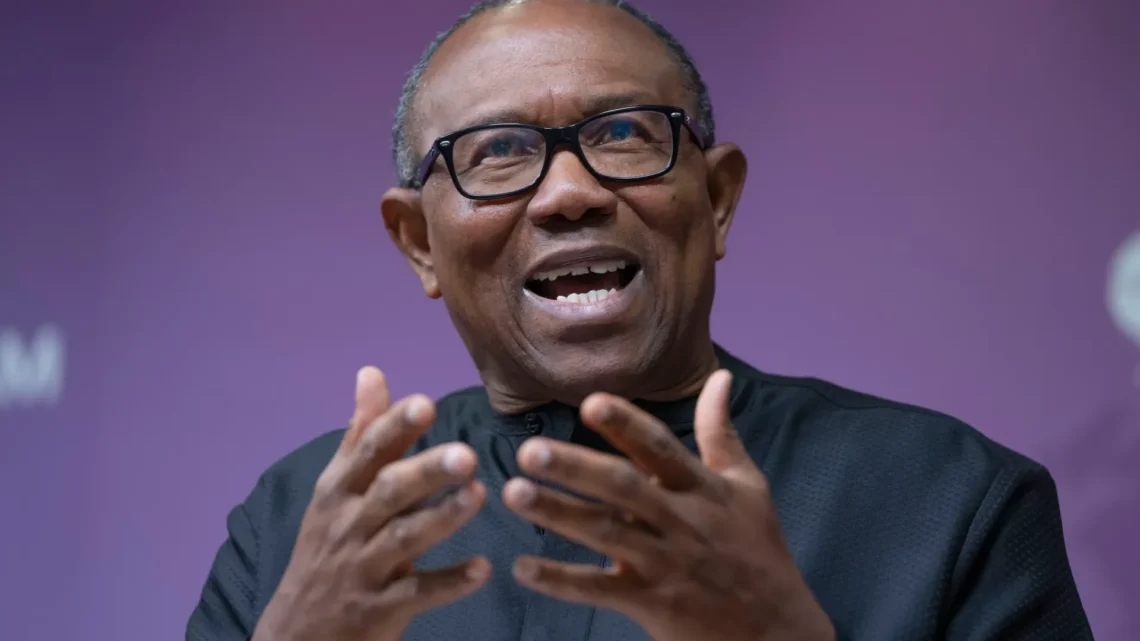
Is Peter Obi Really the Solution to Nigeria’s Problems? Can He Make Nigeria Any Better?
In the lead-up to Nigeria’s February 2023 presidential election, something happened that the country had not quite seen before.
Hundreds of thousands of young Nigerians, most of them first-time voters, poured into the streets, filled stadiums, and flooded social media with a singular conviction: that a 61-year-old Anambra businessman named Peter Gregory Obi was different.
Trending Now!!:
That he was the one. That he was the answer. They called themselves the “Obidient” movement, and for a stretch of months, they made the rest of the world believe it too. Foreign press covered the rallies. Economists retweeted his budget breakdowns. Diaspora Nigerians in London, Houston, and Toronto sent money home for the cause. For a brief, intoxicating moment, Nigerian politics felt like it was being rewritten from the ground up.
Then the results came in.
Peter Obi finished third. The Independent National Electoral Commission declared Bola Ahmed Tinubu of the All Progressives Congress the winner. Obi and the Labour Party disputed the results in court and lost. The Supreme Court upheld Tinubu’s victory in October 2023. The movement grieved, regrouped, and then largely waited.
Now, with Nigeria’s next general election on the horizon and the Tinubu administration presiding over one of the most economically painful periods in recent Nigerian memory, the question has returned with new urgency, carrying with it a fresh layer of complexity: Is Peter Obi actually the solution Nigeria needs, or is he a very effective political brand wrapped around a man who cannot seem to stay in one place long enough to build anything durable?
To understand why Obi commands the loyalty he does, you have to start with the numbers he himself has spent years presenting. As Governor of Anambra State from 2006 to 2014, he handed his successor, Willie Obiano, a reported 75 billion naira in savings and investments, a figure that became the cornerstone of his national reputation.
His administration paid off Anambra’s domestic debt, settled backlog salaries, and invested meaningfully in primary education and healthcare infrastructure. He is known, almost obsessively, for frugality. Stories of him flying economy class, carrying his own luggage, and rejecting the extravagant perks that Nigerian governors traditionally claim circulate endlessly among his supporters.
He made fiscal discipline his entire personality before fiscal discipline was fashionable in Nigerian politics. His campaign message in 2023, “moving Nigeria from consumption to production,” resonated because it named something real.
Nigeria imports toothpicks. Nigeria imports tomato paste. Nigeria has 82 million hectares of arable land and still spends billions of dollars annually on food imports. When Obi stood in front of a crowd and said that needed to change, nobody in the audience disagreed with the diagnosis.
The problem with Peter Obi’s political mythology, however, is that it rests almost entirely on his Anambra governorship, and that record, while genuinely impressive in parts, is more complicated than the campaign version of it. Anambra is a small, oil-poor state with a population of roughly five to six million people and a functioning commercial culture built largely by its Igbo business class, a tradition of civic engagement that predates any single governor.
Critics, including some Anambra residents who lived through his tenure, point out that the state’s infrastructure remained largely underdeveloped. The roads were bad. Awka, the state capital, continued to struggle with basic urban planning. The education record was better, but Anambra’s schools also benefited from a pre-existing culture of community investment that Obi himself did not create.
None of this is to dismiss what he achieved. Saving government money in Nigeria, where nearly every public office is treated as a feeding trough, is itself a radical act. But governing Anambra for eight years and governing the Federal Republic of Nigeria are not remotely the same task, and the comparison collapses under its own weight.
Then there is the party question, and this is where the Obi story takes a turn that his most passionate supporters tend to gloss over at their peril. His political journey across parties is, at this point, difficult to describe as anything other than restless. He served as governor under the All Progressives Grand Alliance. He moved to the Peoples Democratic Party.
He was Atiku Abubakar’s running mate on the PDP ticket in the 2019 presidential election. He abandoned the PDP and reinvented himself as the Labour Party’s candidate in 2023, positioning that move as a clean break from the old guard.
After the 2023 defeat, he eventually left the Labour Party and in December 2025 formally defected to the African Democratic Congress, joining a coalition that included former Vice President Atiku Abubakar, former Kaduna Governor Nasir El-Rufai, and former Rivers State Governor Rotimi Amaechi. The ADC was adopted as the opposition’s platform of choice to challenge Tinubu in 2027, after earlier delays in registering an entirely new party called the All Democratic Alliance.
The ADC coalition, however, did not hold. The race for the party’s presidential ticket quickly narrowed to a contest between Obi and Atiku, with supporters of both men engaging in increasingly intemperate agitation and threatening to either withhold support from, or actively work against, the party should their preferred candidate not secure the nomination.
Even before the dust settled, the ADC’s own 2023 presidential candidate, Dumebi Kachikwu, publicly claimed that Obi was already planning an exit, arguing that the party’s internal machinery was being positioned in favour of Atiku’s presidential ambitions. He was not wrong.
In early May 2026, Obi announced his exit from the ADC, citing internal disputes, ongoing court cases, and division within the party that he said were affecting its ability to focus on national matters. On the same day he dumped the ADC, he formally joined the Nigeria Democratic Congress, alongside former Kano Governor Rabiu Musa Kwankwaso, who had similarly exited the New Nigeria Peoples Party amid leadership disputes within that party.
The two were received at the NDC’s national secretariat in Abuja by the party’s national leader, former Bayelsa Governor Henry Seriake Dickson, and National Chairman Moses Cleopas. Sources familiar with the arrangement said Obi and Kwankwaso joined the NDC on the understanding that they would contest the 2027 election on a joint ticket, with Obi as presidential candidate and Kwankwaso as vice-presidential candidate.
The NDC chapter of this story moved quickly. The party concluded the sale of its Expression of Interest and Nomination Forms for the 2027 presidential ticket, with Obi reportedly emerging as the only aspirant to purchase the forms before the deadline closed on May 17, 2026. The NDC has since announced him as its consensus presidential standard bearer, hinting at his candidacy via its official social media platforms.
The screening process for aspirants was set to begin on May 19, 2026, and run until May 26, assessing candidates on competence, character, grassroots appeal, and adherence to the party’s zoning and affirmative action considerations. For a man who framed his 2023 run as a rejection of the political establishment’s way of doing business, the irony of being the sole name on a nomination list is not lost on his critics.
The APC presidency has already moved to paint the picture exactly as his opponents would prefer. The party’s National Publicity Secretary, Felix Morka, publicly questioned Obi’s pattern of political affiliations ahead of 2027, referencing his past associations with the All Progressives Grand Alliance, the Peoples Democratic Party, the Labour Party, the ADC, and now the NDC, arguing that political stability requires sustained commitment to party structures and that constant movement undermines internal party consolidation. It is a criticism that lands differently depending on who is asking it, but it cannot be entirely dismissed.
To be fair to Obi, Nigeria’s party system is not a clean vehicle for principled candidates. Parties are largely personal fiefdoms controlled by godfathers with money and muscle. The Labour Party that he ran with in 2023 had no real national structure, and the ADC that he entered in December 2025 immediately descended into exactly the kind of power struggle that has paralysed every major opposition party ahead of 2027.
His decision to exit situations where he was being manoeuvred into irrelevance or subordination is, in isolation, understandable. But by his fifth political party in a career spanning roughly two decades, the cumulative effect of all this movement raises a question worth sitting with: can Peter Obi build and sustain institutional loyalty from others if he has never demonstrated it himself for any sustained period?
There is also the structural reality about Nigerian politics that idealism tends to skip over. You cannot govern without building. You need alliances, legislative relationships, executive capacity, and a national network of people who can implement policy beyond the walls of Aso Rock.
Obi has none of that at the federal level, and the NDC is even younger and more organizationally fragile than the Labour Party was in 2023. If he were to win the presidency, he would walk into Aso Rock without a working coalition in the National Assembly, without governors in key states, and without the political debts and relationships that allow a president to move legislation, manage regional tensions, and survive. The “Obidient” movement is emotionally powerful. It is not a substitute for political infrastructure.
Nigeria does not discuss ethnicity cleanly, but it is woven into every political calculation the country makes. Peter Obi is Igbo, and the South-East geopolitical zone has not produced a Nigerian president or head of state since the end of the civil war in 1970. The informal rotation of power that has governed the country’s politics, imperfect and largely unwritten as it is, has consistently excluded that zone from the presidency.
Whether that changes depends on more than Obi’s merits. It depends on whether enough Nigerians from the North, the South-West, and the Middle Belt are willing to vote across ethnic and regional lines in sufficient numbers. In 2023, many were not. A Kwankwaso running mate is a deliberate attempt to address that northern calculus, but whether it is enough remains the open question that only a ballot box can answer.
With all of that said, Peter Obi is raising the correct questions at the right moment. Under President Tinubu, Nigeria removed the petrol subsidy in May 2023, and the naira has been devalued so severely that the exchange rate has moved from roughly 460 naira to the dollar in early 2023 to well above 1,500 naira at various points since. Inflation peaked at levels not seen in decades. Food prices became a crisis. The Nigerian middle class has been functionally dismantled.
In that context, Obi’s insistence on plugging fiscal leakages, reducing the cost of governance, and funding education and agriculture is not idealistic noise. It is an agenda that addresses root causes rather than symptoms. Whether he can execute it is the open question. But the fact that he is asking the right questions separates him from a political class that has spent decades not asking them at all.
The honest answer to whether Peter Obi can solve Nigeria’s problems is: we do not know, and neither does he. Nigeria’s problems are structural. They predate every politician currently alive. The country has 200 million people, a federal character that makes coherent policy implementation exceptionally difficult, a security situation that has metastasized from Boko Haram in the North-East to banditry across the North-West to separatist agitation in the South-East, and a history of military rule that stunted institutional development across generations. No single president, however gifted, fixes all of that in four years or even eight.
What a Peter Obi presidency could plausibly do is change the culture of the office. Reduce waste. Redirect public spending toward productive investment. Restore a degree of confidence, domestically and internationally, in Nigerian governance. Those are not small things.
But whether he can overcome institutional inertia, legislative opposition, the ethnic arithmetic, his own reputation for political wandering, and the sheer scale of Nigerian dysfunction is a question that his governorship in Anambra, and his journey through five political parties, cannot fully answer.
Peter Obi represents a genuine opportunity, and he may yet prove to be the disruption that Nigeria needs. But at some point, the man who keeps asking Nigeria to trust him will need to demonstrate that he can trust a party long enough to build one.
That is not a small ask. And in Nigeria, it may be the difference between a movement and a presidency.