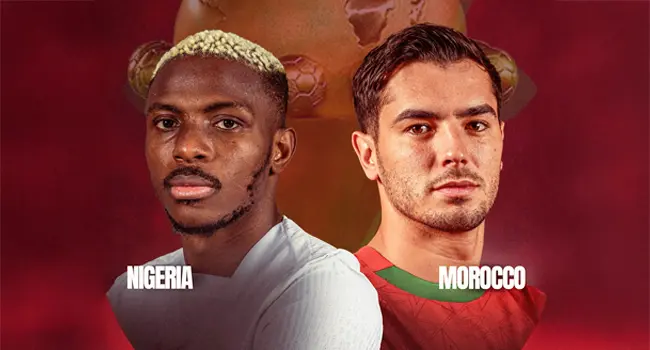
Two Powers, One Ticket: Nigeria and Morocco Battle for AFCON Final Ticket
On Wednesday night in Rabat, under the floodlights of the Prince Moulay Abdellah Stadium, African football will pause for a contest that feels less like a semi-final and more like a final brought forward. Nigeria and Morocco, two of the continent’s most storied and formidable teams, meet with history, pride, and a place in the Africa Cup of Nations final at stake.
Kickoff is at 9:00 p.m. local time, and the setting could hardly be more charged. Morocco is hosting the tournament, which has unfolded across nine venues in six cities since December 21, and they arrive buoyed by home support that has grown louder and more confident with every round.
Trending Now!!:
Nigeria, meanwhile, comes carrying the authority of perfection. Five matches, five victories, fourteen goals scored, none lost. No team in this competition has been as ruthless or as assured.
For many supporters and analysts, this match is the tournament’s true summit, a meeting of Africa’s most complete side and its most in-form one.
Nigeria, three-time champions, are seeking to return to the final for the ninth time in their history. Their path to the semi-final was sealed with a composed 2–0 victory over Algeria in Marrakech, where Victor Osimhen opened the scoring, and Akor Adams delivered the late assurance.
Under Eric Chelle, the Super Eagles have blended defensive discipline with relentless attacking intent. Osimhen, with four goals, has led the line with power and precision, while Ademola Lookman has emerged as the tournament’s most influential all-around attacker, directly involved in seven goals through a mix of scoring and creativity.
There is an edge of redemption to Nigeria’s run. Having failed to qualify for the 2026 World Cup, this tournament has become a statement of resilience and renewal. Each victory has carried the tone of a team determined to reassert its place at the summit of African football.
Morocco’s story is equally stirring, alive with a sense of unfulfilled destiny. Ranked top in Africa and riding the euphoric afterglow of their historic World Cup run, they hunger for a prize denied for generations: a second Africa Cup of Nations crown to finally end a fifty-year drought.
They have moved through the tournament with measured authority. Unbeaten in five matches, they dispatched Cameroon 2–0 in the quarter-final, guided once again by the brilliance of Brahim Díaz. The Real Madrid forward has been the competition’s most consistent star, scoring in every match and leading the goal charts with five. Around him, Ayoub El Kaabi has provided spectacular finishes, while a disciplined defense has conceded just once and kept four clean sheets.
Under Walid Regragui, Morocco has forged a style steeled by unwavering belief and resolve. They do not simply defeat opponents; they smother them, biding their time until hope drains and opportunity blazes. As home supporters roar and history leans in, a sense of destiny pulses through every match.
The rivalry between Nigeria and Morocco deepens the drama. Their competitive meetings stretch back to 1976, when Morocco defeated Nigeria twice en route to their only continental title. Nigeria answered in 1980, edging Morocco 1–0 in the semi-final en route to lifting their first Africa Cup of Nations trophy.
Since then, their encounters have been infrequent but decisive. All five of their previous AFCON meetings produced winners, with Morocco holding a narrow 3–2 advantage. The last came in 2004, a 1–0 Moroccan victory. Twenty-two years later, the rivalry is renewed on a far grander stage.
Team news adds to the uncertainty at an already volatile occasion. Nigeria will be without their captain, Wilfred Ndidi, who is suspended after accumulating yellow cards. His absence removes a pillar of stability from midfield and places greater responsibility on players such as Frank Onyeka, Alex Iwobi, and Moses Simon to control the tempo. Yet Nigeria’s attacking trident of Lookman, Osimhen, and Samuel Chukwueze remains among the most feared in the tournament.
Morocco, too, carries concerns. Azzedine Ounahi is sidelined with injury, and Romain Saïss is doubtful. Still, the spine of the team remains intact: Yassine Bounou in goal, Achraf Hakimi surging from right back, and Sofyan Amrabat anchoring midfield. In attack, Brahim Díaz stands as the match’s potential difference-maker, the player most capable of bending a game to his will in a single moment.
The reward for victory is a place in Sunday’s final against either Senegal or Egypt, who meet earlier in Tangier. For Nigeria, it would mark a return to the summit of African football and a chance to claim a fourth continental crown. For Morocco, it would keep alive the dream of lifting the trophy on home soil, ending a fifty-year wait, and sealing a golden chapter in their modern football history.
This is more than a game of tactics or skill. It’s a collision of dreams and legacy, a battle of Nigeria’s relentless restoration versus Morocco’s passion to fulfill a nation’s yearning. One arrives bearing the charge of perfection. The other feels the heartbeat of history and the wild promise of glory at home.
By night’s end in Rabat, one will step from the fire, hope still blazing, one stride away from immortality.