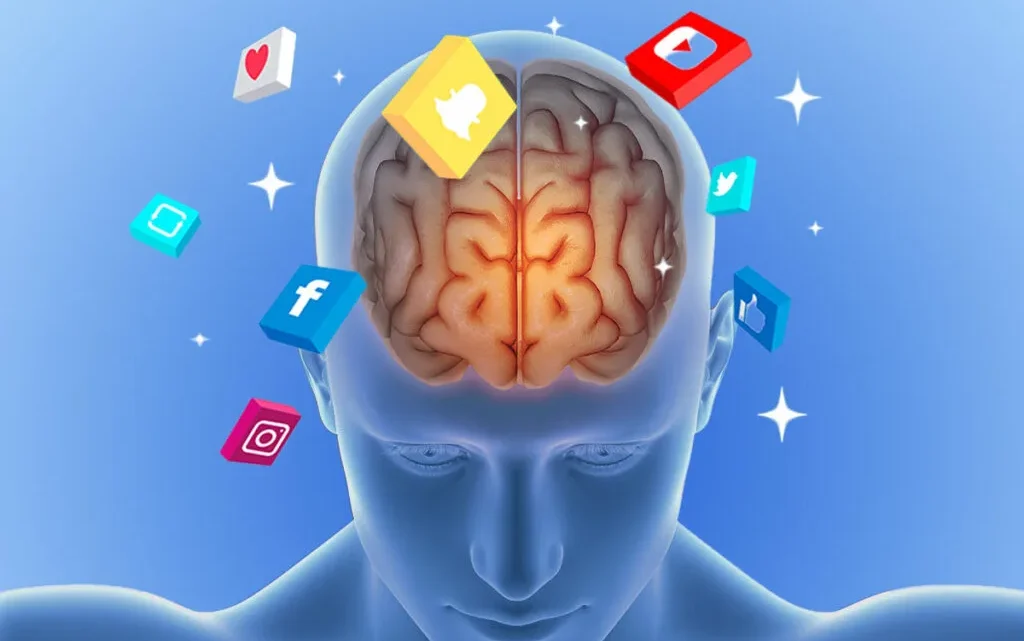
Dopamine and Social Media: What the Neuroscience Says
The reward system behind compulsive scrolling tracks anticipation rather than pleasure, and the research on what that means for the brain is far less settled than the headlines suggest.
Dopamine does not make social media feel good so much as make it feel worth checking.
The neurotransmitter drives anticipation and motivation, spiking when rewards are uncertain, such as unpredictable likes or notifications. Platforms exploit this prediction mechanism, which explains compulsive checking, though researchers dispute whether this amounts to true addiction.
Trending Now!!:
The popular version of the story is simpler and less accurate. Social media is described as a dopamine hit, a chemical jackpot that hijacks the brain.
The laboratory evidence points somewhere more specific: dopamine tracks the gap between what a person expects and what arrives, and the modern feed is engineered to keep that gap permanently open.
What Dopamine Actually Tracks
The foundational work came from Wolfram Schultz, whose recordings of dopamine neurons in monkeys showed that the cells did not simply fire in response to rewards.
They fired in response to surprises. An unexpected reward produced a burst, a fully predicted reward produced almost none, and a reward that failed to arrive produced a dip below baseline. Neuroscientists call this the reward prediction error.



Applied to a smartphone, the implication is direct. The buzz of a notification is not rewarding in itself. The uncertainty before opening the app is what carries the signal: the brain has learned that checking sometimes pays off, and it cannot know in advance whether this time will be one of them. Pull-to-refresh, with its brief pause before new content appears, compresses that uncertainty into a single gesture.
Wanting Is Not Liking
One of the most useful distinctions in this field comes from Kent Berridge, whose research separates “wanting” from “liking”. Wanting, which he terms incentive salience, is the motivational pull toward a cue. Liking is the pleasure experienced on receipt. The two systems overlap but run on different circuitry, and dopamine is far more closely tied to the first.
This explains a familiar and slightly embarrassing experience: scrolling for an hour without enjoying any of it. The motivational system keeps pushing while the pleasure system has long since stopped contributing. Heavy users frequently report exactly this mismatch, describing a feed they feel compelled to open but do not especially like.
Variable Rewards and the Slot Machine Comparison
B.F. Skinner established decades ago that variable-ratio schedules, where rewards arrive after an unpredictable number of responses, produce the most persistent behavior.
Slot machines run on this principle. Feeds share its structure: most refreshes deliver forgettable content, and an occasional one delivers something striking, a message from a person of interest, a post that has gone viral, a surge of likes.
The comparison has limits. Slot machines involve money and a defined loss, while feeds involve attention and social information, which the brain evolved to prioritize.
The social element may in fact be the stronger hook. Humans are acutely sensitive to signals about status and acceptance, and a feed delivers those signals in a quantified, public form.
What Brain Imaging Shows
A frequently cited study from Lauren Sherman and colleagues at UCLA scanned adolescents as they viewed photos in a simulated social feed.
Images carrying more likes drew greater activity in the nucleus accumbens, a core reward region, and teenagers were more likely to like photos that already had many likes. Peer approval, in other words, registered in the same circuitry that responds to other rewards, and it shaped behavior.
Related work by Diana Tamir and Jason Mitchell found that disclosing information about oneself activates reward regions, which offers a neural reason why sharing personal updates feels compelling in the first place. The findings fit together: posting, receiving feedback, and checking for feedback each engage motivational circuitry.
A caution applies to all of this research. Brain imaging shows correlation between activity and behavior in a scanner, usually in small samples. It does not demonstrate that social media rewires the brain or causes dependence.
Common Misconceptions
The most persistent error is treating dopamine as the pleasure chemical. Pleasure involves opioid and endocannabinoid systems, among others. Dopamine is better described as a learning and motivation signal, which is why its role in compulsive behavior is real but frequently overstated in headlines.
A second error concerns the “dopamine detox” trend. The technique was popularized by the psychologist Cameron Sepah as a behavioral method for reducing impulsive habits, and he did not intend it as a literal claim about draining a neurotransmitter.
Dopamine cannot be fasted away. What a break from the phone actually changes is the learned association between cues and checking, which is a behavioral effect, not a chemical reset.
The third concerns the word “addiction.” Neither clinical manual in wide use recognizes social media addiction as a diagnosis.
The World Health Organization’s ICD-11 includes gaming disorder, and the American DSM-5 lists internet gaming disorder as a condition requiring further study. Problematic social media use is an active research area, not a settled diagnosis.
The Counterargument Researchers Take Seriously
Large population studies complicate the alarm. Amy Orben and Andrew Przybylski analyzed several large datasets and found that the association between digital technology use and adolescent wellbeing was very small, comparable in magnitude to the association with eating potatoes.
Their work does not prove harmlessness, and critics argue that averages can hide serious harm in vulnerable subgroups. It does show that sweeping claims about a generation’s brains outrun the evidence.
The most defensible reading is that effects are heterogeneous. Individuals with high impulsivity, attention difficulties, or existing anxiety appear more susceptible, and adolescents face particular exposure because the prefrontal circuits that regulate impulse control are still maturing into the mid-twenties. Average effects may be small while the effect on some individuals is large.
What the Intervention Evidence Suggests
Experimental work offers more practical guidance than correlational scans. A study led by Melissa Hunt at the University of Pennsylvania randomly assigned students to limit Facebook, Instagram, and Snapchat to about thirty minutes a day.
Over three weeks, the limited group reported reductions in loneliness and depression compared with a control group, with the benefits concentrated among those who were more depressed at the start.
Applying the neuroscience, a useful way to think about managing the pull is a three-lever framework covering cues, uncertainty, and friction. Cues are the notifications and badges that trigger anticipation, and most nonessential ones can be switched off.
Uncertainty is the variable payoff, which checking in scheduled batches rather than on impulse partly removes. Friction is the effort required to open an app: logging out, moving icons off the home screen, or using grayscale display all add small delays that give the slower, deliberate part of the brain time to intervene.
Each lever targets a different part of the prediction-and-reward loop, which is why combining them tends to work better than willpower alone.
Design, Regulation, and Accountability
The design choices behind these mechanisms have drawn public scrutiny. Early executives from major platforms have publicly acknowledged that engagement features were built with human psychology in mind, and the U.S. Surgeon General, Vivek Murthy, issued an advisory in 2023 calling for more research and safeguards for young users.
Australia has legislated a minimum age of 16 for social media accounts, and several platforms introduced options to hide like counts after internal and external debate about social comparison.
Whether these measures change outcomes remains an open empirical question. Product changes that reduce visible metrics may blunt the social reward signal, but the underlying loop of uncertainty, anticipation, and variable payoff is intrinsic to any feed that ranks content by predicted engagement.
What Remains Unknown
Several questions are unresolved: whether heavy use causes dysregulated reward processing or whether people with that tendency use more, how long any change persists after reducing use, and which design features matter most. Longitudinal studies that follow individuals for years, paired with imaging, are beginning to address these gaps, but they are expensive and slow.
For now, the evidence supports a measured position. Dopamine is central to why feeds are hard to put down, the mechanism is real and well characterized, and the clinical picture is more nuanced than the word “addiction” implies.
Reducing cues, removing unpredictability, and adding friction offer a practical response grounded in how the reward system actually works.
What People Ask