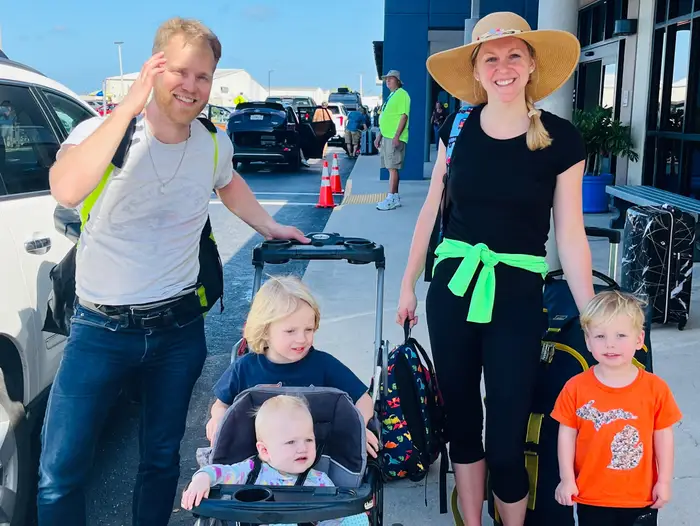
How to Travel With Children Under 5 Without Dreading the Trip
Most parents don't fail at family travel because they lack patience. They fail because nobody warned them what it actually looks like.
There is a photograph somewhere on the internet, probably on a travel blogger’s Instagram, of a toddler sleeping peacefully in a window seat at 35,000 feet, a soft blanket tucked under a cherubic chin, golden light pouring in from the clouds below.
That photograph is a lie. Not technically, but practically. Because for every one of those moments, there are 47 minutes of negotiating why the tray table must stay up, a juice box explosion on a stranger’s white linen shirt, and a meltdown so loud the flight attendant offers you a drink you didn’t order.
Trending Now!!:
Traveling with children under 5 is one of the most logistically demanding things a parent can do. It is also, when done with any degree of preparation, one of the most rewarding.
The parents who dread it the most are usually the ones who walked in with the wrong expectations. The ones who come out the other side with good stories, good photos, and children who are surprisingly adaptable, those parents had a plan. Not a perfect plan, a real one.
After years of navigating airports with diaper bags, surviving cross-country road trips with a car full of snacks and a toddler who has decided, with absolute conviction, that she hates her car seat today, and figuring out international travel with a child who still needs naps, there are things you learn that no parenting book fully captures. This is an attempt to give you those things.
The Biggest Mistake Parents Make Before the Trip Even Starts
Most parents spend their pre-trip energy on packing. What they should spend it on is expectation-setting, both for themselves and for the child.
A two-year-old does not understand that you have been planning this vacation for six months. She does not understand that this hotel costs a fortune, that this flight was the cheapest option, or that everyone in the family needed a break.
What she understands is that her routine has been upended, the environment is loud and unfamiliar, and nobody is letting her touch the interesting things. Understanding that her behavior is a response to disruption, not defiance, changes everything about how you travel.
Set your own expectations honestly. A family trip with a child under 5 is not a vacation in the traditional sense of the word. It is a trip. It may contain moments of genuine joy and beauty. It will also contain inconvenience, exhaustion, and at least one scene in a public place that you will find funny in exactly three years.
The parents who enjoy these trips the most are those who stopped trying to have the vacation they had before children and fully committed to the one they have now.
Choosing the Right Destination
Not every destination is a good fit for toddlers, and pretending otherwise is how you end up crying at a cobblestone street in a European city because your stroller wheels are jammed and your child has refused to walk for forty minutes.
The best family vacation destinations for young children share a few traits: manageable transit times, outdoor or open spaces where kids can move freely, access to familiar food options alongside new ones, and accommodation that doesn’t punish you for being a parent.
Beaches, national parks, lake towns, and cities with strong family tourism infrastructure tend to work well. Highly curated, museum-heavy, or nightlife-oriented cities work less well, unless you are willing to restructure your entire itinerary around nap times and early dinners.
For first-time family travelers with a child under 3, a domestic destination with a drive or short flight is almost always the right move. Save the long-haul international travel for when the child is a little older, and you have a trip or two under your belt.
That said, international travel with toddlers is absolutely possible, and some families find it surprisingly manageable. The key is choosing the right destination. Countries with strong family travel culture, like Japan, Portugal, and much of Scandinavia, make it easier. Places with poor infrastructure, extreme heat, or limited access to pediatric care require more preparation and a higher tolerance for the unexpected.
Flying With Toddlers: What the Airline Doesn’t Tell You
Flying with a toddler is its own discipline. Every parent who has done it more than once has a system, and that system was built on at least one flight that did not go well.
Book your seats intentionally. The window seat is almost universally preferred by experienced traveling parents with young children. It gives you a wall to lean against during naps, room for the child to look out during takeoff and landing, and a natural buffer from other passengers.
If you are two adults traveling with one toddler, book the window and aisle in the same row. The middle seat will likely stay empty on a full flight because it is the last seat anyone wants. If someone does take it, they will almost always swap with you.
Do not board early just because the airline invites you to do so. It sounds counterintuitive, but every extra minute you spend on a parked plane is a minute you are using up your child’s patience before the flight has even started.
Let everyone else board. Gate-check the stroller. Walk the child around the terminal until the last possible moment. Let them run. Burn off as much energy as possible before they are expected to sit still.
On ear pressure, which is one of the most common and most fixable sources of distress for young flyers: toddlers cannot chew gum, so the approach is to give them something to suck or chew during takeoff and landing.
A pacifier works well for younger children. A snack that requires sustained chewing or sucking is a reliable option. Timing a feed for infants during ascent and descent helps equalize pressure naturally. Formula, breast milk, and baby food are allowed through TSA security in quantities over 3.4 ounces and do not need to fit inside a quart-sized bag. Knowing this before you reach the checkpoint saves enormous stress.
Pack a carry-on bag that you can access without standing up. Everything the child might need in the first two hours of flight should be within reach from your seat: snacks, a change of clothes for both of you, wipes, a small comfort toy, and a fully charged tablet loaded with content downloaded offline. Streaming is unreliable at altitude. Downloaded is everything.
On tablets and screens: ignore the parenting guilt entirely on travel days. The rules that apply at home do not apply on an airplane. This is not a character-forming moment. This is a survival exercise.
For any child under 5 on a long-haul flight, pull-ups are worth considering even if the child is fully toilet-trained, because turbulence can keep you seated for extended periods, and toilet queues after meal service can be long. Nobody ever regretted packing pull-ups. Plenty of parents have regretted not doing so.
The Packing Question: What You Actually Need vs. What You Think You Need
Overpacking is the universal disease of parents traveling with young children. The cure is experience, but here is what experience teaches early.
You need a lightweight, compact travel stroller that you are willing to gate-check. You do not need the full-size stroller you love at home. A lightweight compact stroller or a good quality baby carrier is the most functional toddler travel gear combination you can invest in, and a portable potty seat and travel crib make longer trips significantly easier.
You need more snacks than you think. Double what you planned. Then add more. Snacks are the single most reliable behavioral intervention available to a traveling parent. Hunger is behind a remarkable percentage of toddler meltdowns in transit. Varied textures, familiar favorites, and a few special treats reserved only for travel, things the child does not get at home, turn snack time into something exciting rather than just functional.
You need one comfort object, the specific one, the exact stuffed animal or blanket your child cannot sleep without. Photograph it before you travel. If it gets lost, you will want that photograph when you are searching online at midnight in a hotel room.
You do not need every toy in the house. Small, novel items that the child has not seen before work better than familiar toys. A few new sticker books, a magnetic drawing board, and a set of small figures. Novelty buys time. Familiar items quickly lose their entertainment value.
Pack an extra change of clothes for yourself, not just the child. The number of parents who have packed meticulously for their toddler and forgotten to protect themselves from the inevitable spill or blowout is staggering.
Road Trips With Young Children: The Underrated Option
The road trip is undervalued by parents with children under 5. It offers something air travel never can: the ability to stop whenever you need to.
This is not a small thing. The ability to pull over at a rest stop and let a toddler run in circles for twenty minutes is genuinely transformative for the morale of an entire family. You cannot do that on a plane. You cannot do that on a train. But you can do it in a car, and that flexibility covers a lot of the logistical sins that make travel with young children difficult.
The foundational rule of road trips with toddlers is to build in stops you did not think you needed. Every ninety minutes to two hours is a reasonable framework for the under-5 demographic, but your child will tell you when they need to move. Watch for the specific kind of restlessness that precedes a meltdown and get ahead of it. A ten-minute stop at a playground or a wide-open parking lot costs almost nothing in time and buys remarkable goodwill.
Drive during nap time or overnight when possible. Align departure times with your child’s natural sleep schedule. A toddler who sleeps for two hours in the car is a toddler who did not spend two hours demanding things from you at 70 miles per hour.
Car safety for toddlers is non-negotiable and worth mentioning plainly: a rear-facing car seat until the child exceeds the height and weight limits for that position is the safest configuration available. Follow the manufacturer’s guidelines, not the legal minimum, which varies by state and country and frequently lags behind pediatric safety research.
Audiobooks and children’s music playlists are worth building before the trip. Silence and adult conversation are not sustainable for long drives with a young child who is not yet reading independently. A curated playlist that the child knows and loves, heard specifically in the car, builds a kind of Pavlovian association between driving and calm that actually compounds over time.
Managing Sleep and Routine Disruption
Sleep is the thing. When a child under 5 is sleeping adequately, most other problems are manageable. When they are not, almost everything becomes harder.
The combination of jet lag and a toddler’s natural fear of the dark in an unfamiliar room is genuinely difficult. The most effective approach is to replicate the bedtime routine as faithfully as you can, regardless of location.
Same order of events, same time if possible, same comfort object, same white noise if the child uses it at home. The routine is the signal. When the routine happens, the brain associates it with sleep, and that association travels.
When the time zone difference is small, one to two hours, sticking to the home routine adjusted to local time is often the simplest strategy. When the difference is larger, getting into the destination routine as quickly as possible, using natural light during the day and a dark, cool room at night, tends to produce the fastest adjustment.
Do not sacrifice naps at the altar of sightseeing. This is one of the most common and most costly mistakes parents make on family vacations. The afternoon tantrum that ruins a dinner, the evening meltdown that cuts a beach sunset short, the morning that starts at 4 a.m. because a child’s sleep debt has become unmanageable: these are the costs of skipping naps to squeeze in one more activity. They are not worth it. Build the nap in. Schedule around it. Accept it. The vacation will be better.
Eating on the Road: The Picky Eater Problem
Traveling with a toddler who eats twelve foods and twelve foods only, which is most toddlers, requires a strategy.
The most functional approach is a blend of preparation and flexibility. Always carry familiar, non-perishable snacks from home as a baseline. When dining out, look for restaurants that can accommodate simple requests, plain pasta, plain rice, grilled protein, things that most kitchens anywhere in the world can produce. If the accommodation has a kitchen, preparing a few familiar meals provides both comfort and nutritional reliability.
Do not make mealtimes a battleground on travel days. A child who eats imperfectly for a week will not have lasting nutritional harm. A child who associates travel with food-related conflict will associate travel with stress, and that is harder to undo.
Breakfast is often the easiest meal to manage. Most hotels and most destinations handle breakfast in ways that toddlers tolerate well: eggs, bread, fruit, simple foods. Make breakfast the meal where you relax, and work forward from there.
Food markets, buffets, and casual outdoor dining consistently work better with young children than formal restaurants. The noise floor is higher, expectations are lower, there is often room to move, and the variety allows a toddler to eat what they want without the entire table suffering through a sit-down negotiation.
Toddler Tantrums in Transit: The Real Strategy
Every parent who has had a toddler has had a public tantrum. The travel version is simply a public tantrum with an audience that includes people who paid $600 for their seat and would rather be sleeping.
The most important thing to know is that a tantrum in transit is almost always traceable to one of four causes: hunger, fatigue, overstimulation, or a loss of control in an environment where everything feels unpredictable. Identifying which one is driving the behavior is the first step to addressing it.
Prevention is almost always more effective than intervention. The snack strategy mentioned above handles hunger. Sleep management handles fatigue. Building in movement and rest handles overstimulation. And giving a toddler micro-decisions throughout the day, which color cup, which snack first, whether they walk or ride in the stroller right now, addresses the need for control without surrendering the actual decisions that matter.
When a tantrum does happen despite your best efforts, as it will, the advice is simple and also the hardest thing to execute in a public setting: stay calm, get down to their level, acknowledge what they are feeling without capitulating to the behavior, and move through it.
Do not catastrophize. Do not make eye contact with disapproving strangers. The humanity of other travelers is more consistent than you expect. Most people have children or have been around children long enough to know that this moment is temporary.
Family-Friendly Accommodation: What to Look For
The accommodation choice is more consequential with a child under 5 than at any other point in a child’s life, and most parents underestimate it until they are stuck somewhere that was not designed with young families in mind.
Family-friendly hotels are not just hotels that allow children. They are hotels with room configurations that allow for separation between sleeping adults and sleeping children, with blackout curtains or the ability to make a room dark, with enough space for the gear a young child requires, and with a bathroom that accommodates a bath or a practical alternative. Vacation rentals frequently win on these criteria over hotel rooms, and the kitchen access they typically provide is a significant advantage for parents managing a young child’s food needs.
Look for ground-floor or low-floor accommodation. It matters more than you think when you are carrying a sleeping toddler, a stroller, and a diaper bag at 9 p.m. after a long day. Look for proximity to outdoor space. A hotel that opens onto a garden, a park, or a beach gives you somewhere to go during the early morning hours when a toddler is awake and full of energy, and the rest of the adult world has not started yet.
Request a crib or travel cot in advance, not at check-in. Confirm it at check-in anyway. The number of times “we have that on file” has not translated to an actual crib in the room is enough to make confirmation a non-negotiable habit.
The Documents You Cannot Forget
This section is brief and important.
Every child, including lap infants, needs a passport for international travel. Many parents are surprised to learn that an infant who will sit on a parent’s lap for a fourteen-hour flight still requires a full passport. Apply well in advance. Passport processing times fluctuate and have historically caused families to miss trips they had fully planned and paid for.
For domestic travel in the United States, a birth certificate or a copy of one is useful for verifying a child’s age, particularly for lap children under 2. For international travel, ensure all passports are valid and carry any required visas for your specific destination, including for children and infants.
Travel insurance for families with young children is worth taking seriously. Children under 5 are uniquely susceptible to sudden illness, and the cost of a last-minute cancellation or an emergency medical situation abroad without coverage is significant enough that insurance pays for itself in the peace of mind alone.
A Note on Solo Travel With a Child Under 5
Solo parents and parents traveling alone with a young child without another adult present deserve specific acknowledgment, because the logistics are different and the difficulty is genuinely higher.
The window seat advantage applies doubly when you are solo. Pack so that everything you need is accessible with one hand, because your other hand will frequently be occupied.
Ask flight attendants for help without hesitation; it is part of their job, and most do it gladly. Gate-check the stroller so it is waiting when you exit. Use airport family lanes where available. Give yourself more time than you think you need at every transition.
The mental load of solo family travel is real and should be planned for. Traveling with a toddler alone is not twice as hard as traveling with a partner. It is more than that. Budget for moments where you simply need to sit down, and give yourself permission to find those moments without guilt.
The Thing Nobody Says Out Loud
Here is the truth that experienced family travelers know and rarely say in polite company: some trips with children under 5 are not fun while they are happening. They are only fun in retrospect. The moment you stop requiring the trip to be fun while it is occurring, and instead allow it to simply be an experience, the weight of it changes.
Your child will not remember the hotel room, the delayed flight, or the tantrum in the airport food court. What research on early childhood consistently shows is that young children absorb the emotional temperature of an experience more than its content. If you are anxious and tense, the trip feels anxious and tense to them. If you are present, flexible, and occasionally laughing at the chaos, they feel that, too. It transfers.
You will remember everything. Including, eventually, how small their hands were on that trip, how they fell asleep against your shoulder in the window seat, how they saw the ocean for the first time and ran at it like they had been waiting their whole short life for exactly that moment.
Pack the snacks. Book the window seat. Adjust your expectations. Go.