The Hidden Sugar in Foods That Are Marketed as Healthy
Flavored yogurt, granola, plant-based milk, and protein bars routinely carry more added sugar than shoppers expect, and the labeling rules that govern them were never built to warn anyone.
Granola bars, flavoured yoghurt, protein snacks, and salad dressings routinely carry the vocabulary of virtue: natural, organic, low-fat, no high-fructose corn syrup.
Few of those claims say anything about added sugar, and that gap is precisely where food manufacturers have learned to operate.
Trending Now!!:
A product can be genuinely low in fat and still carry more sugar per serving than a can of soda, because United States labelling law regulates what companies must disclose, not what they are barred from adding.
The scale of the problem is well documented. The American Heart Association estimates that the average American consumes roughly 17 teaspoons, or about 68 grams, of added sugar daily, far above its recommended ceiling of 25 grams for women and 36 grams for men. Much of that intake does not come from dessert.
It comes from foods stocked in the “healthy” aisle: granola, flavoured yoghurt, protein bars, plant-based milk, and condiments that read as savoury rather than sweet.
Why “Healthy” Labels Don’t Mean Low Sugar
Regulatory labelling and nutritional reality are two different systems, and few shoppers realize how far apart they can drift. The U.S. Food and Drug Administration requires “Added Sugars” to appear as its own line on the Nutrition Facts panel, a rule that took full effect for most manufacturers by 2021.




Still, it does not cap how much sugar a product marketed as healthy is allowed to contain. A cereal can call itself whole grain and still derive a third of its calories from added sugar. A yogurt can be marketed for probiotics and still contain more sugar per cup than a candy bar of similar weight.
Registered dietitian Kaitlyn Miele, health promotion and wellness team lead at Capital Blue Cross, has put the disconnect plainly: people tend to associate sugar with sweets, “but many foods marketed as healthy, like flavored yogurt or granola, can contain surprising amounts of added sugar.”
That framing captures the core issue. Consumers are not failing to read labels out of laziness. They are reading labels that were never designed to flag this particular risk on the front of the package.
Collin Popp, a dietitian and professor at NYU Langone Health, has raised a related concern about how loose current federal guidance actually is. The FDA’s Dietary Guidelines currently allow up to 10 percent of daily calories from added sugar, roughly 50 grams on a 2,000-calorie diet, a threshold Popp argues is too generous.
He has said he would prefer to see that figure closer to 5 percent, and closer to zero for people managing diabetes or prediabetes. His broader point matters for anyone shopping the healthy aisle: a product can sit well within federal guidelines and still be a meaningfully worse choice than an unsweetened alternative sitting next to it on the shelf.
The Foods Where Sugar Hides Best
Flavored Yogurt
Plain Greek yoghurt is a genuinely strong nutritional choice: high in protein, low in sugar, rich in probiotics. Flavoured versions of the same product frequently undo most of that advantage. Industry sampling has repeatedly found flavoured yoghurts carrying 15 to 20 grams of added sugar per serving, and some fruit-on-the-bottom varieties push higher.
One widely cited black cherry yoghurt example contains 9 grams of added sugar despite carrying zero grams of fat, a combination that looks impressive on a front label built around fat content while quietly ignoring sugar. The fix is mechanical rather than dietary: buy plain, add real fruit, and treat flavour packets as dessert-adjacent rather than breakfast-adjacent.
Granola and “Healthy” Cereal
Granola’s reputation rests on oats, nuts, and the visual language of a farmers’ market. Its manufacturing process tells a different story. Sugar in granola is not incidental; it is functional.
Honey, maple syrup, brown sugar, and corn syrup are used to bind clusters together and produce the crunch consumers associate with quality.
A single ounce of commercial granola, which is a smaller portion than most people pour, can carry up to 11 grams of added sugar, meaning a generous morning bowl can approach or exceed a full day’s recommended intake before any milk or fruit is added.
Plant-Based Milk
Unsweetened almond, oat, and soy milk are reasonable low-sugar choices. The sweetened versions that dominate supermarket shelf space are not. A cup of flavoured almond milk can carry around 7 grams of added sugar, and vanilla or chocolate variants of oat milk often run considerably higher.
Because plant-based milk is frequently purchased on the assumption that it is automatically the lighter option relative to dairy, shoppers routinely skip the label check that a whole-milk carton might have prompted.
Bottled Smoothies and “100%” Juice
Juice presents a particularly stubborn labelling problem, because a bottle can be entirely fruit-derived and still deliver a sugar load closer to soda than to whole fruit, without a gram of it counting as “added.” A cranberry-pomegranate blend marketed around vitamin C and the absence of high-fructose corn syrup has been found to carry 30 grams of sugar per 8-ounce serving, some naturally occurring and some added during processing, a distinction the label does little to clarify for the average shopper.
The nutritional loss is structural rather than just caloric: juicing strips out the fibre that would otherwise slow sugar absorption, so the same sugar content hits the bloodstream faster in liquid form than it would from eating the intact fruit.
Protein and Granola Bars
Protein bars are bought specifically to signal discipline, which makes their sugar content the most underexamined item on this list.
Formulations built around palatability rather than macros can carry 7.5 teaspoons, roughly 30 grams, of added sugar in a single bar, a figure that rivals a full-size chocolate bar. The protein content is real. The sugar content marketed alongside it is often just as real and considerably less discussed.
Condiments and Savoury Sauces
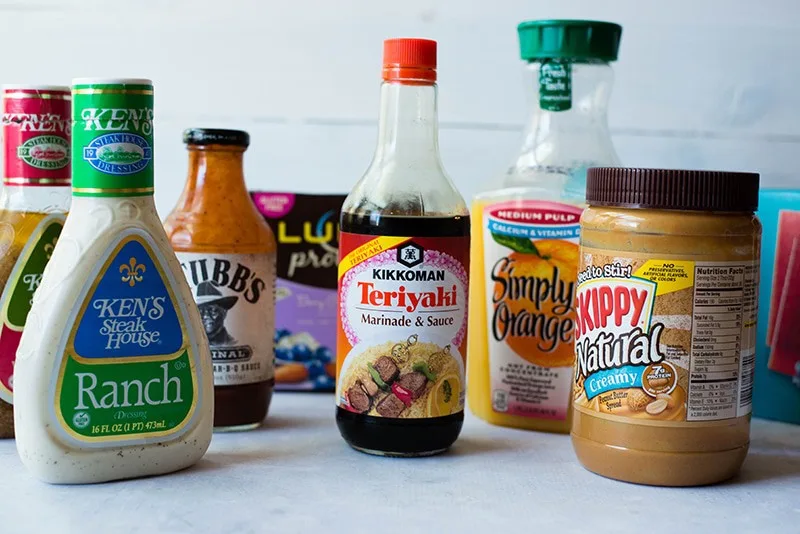
Sugar hides most effectively where a shopper has no reason to look for it. Ketchup, barbecue sauce, jarred pasta sauce, and bottled salad dressings are savoury by taste, which is exactly why their sugar content escapes scrutiny.
A single tablespoon of ketchup carries roughly 4 grams of sugar, and because condiments are used in multiples, not single servings, the cumulative intake from a burger night or a pasta dinner can rival dessert without tasting sweet at any point in the meal.
How Food Companies Make Sugar Harder to See
Three techniques account for most of the disconnect between a product’s health marketing and its actual sugar load.
Sugar splitting. Because ingredients are listed by descending weight, a manufacturer can use three or four different sweeteners, cane sugar, brown rice syrup, honey, and molasses, in smaller individual amounts.
Each one appears lower on the ingredients list than a single larger dose of one sugar would, even though the combined total may be identical or higher. A shopper scanning for “sugar” near the top of the list can miss a product that is, in aggregate, heavily sweetened.
Naming obscurity. Added sugar appears under dozens of names beyond the obvious ones. Cane juice, barley malt, dextrose, maltose, rice syrup, and agave nectar are all sugar in functional terms, but few shoppers recognize them on sight the way they would recognize the word sugar itself.
Selective front-label framing. Front-of-package claims are engineered to draw attention toward one favourable metric, fat, calories, or protein, and away from added sugar. A “low-fat” or “high-protein” claim is accurate and simultaneously irrelevant to the sugar question, yet it functions psychologically as a general health endorsement that discourages further label scrutiny.
What the Sugar Actually Does
The health argument against hidden sugar is not aesthetic. Consistent overconsumption of added sugar is linked to weight gain, insulin resistance, and elevated risk for type 2 diabetes, heart disease, and high blood pressure.
The mechanism is fairly direct: a sugar-heavy food or drink produces a rapid blood glucose spike, triggering an insulin surge that is typically followed by an energy crash and renewed hunger, often for more refined carbohydrates.
That cycle is a meaningful part of why a “healthy” high-sugar breakfast can leave someone hungrier by mid-morning than a lower-sugar, higher-fibre alternative would.
It is worth stating clearly that sugar itself is not the villain of this story. Miele’s assessment is accurate: the problem is overconsumption relative to a baseline that is already elevated by hidden sources, not sugar’s mere presence in the food supply.
A person who understands where their added sugar is actually coming from is in a far stronger position to manage total intake than one who assumes their diet is low in sugar simply because it looks healthy.
Reading a Label the Way a Nutrition Professional Does
A few habits separate people who consistently avoid hidden sugar from those who do not.
Start with the added sugars line specifically, not total sugars. Total sugars includes naturally occurring sugar from fruit or dairy, which is not the same nutritional concern as sugar added during processing. A product can have a high total sugar number driven almost entirely by natural lactose or fructose and still be a reasonable choice.
Check where sugar sits on the ingredients list, and add up every sweetener name rather than looking for a single dominant one. If three of the first six ingredients are variations on sugar, the product is a high-sugar food regardless of what the front label claims.
Compare the sugar content to protein and fibre. A food with meaningful sugar but also substantial protein or fibre slows the resulting glucose spike considerably. A food with sugar and little of either does not offer that buffer, which is why a fibre-rich oat cereal with moderate sugar can behave very differently in the body than a fibre-poor granola bar with the same gram count.
Treat “zero sugar” and “no added sugar” claims with the same scrutiny as high-sugar claims. The Centers for Disease Control and Prevention notes that packaged foods marketed as sugar-free are not automatically nutritious, since manufacturers frequently compensate with sugar alcohols, artificial sweeteners, or additional sodium and fat to preserve taste and texture. Low sugar and low nutrition are not mutually exclusive.
The Bigger Misconception
The most persistent mistake among health-conscious shoppers is treating “marketed as healthy” as a reliable proxy for “nutritionally sound.” It is not, and it was never designed to be. Front-of-package marketing exists to sell a product on whichever attribute tests best with consumers, not to summarize its full nutritional profile.
The gap between those two functions is exactly where hidden sugar accumulates, and closing that gap requires a habit shift: treating the ingredients list and the added sugars line as the primary source of truth, and the front of the package as advertising copy that happens to be accurate about one thing while staying silent about another.
What People Ask