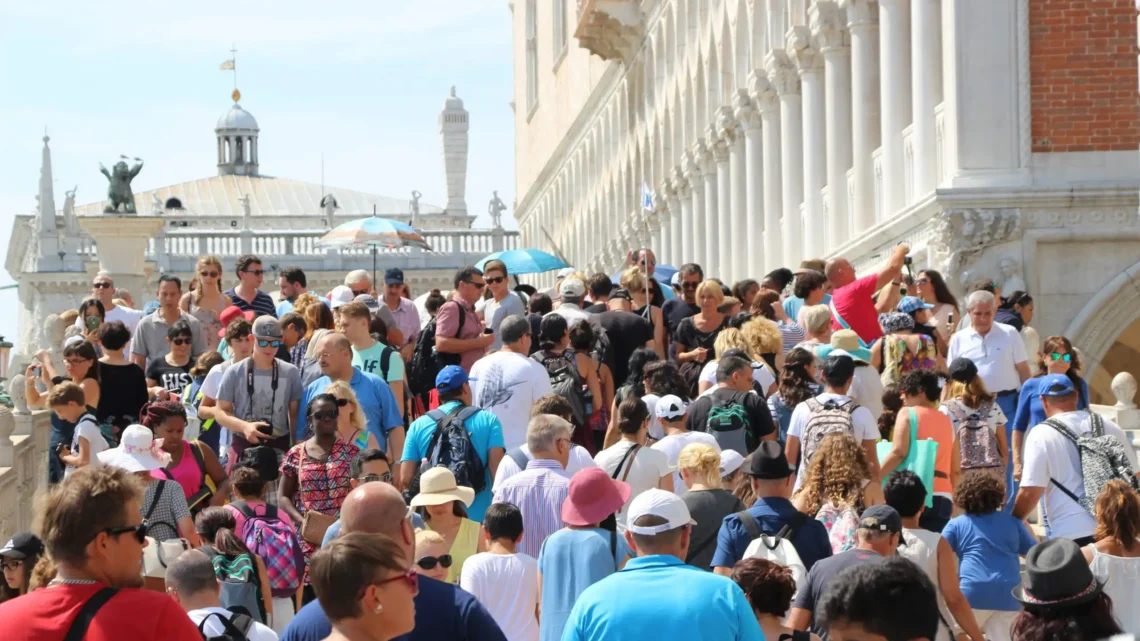
Overtourism: The Destinations That Are Being Loved to Death
As Venice, Barcelona, and Mount Fuji roll out fees, caps, and permits in 2026, the data reveals a harder truth: taxing tourists rarely stops them, only redistributing pressure to the destinations governments haven't regulated yet.
Overtourism describes what happens when a destination’s visitor volume exceeds what its infrastructure, housing market, environment, and residents can absorb, converting a place’s main economic asset into a source of local resentment and physical degradation.
In 2026, that tension has moved from academic conferences into national policy, with governments across Europe and Asia rolling out entry fees, visitor caps, and cruise restrictions in an attempt to manage destinations that tourism itself is now threatening to ruin.
Trending Now!!:
What Overtourism Actually Looks Like on the Ground
The word gets thrown around loosely, often as shorthand for crowded. That undersells the phenomenon. Crowding is a symptom.
The underlying problem is capacity mismatch: a city built for 200,000 residents absorbing 15 million annual visitors, a mountain trail engineered for a few hundred daily hikers processing thousands, a housing stock converted so heavily to short-term rentals that the people who staff the hotels and restaurants can no longer afford to live near their jobs.
In Barcelona, tourism accounts for roughly 12 percent of the city’s GDP, which is precisely why the backlash there matters as an industry signal rather than a fringe complaint.
A sector that large does not get regulated lightly, and when residents in a city that dependent on tourism revenue start organizing street protests against visitors, it indicates the strain has crossed from inconvenience into structural grievance.




Spain welcomed a record 94 million international visitors in 2024 against a resident population of 48 million, a ratio that illustrates the scale problem cleanly: nearly two tourists for every resident, concentrated overwhelmingly in a handful of cities and islands during a handful of summer months.
That concentration, not the raw visitor count, is what breaks a destination. Spain’s total land area could theoretically absorb far more tourism if it were spread evenly across the calendar and the map. It is not. Barcelona, Palma, and a few coastal strips take the brunt of it in a ten-week window.
The Housing Connection Most Coverage Underplays
Much travel journalism frames overtourism purely as a crowd management problem: too many people at the Trevi Fountain, too many cruise ships in the lagoon. That framing misses the mechanism doing the most damage in cities like Barcelona and Lisbon, which is the conversion of long-term residential housing into short-term rental inventory.
Spain’s government ordered Airbnb to remove nearly 66,000 holiday rentals from the platform after finding they violated local rules, a regulatory action far more consequential to residents than any entry fee, because it addresses the housing supply squeeze directly rather than merely taxing foot traffic. Protesters in Barcelona have made this connection explicit.
One resident, Andreu Martínez, described watching his rent rise more than 30 percent as more apartments in his neighborhood shifted to tourist rentals, framing the demonstrations as a fight to reclaim the city rather than simple annoyance at foot traffic.
This is the piece a purely crowd focused article on overtourism tends to skip: destination management plans that only address visitor flow, timed entry, queue systems, capacity caps, treat the symptom while leaving the housing market mechanism untouched.
Cities that have made the most measurable progress on resident sentiment are the ones pairing tourist-facing restrictions with rental market intervention, not the ones relying on an entry fee alone.
Case Study: Venice’s Day Tripper Fee, and Why the Data Is More Complicated Than the Headlines
Venice remains the most closely watched overtourism experiment in the world because it was the first city to charge a general entry fee for day visitors, and because the data from its first three seasons offers a genuine lesson in the limits of pricing as a crowd control tool.
During its 2024 trial period, the fee generated €2.43 million from 485,000 payments, more than tripling the initial revenue estimate of €700,000, a result city officials found hard to spin as unambiguous success. High revenue from a fee designed to discourage visits is, definitionally, evidence the fee did not discourage many visits.
Analysts who reviewed the first two seasons concluded the fee functioned more as a flow management and monitoring tool than a mechanism for cutting numbers, with its clearest effect being a modest flattening of the very sharpest visitor peaks rather than a broad reduction.
Venice expanded the program anyway. The 2026 calendar covers 60 days between April and July, up from 54 in 2025, operating from 8:30 a.m. to 4:00 p.m. on designated dates with free access outside those hours, and random checks carry fines of roughly $300 for visitors caught without a valid pass.
By the close of the 2026 season, the fee had generated more than €5 million in revenue from over 650,000 paid vouchers across those 60 days, with council officials reporting early indications that overcrowding on the city’s busiest days had softened compared with previous years, though a full analysis was still pending.
The practical lesson for other destinations watching Venice is not that entry fees fail. It is that a fee set low enough to be politically palatable rarely functions as a deterrent for a bucket list destination; it functions as a mild tax on a behaviour that continues largely unchanged. Venice’s own trajectory, adding days rather than raising the price meaningfully, suggests the city recognizes this and is choosing volume of coverage over price as its lever.
Case Study: Barcelona and the Water Gun Summer
The June 2025 demonstrations marked the first coordinated protest effort by activists across southern Europe’s top destinations, with several thousand marching in Mallorca, the largest single gathering, and hundreds more in Barcelona, Venice, and Lisbon.
The imagery, protesters spraying seated diners with cheap plastic water guns, became the defining visual of the overtourism story in 2025 precisely because it was so disproportionate to the underlying grievance, which made it shareable, and so pointed in its message.
Signs carried through the march read “One more tourist, one less resident”, and stickers left on hotel doors and lampposts paired a squirt gun icon with the phrase “Tourist Go Home”. The tactic reportedly originated a year earlier as an improvised way for a small degrowth activist group to cool off during a hot rally, before it was deliberately turned outward toward tourists themselves.
An overlooked detail in most coverage of that day is how narrow the participation actually was. Reporting on the ground noted that the number of protesters actually carrying water guns was a minority of the crowd, and that outside the organized marches, Barcelona residents were not generally confronting tourists on the street.
That distinction matters for anyone assessing destination risk. The protests generated global headlines and real policy pressure, but they do not reflect the day to day experience most visitors to Barcelona have, nor do they represent uniform resident sentiment in a city where, as noted above, tourism still funds a substantial share of the local economy.
Case Study: Japan’s Mount Fuji and the Bullet Climb Problem
Japan’s approach illustrates a different overtourism pattern: not urban housing displacement, but safety failure from volume on fragile terrain.
Roughly 205,000 people climbed Mount Fuji during a recent summer season, with crowding, litter, and unprepared hikers in street sneakers pushing local authorities to tighten access for a third consecutive year. Since 2025, every climber on every official trail has paid a mandatory ¥4,000 fee, roughly $27, replacing what had previously been a voluntary conservation donation collected on only one of the mountain’s four routes.
The 2026 season went further than pricing. Every climber now needs an online permit booked before reaching the trailhead, and the most heavily used route enforces a hard daily cap once it fills.
The Yoshida Trail specifically limits climbers to 4,000 per day, with gates closed from 2:00 p.m. to 3:00 a.m. to prevent so-called bullet climbing, the dangerous practice of rushing to the summit overnight without resting in a mountain hut. Climbers on the Shizuoka side routes must additionally complete an e-learning safety module and pass through QR code authentication before entry.
This is a useful counterpoint to the assumption that overtourism regulation is primarily a European phenomenon aimed at protecting quaint historic centers. Fuji’s rules exist because volume tourism was producing search and rescue incidents and permanent trail erosion on a working religious and natural site, a genuinely different risk category than a crowded piazza.
The Broader 2026 Policy Wave
What distinguishes 2026 from the preceding decade of overtourism commentary is coordination. Individual cities experimenting with entry fees have given way to a recognisable multi-country policy pattern.
France, Spain, Italy, Greece, the Netherlands, Japan, and Iceland have all tightened tourism regulation through a combination of quantitative limits, daily quotas, accommodation caps, group size restrictions, financial instruments, entry fees, punitive fines, and regulatory tools such as short-term rental registration and coastal development restriction. The stated goal across these governments is a shift toward planned access and equitable tourism rather than unrestricted growth.
The pricing detail varies significantly by destination and is worth knowing in specifics rather than in generalities, since generic overtourism coverage tends to blur the numbers together:
Spain. Barcelona’s Catalan Parliament doubled the regional tourist levy, and stays in luxury accommodation now cost tourists between €10 and €15 per person, per night, among the highest tax burdens in Europe. Tenerife introduced a separate eco-tax of up to €25 for hikers accessing Mount Teide National Park, with revenue directed toward conservation and park maintenance.
Greece. Cruise passengers disembarking at island ports including Santorini and Mykonos now pay a fee that scales by season, peaking between June and September, with proceeds funding waste management, port maintenance, and crowd control.
Norway. A municipal tourism tax launching in summer 2026 applies to hotels, guesthouses, and cruise visits, with selected municipalities charging up to 3 percent on overnight stays, aimed squarely at the Lofoten Islands and fjord regions where cruise volume has outpaced trail and parking infrastructure.
Japan. Beyond the Fuji climbing fee, Japan’s departure tax is set to triple in July 2026, Kyoto’s hotel tax rose sharply in March, and new prefecture-wide lodging taxes have started in Hokkaido and Hiroshima.
Amsterdam, Barcelona, Venice. Amsterdam charges a 12.5 percent hotel room tax or a separate €15 per person cruise levy, Barcelona’s combined hotel tax reaches €15 per person per night, and Venice’s day tripper fee sits at €10, making these three the highest combined tourism charge destinations in Europe by most current tallies.
What the Data Says About Whether Any of This Is Working
This is the question every overtourism article should be answering and most do not, because the honest answer is unsatisfying: it is too early to say definitively, and the early evidence is mixed rather than conclusive.
Skyscanner’s 2026 travel trends report, drawn from more than 22,000 travelers, found that 32 percent had experienced negative effects from overtourism and 34 percent were actively seeking quieter destinations, which indicates the travelers themselves are responding to crowding independent of any government policy, simply by rerouting their bookings. That same shift shows up in booking patterns favoring Albania over the Amalfi Coast and Ljubljana over Prague, a market correction that fee structures did not cause but that fee structures are now riding.
The clearest misconception in mainstream overtourism coverage is treating a tourist tax as a solution rather than a funding mechanism. A €5 or €10 charge does very little to change the calculus of someone who has already booked flights to see Sagrada Família or the Rialto Bridge; it is not priced at a level that functions as genuine deterrence, and Venice’s own revenue data proves as much.
What these fees reliably do is generate dedicated funding for the infrastructure absorbing the damage, waste management, trail maintenance, and crowd-control staffing, without meaningfully reducing peak-day volume. Destinations that have achieved actual volume reduction, rather than just revenue collection, have generally done so through hard caps: Mount Fuji’s Yoshida Trail daily limit of 4,000 climbers or short term rental removal at scale, not through pricing alone.
Practical Implications for Travelers
For anyone planning travel to a destination currently managing overtourism, a few operational realities are worth internalizing beyond the headline fee amounts.
Fees and caps are concentrated in narrow windows, not applied year-round. Venice’s day tripper charge only applies on specific Friday through Sunday dates across April, May, June, and July, with free access every other day and every evening after 4:00 p.m. Shoulder season travel avoids nearly all of it.
Venice’s fee only runs April through July, and Greece’s cruise port levy drops from €20 to €12 outside peak months, meaning the same trip planned six weeks earlier or later can cost meaningfully less and involve dramatically smaller crowds.
Exemptions are broader than most visitors assume. Venice’s fee does not apply to overnight guests at all, only same-day visitors, and residents, students, and workers are also exempt. Anyone booking accommodation within the historic centre rather than commuting in from the mainland sidesteps the charge entirely.
The budget impact compounds across a multi-city itinerary. A realistic estimate for new taxes, entry fees, and access charges that did not exist three years ago runs an extra €150 to €300 per multi-city European trip, a figure worth building into trip budgeting rather than discovering at checkout.
The Destinations Worth Watching Next
The pattern emerging across 2026’s policy wave suggests the next phase of overtourism management will move beyond fees toward hard infrastructure limits, permit systems modelled on Mount Fuji’s daily cap, and continued regulatory pressure on short-term rental platforms.
Tourism experts anticipate stronger growth in secondary destinations and rural tourism regions as travellers seek alternatives to the most heavily regulated hotspots, a redistribution effect that may end up doing more to relieve pressure on Venice, Barcelona, and Kyoto than any single fee structure.
The destinations genuinely worth watching for early warning signs of the next overtourism flashpoint share a common profile: fragile physical infrastructure, a single dominant attraction that anchors nearly all visitor traffic, and a local economy dependent enough on tourism revenue that residents cannot simply opt out of the industry, causing their displacement.
That combination, not visitor count in isolation, is what turns a popular destination into one being loved to death.
What People Ask