
At 29, She Had Everything She Thought She Wanted, Except the Feeling of Being Home
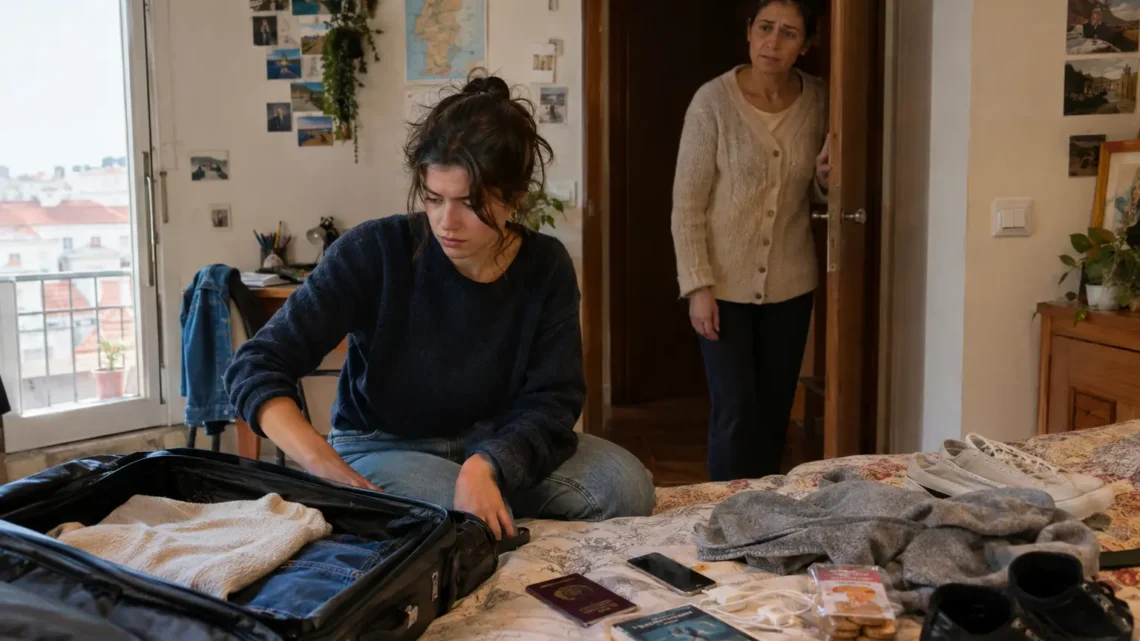
The suitcase was still open when Inês told her mother she was not going to the airport.
Her passport was on the bed. Her phone was charging beside it. A train ticket to Lisbon Oriente was folded under a paperback she had not finished, and on the floor were three pairs of shoes, a grey sweater, two chargers, and a packet of biscuits her mother had slipped into the side pocket without asking.
Trending Now!!:
Her mother stood in the doorway and stared at the mess.
What do you mean you are not going?
Inês looked at the suitcase.
I mean I am not getting on that plane tonight.




Her mother did not move.
Outside their apartment in Setúbal, a scooter went past with the engine making that strange coughing sound that always made Inês think of summer evenings when she was younger. Someone downstairs was dragging a chair across a tiled floor. From the kitchen came the smell of coffee that had been sitting in the pot too long.
It was not the kind of moment anyone would put in a film.
Nobody screamed.
Nobody packed a bag and stormed out.
Her mother simply said, You bought the ticket three weeks ago.
I know.
You told everyone you were excited.
I know.
Then her mother looked at the suitcase again.
Did something happen?
That was the problem.
Nothing had happened.
At twenty-nine, Inês had spent most of her adult life believing that important decisions were supposed to arrive with a reason attached to them. A new job. A breakup. A death. A baby. A better apartment. Something clear enough that other people could nod and say, Of course.
Her reason was harder to explain.
She had been living in London for six years.
She had built a life there.
She had a job at a small design company near Shoreditch, a rented flat with terrible windows, a favorite bakery, a gym she barely used, and a group chat that never stopped buzzing. She knew which supermarket stayed open late. She knew how long it took to get from her flat to Liverpool Street when the Central line was behaving badly.
She had even learned to complain about the weather like she belonged there.
Then, eight months earlier, her father had a minor heart problem.
Nothing dramatic. He recovered. The doctors told him to walk more, eat better, and stop pretending that fried food did not count if he ate it standing up.
Still, Inês flew home.
She stayed for twelve days.
Those twelve days changed something she could not name.
When she returned to London, everything looked exactly as it had before. Her flat was still cold. Her neighbor’s television was still too loud. Her colleague Maya still sent her memes before nine in the morning.
Yet something felt slightly misplaced.
At first, Inês blamed the city.
Then she blamed herself.
She started spending too much time scrolling through photos of Portugal. Streets in Lisbon. Cafés in Setúbal. The waterfront at sunset. The little grocery shop near her parents’ apartment. A bakery where she had once bought a custard tart with her father and argued with him about football.
She knew social media could turn any ordinary place into a postcard.
She also knew she was not looking at postcards.
She was looking at home.
Or what she thought home was supposed to mean.
Her boyfriend, Daniel, did not understand.
You can visit whenever you want, he had told her.
They were sitting on the floor of their London flat eating takeaway noodles because neither of them wanted to wash dishes.
Inês had said, That is not the same thing.
Daniel had looked at her for a moment.
What would be the same thing?
She had not answered.
That was when the arguments started.
Not big arguments.
Small ones.
The kind that begin with a question about dinner and somehow become about your entire future.
Daniel wanted to know whether she was thinking about moving back.
Inês said she did not know.
He asked whether she wanted him to move with her.
She said she did not know that either.
He became quiet after that.
The strange part was that Inês loved him.
That made everything worse.
If she had stopped loving him, the decision would have been easy.
Instead, she loved him and still wanted something else.
She began searching for apartments in Lisbon late at night. Then she would close the browser and feel guilty.
She read articles about the cost of living in Lisbon. She looked at salaries. She checked rental prices. She searched for career growth tips and quietly laughed at herself because she had no idea what kind of growth she was actually looking for.
She was not trying to become richer.
She was trying to become less divided.
One Saturday, Maya found her staring at her phone during lunch.
You are doing it again.
Inês looked up.
Doing what?
Looking at apartments you cannot afford.
Inês laughed.
That obvious?
You have been looking at the same apartment for seven minutes.
The apartment was near Arroios. Small kitchen. Tiny balcony. Good light.
Maya took a sip of her coffee.
If you move back, will you be happy?
Inês shrugged.
I do not know.
If you stay?
Another shrug.
I do not know.
Maya put down her cup.
That sounds annoying.
It is.
Then stop asking yourself which city is better.
Inês frowned.
What should I ask?
Which life feels more like yours.
That sentence stayed with her.
A week later, Inês bought the ticket to Lisbon.
She told Daniel.
He went very quiet.
For how long?
I do not know.
You keep saying that.
Because I do not know.
He nodded.
Then he asked something she had been avoiding.
Are you going there to decide whether you want to stay with me?
She looked at him.
I think I am going there to decide whether I still want the life I have here.
He did not argue.
That hurt more than arguing would have.
Now, back in Setúbal, with her suitcase open and her mother waiting for an explanation, Inês finally understood that the ticket had become bigger than a train ticket.
It was a decision.
Her mother walked into the room and sat on the edge of the bed.
You do not have to know everything today.
Inês rubbed her eyes.
Everyone keeps asking me what I am going to do.
Everyone likes answers.
Her mother smiled.
Answers make people comfortable.
Inês laughed.
You are saying this like you have never worried about what people think.
Of course I worry.
You hide it better.
I have had more practice.
They both laughed.
Then her mother picked up one of the shoes from the floor.
Take these.
Why?
Because you will regret leaving them here.
That was when Inês started crying.
Not because her mother had said anything profound.
Because it was such an ordinary thing to say.
The next morning, she went into Lisbon anyway.
She walked through Baixa, crossed Praça do Comércio, and stopped near the river. Tourists were taking pictures. A man was selling bottled water. Two children were chasing pigeons while their father shouted their names.
Inês stood there with her phone in her hand.
She opened the chat with Daniel.
She typed:
I think I want to come back.
Then she deleted it.
She typed:
I think I want to stay in Portugal.
Deleted.
Finally, she wrote:
I do not know yet. I just know I need to find out.
She stared at the message.
Then she sent it.
For several minutes, nothing happened.
She walked toward Rossio.
Her phone buzzed.
Daniel had replied.
Okay.
Just that.
Inês stopped walking.
She read it twice.
Then three times.
She had expected anger. Questions. Maybe a long message about everything they had built together.
Instead, there was one word.
Okay.
She put the phone back into her pocket.
At Rossio station, she bought a coffee and sat near the window. People came and went around her, dragging suitcases, checking train times, hugging relatives, complaining about delays.
A woman across from her was trying to calm a crying child.
A man in a suit was eating a sandwich while typing with one hand.
An elderly couple shared a pastry without speaking.
Nobody looked like they knew exactly where they belonged.
That thought made Inês smile.
For years, she had treated belonging like an address.
London or Portugal.
There or here.
Stay or leave.
Maybe it was never that simple.
Her phone buzzed again.
This time it was her mother.
Are you coming home for dinner?
Inês smiled.
She typed back.
Yes.
Then she paused.
She almost added something else.
She almost wrote that she had made a decision.
Instead, she put the phone away.
She still had a suitcase waiting in Setúbal.
She still had a boyfriend in London.
She still had a job, a lease, friends, bills, plans, fears, and a return ticket she had not cancelled.
Nothing had been solved.
For the first time, that did not frighten her.
She finished her coffee and watched a train pull into the station.
Maybe home was not the place you finally chose.
Maybe it was the place where you could admit you were still choosing.