How a Bankruptcy Filing Became the Beginning of a New Life
The phone buzzed on the dashboard, a 901 number I didn’t know, and I let it ring out the way I had let out hundreds of others.
I was parked outside a strip mall on Summer Avenue in Memphis, between a tax preparer and a Chinese buffet that had been “closing for renovations” since before the pandemic.
Trending Now!!:
The lawyer’s office was the third door down. I had been in the car twenty minutes, eating a Little Debbie oatmeal creme pie I didn’t even want, because my hands needed a job.
My name is Tasha Greer. I was thirty-eight, I did hair out of a rented booth at a salon on Poplar, and I owed sixty-one thousand, four hundred dollars to eleven different places.
Most of it started with my mother’s stroke. I signed the hospital paperwork on a clipboard in a hallway at two in the morning, holding her purse, not reading a word. Nineteen thousand dollars of it came from that night.
The rest was credit cards that covered the cost of living when my tips didn’t, and a payday loan from a place on Lamar that began as four hundred dollars and grew a new head every month.



I had told nobody. My sister Monique thought I was fine because I posted my Sunday press-and-curls on Facebook with the good lighting. Every letter went into a Kroger bag in the hall closet. I stopped answering any number I didn’t have saved, and I muted the church group chat because the buzz of a notification made my stomach drop through the floor.
Inside the office, a receptionist named Brenda looked up from her screen. Her wig needed a touch-up at the lace line, and I noticed it, and hated myself for noticing, and could not stop noticing. Some people count exits. I count edges.
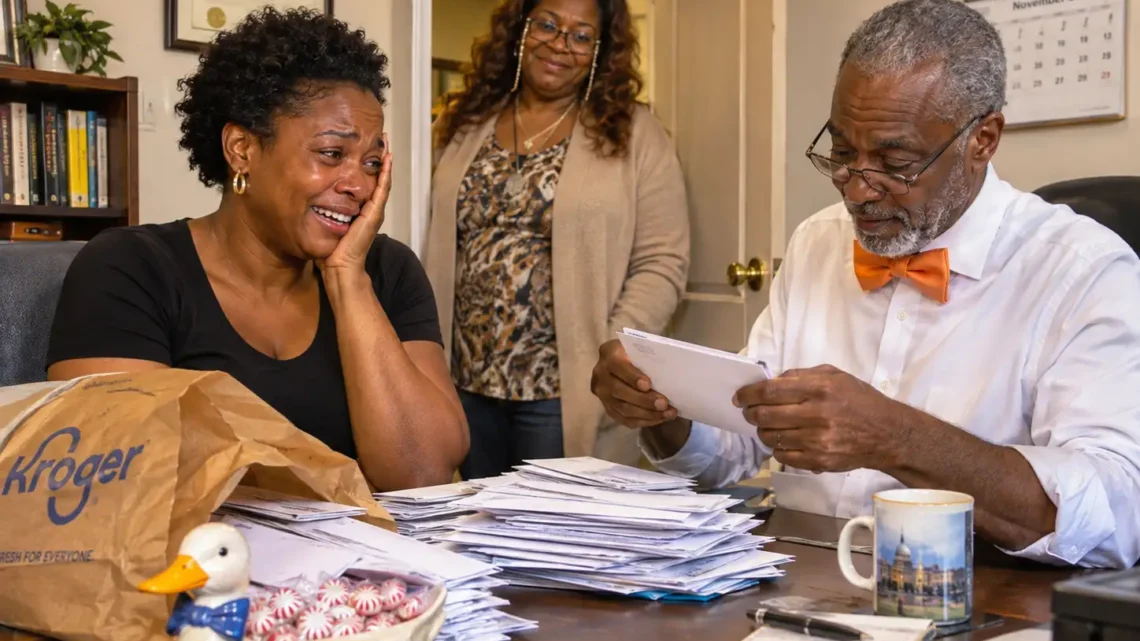
Winston Abernathy was sixty-seven and wore a bow tie the color of a traffic cone. He kept peppermints in a ceramic duck. His office smelled like carpet and coffee that had been made at seven and forgotten.
Put it all on the desk, he said.
I tipped the Kroger bag over. Two hundred and some envelopes slid out, most of them sealed. I watched his face for the thing I had dreaded for two years, and it never showed up.
He opened them one at a time. Hospital. Card. Card. A debt buyer in Delaware I had never heard of. He made little stacks, like a man dealing a slow game of cards.
I’ve had people bring me a shoebox, he said. One man brought a wheelbarrow. A grocery bag is organized.
I laughed, and then I was crying, and he slid the duck across the desk without a word. I took a peppermint. It was stale. I ate it anyway.
He explained everything in about six minutes. Chapter 7. Most of what I owed could be wiped out. I would keep my car, my clippers and my mother’s furniture. The moment he filed, the calls had to stop by law. He called it the stay. I called it the best word I had ever heard.
What does it cost? I asked.
Fifteen hundred for me, and three hundred and thirty-eight to the court, he said, looking at me over his glasses. You can pay me in pieces. Most people do.
For two months I paid him in pieces. A hundred here, eighty there, cash from weekend clients, counted out on his desk. Brenda wrote each one on a receipt pad with a pen that kept skipping. It was the strangest feeling, paying someone so I could stop paying everyone else.
The list was the hard part. Every creditor had to go on it, even the ones I loved. Monique was on there for four thousand dollars, the deposit she had lent me to move our mother into a one-level apartment off Winchester.
I asked if I could pay her back first, quickly, before the filing.
Winston Abernathy unwrapped a peppermint slowly. You can try, he said. The trustee can come back and pull it out of her hands, though. Family gets looked at harder than anyone.
Then she just gets a letter? I asked.
The court mails everyone on the list. I’m sorry. I really am.
I did not tell her. I told myself it was kinder to wait until it was over. The truth is that I was scared, and I wanted one clean month before anyone looked at me differently.
He filed on a Thursday. It took eleven minutes at his computer while I sat across from him holding a peppermint I never unwrapped. Then he said it was done. My phone lay on the desk, and nothing happened. This was the whole ceremony.
Friday morning I woke at 6:10 with no knot in my chest, and it scared me more than the knot ever had. The hot water ran out halfway through my shower, and I stood there laughing at the cold like it was a gift. I ate cereal standing at the counter. My phone buzzed with a 901 number and I flinched so hard I dropped the spoon.
It was the salon, asking if I could take a nine o’clock. I took it.
The meeting of creditors was held at the federal building on Jefferson Avenue, in a room with plastic chairs and a flag in the corner. About thirty of us waited.
A man in work boots held his hard hat on his knee. A girl in a Grizzlies jersey kept checking her phone and putting it face down. Nobody spoke, and we all knew exactly why the others were there, which is a strange kind of company.
The trustee, Carolyn Dukes, called my name and asked four questions. Did you read your petition before signing? Is everything in it true? Any property left off? Any payments to family in the last year?
No, ma’am, I said to the last one, and it was true, and I have never been so grateful to have been too broke to be sneaky.
It took under five minutes. I sat on the steps afterward with a Coke from the lobby machine and watched the trolley go by, feeling nothing I could name. Then I felt hungry. It was the first time in two years I wanted food instead of just eating it.
Nine days after the filing, Monique called. I knew before I answered, because she never called in the daytime.
I have a letter from the United States Bankruptcy Court on my counter, she said. Tell me it is not what it looks like.
I told her. All of it. The hospital, the cards, the bag in the closet. She stayed quiet so long I checked the screen to see if the call had dropped.
Four thousand dollars, she said at last. You hugged me at Easter. You let me pay for the lemon pound cake.
I didn’t have a choice, I said.
You had a phone, she said, and hung up.
The discharge came on day ninety-seven, two pages in a plain white envelope. I read it in the car outside the salon. No trumpets. A case number, a judge’s signature, and a line saying I was released from personal liability for my debts. I read that line four times, the way you reread a text when you can’t believe the person meant it.
Nobody called to congratulate me, because nobody knew.
I opened a savings account at a credit union on Union Avenue with forty dollars. I applied for nothing else. The cost of living in this city does not care what a court says about your past, and I still kept every grocery receipt, but I slept. I slept eight hours on a Tuesday and woke up not knowing where I was.
Monique had not spoken to me in three weeks. The court had erased the four thousand dollars. It had not erased the lemon pound cake.
The night before, I worked out what I could afford: fifty dollars a month for eighty months, with nobody making me and nothing the law said I owed. Part of me thought it was the only decent thing left to do. Another part thought it was what a person does to feel clean, and that I was doing it for me and not for her. Both parts sounded like me.
I sent fifty dollars on Cash App from the car, with one line in the note: first of eighty.
It has been three days. Beside her name, where the little checkmark should be, one word is waiting. Pending.
Starting over is easy to file for and hard to explain to the people who were standing next to you when you fell.