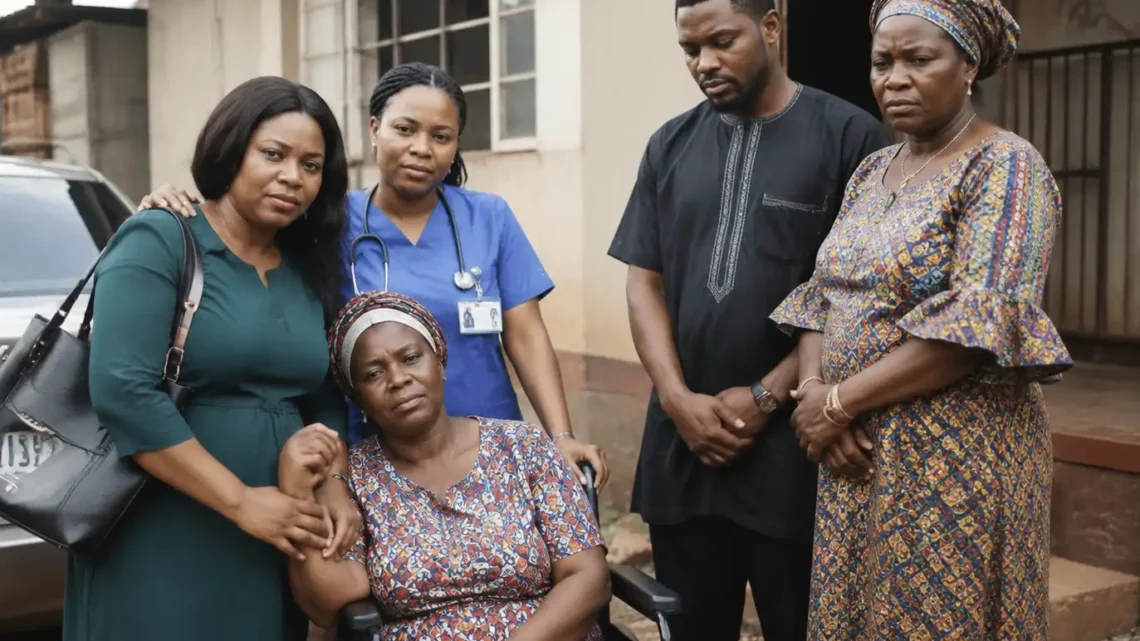
How Three Old Schoolmates Fought a Whole Family to Save Ogechi
I hadn’t set foot in Enugu in nine years when Chidinma’s message landed on my phone at 11pm on a Tuesday, three words long: Ogechi is dying.
I read it twice before my hands understood what my eyes had already known, and by 5am I was on a Peace Mass Transit bus out of Lagos, watching the Niger Bridge blur past through a window fogged with my own breath.
Trending Now!!:
Chidinma, Ogechi, and I had been inseparable at Queens School, Enugu, the kind of trio that finished each other’s sentences and got punished together for offenses only one of us actually committed. Then life did what life does. I moved to Lagos for a banking job.
Chidinma stayed and became a nurse at UNTH. Ogechi married a man from Nsukka and disappeared into a life none of us were invited into, not because she didn’t want us there, but because her husband’s family treated visitors like intruders casing the compound.
The bus dropped me at Holy Ghost roundabout a little after 1pm, and Enugu welcomed me with its particular smell, red dust mixed with roasting corn, and hills sitting quiet in the distance like they were waiting for something. I took a keke straight to Chidinma’s flat off Chime Avenue, and she opened the door already crying before I said a word.
She is not dying dying, Chidinma said, wiping her face with the back of her wrist. I just needed you to come fast. Ndi be ya, her husband’s people, they have refused to let her go to Lagos for proper treatment.




They are saying it is spiritual attack, that somebody in her husband’s family is fighting her from breast cancer diagnosis to now, and they have taken her phone so she cannot call anybody.
I sat down hard on Chidinma’s plastic chair, the kind with the woven seat that leaves marks on your thighs. Cancer. The word sat between us like a stone nobody wanted to lift.
We went the next morning, the two of us, in a taxi that rattled down the road to Nsukka like it was auditioning for scrap metal. Chidinma had somehow gotten a message to Ogechi’s younger sister, who agreed to let us in through the back gate while the mother-in-law was at a prayer meeting.
Ogechi had lost weight in a way that frightened me, her collarbones sharp under a faded ankara wrapper, her head wrapped in a scarf that couldn’t hide how thin her hair had become. But when she saw us standing in that doorway, something came alive in her face that the sickness hadn’t touched.
Is this a dream, she said, her voice cracking down the middle. Chidi, Amaka, is this really you people?
We are not a dream, Chidinma said, already crossing the room to hold her. We are very real, and we came to carry you out of here whether these people like it or not.
Ogechi laughed, a small broken sound, and told us how her husband’s mother had spent months insisting that chemotherapy was for people who didn’t have faith, that the family’s herbalist in Obollo Afor had roots that could reverse anything hospitals couldn’t touch, that going to Lagos for a second opinion was an insult to the ancestors and to her husband’s authority as head of the house.
Her husband, caught between his mother and his wife the way many Nsukka men are trained to be, had simply gone quiet and let his silence do the deciding for him.
I have missed two rounds of treatment, Ogechi whispered, glancing at the door like the walls themselves might report her. The doctor at UNTH said if I miss more, we may lose the window.
Chidinma didn’t waste another second. She called her cousin who worked at the Federal Ministry of Health liaison office, then called a lawyer friend from her nursing union, then called our old school’s alumni WhatsApp group, forty women scattered from Enugu to Houston, and within two hours money and manpower had assembled around Ogechi like she’d sent out an invitation. It was the kind of thing that made me remember why Nigerian women’s networks are underrated as a national resource.
The confrontation happened that evening when Ogechi’s mother-in-law returned from her meeting and found her son’s wife dressed, packed, and standing in the parlour with two women she didn’t recognize and a car waiting outside.
Where do you think you are carrying her to, the older woman demanded, her wrapper still smelling of church incense.
University of Nigeria Teaching Hospital, Chidinma said, calm the way only nurses who’ve survived worse shouting matches can be calm. Her treatment cannot wait again. If anybody wants to stop us, they can explain to the police why a dying woman was denied medical care.
Ogechi’s husband stood in the corner the entire time saying nothing, and I watched something in Ogechi’s eyes settle, not with hope exactly, but with the clarity of a woman finally seeing her situation without the fog of hoping her husband would choose her first.
The mother-in-law kept shouting about faith and disrespect, but nobody was listening anymore, and eventually, in the way loud voices lose their power when nobody flinches, she went quiet too.
We got Ogechi to UNTH that night. The doctors resumed her treatment the following morning. It wasn’t a miracle cure, nobody’s story works that cleanly, and the road ahead of her was still long and uncertain, but it was a road again, which was more than she’d had in weeks.
I stayed in Enugu for eleven days, sleeping on Chidinma’s floor, sitting with Ogechi through drips and nausea and the particular boredom of hospital afternoons, the three of us laughing sometimes about nothing, the way we used to laugh at Queens School over jokes that made sense only to us.
Ogechi’s husband started visiting more, quieter now, like something in him had shifted too, though whether it would hold once the crisis passed, none of us could say for certain.
On my last morning before heading back to Lagos, Ogechi held my hand in that hospital bed and said, You people came back for me when I had already stopped expecting anybody to.
That is what real friends do, Chidinma said from the window, arms folded, refusing as always to let a moment get too soft.
I think about that sentence often now, months later, whenever Enugu comes up in conversation and people ask what took me back to the Coal City after nine years. It wasn’t nostalgia, and it wasn’t obligation. It was three girls from Queens School remembering that some promises don’t come with an expiry date, they just wait quietly until somebody needs them kept.