I Saw Him With Another Woman in Lekki. I Said Nothing for Three Weeks
The cracks on her ceiling had a pattern Ngozi Okafor knew better than she knew her own husband’s schedule, which was the first sign something was wrong with her life, though she wouldn’t admit that part to anyone, not even herself, not yet.
It was a Tuesday in July, the kind of Lagos rain that turned Ojuelegba into a small lake and made every danfo conductor scream twice as loud just to be heard over the downpour drumming on zinc roofs.
Trending Now!!:
Ngozi lay on the bed she shared with Emeka four nights a week, staring at that ceiling, listening to her phone buzz against the side table where it had been buzzing every fifteen minutes since six that morning.
Madam, good morning oh, just checking if you saw the design, the voice note said. It was Blessing, her tailor, the one everyone on the street called “Blessing Hands” because of how her needle moved like it had its own sense of direction.
Ngozi didn’t pick up the design question first. She picked up the bigger question sitting in her chest like swallowed pepper soup: should she tell Emeka that his brother Chidi had been the one driving the Toyota Camry she saw parked outside the Lekki Phase 1 apartment three weeks ago, at 11pm, with a woman who was definitely not his wife, Adaeze?
She had said nothing then. She told herself it was not her business. Lagos people, especially Lagos wives, learned quickly that some doors you don’t open because once you open them, you cannot un-see what is inside, and you cannot un-know what you now carry.




But three weeks of silence had grown teeth, and every time she sat across from Adaeze at family gatherings, watching her laugh at Chidi’s jokes, refill his plate of jollof without being asked, Ngozi felt the secret chewing through her insides like termites in old wood.
By the time Emeka came home that evening, soaked from the rain, dropping his work bag by the door with the particular sigh of a man who had spent six hours stuck in traffic on the Third Mainland Bridge, Ngozi had already decided.
She would not tell him. It was, after all, his brother’s marriage to ruin, not hers.
Babe, this Lagos will kill somebody o, Emeka said, peeling off his wet shirt. Three hours from Yaba to here. Three hours. For what distance?
Welcome, she said, and brought him a towel, and said nothing else.
But Lagos, true to its reputation, does not let secrets rest long. Two days later, Ngozi’s phone rang while she was haggling over tomatoes at Mile 12 market, the air thick with the smell of fermented locust beans and diesel smoke from generators powering the cold rooms. It was Adaeze.
Ngozi, abeg, you have to come now now, Adaeze said, her voice cracking in a way Ngozi had never heard before, not even when Adaeze’s father died two years back. I found pictures. On his phone. I found everything.
Ngozi stood there between two tomato sellers shouting prices at each other, holding a black plastic bag full of pepper and onions, feeling the weight of three weeks of swallowed knowledge finally demanding to be spat out.
She told the tomato seller she would come back, which she would not, and she boarded the first okada she could flag, ignoring the rain that had started again, fine and needling.
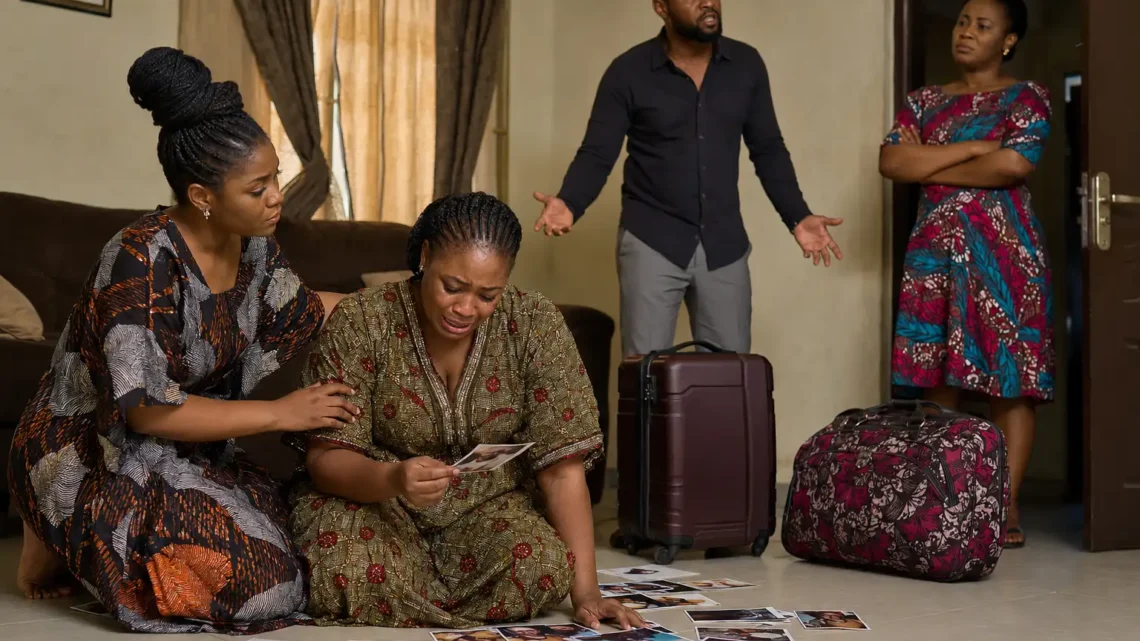
When she arrived at Chidi and Adaeze’s flat in Ogudu, the door was open, which in Lagos is never a good sign. Inside, Adaeze sat on the floor surrounded by printed photographs, the kind from a real camera, not phone screenshots, photographs of Chidi and a woman Ngozi now recognized as his secretary at the shipping company, taken over what looked like the better part of a year.
You knew, Adaeze said, not looking up. It wasn’t a question.
Ngozi’s mouth went dry. Knew what?
Don’t do that with me. Adaeze finally lifted her face, and her eyes were red but dry, the crying long finished, replaced by something colder. I called the apartment building. The security man described you. You were there three weeks ago. You saw the car.
There was no escaping it now. Ngozi sat down on the floor beside her, careful of her wrapper, and admitted it, every detail, the time, the Camry, the woman who was not Adaeze, the three weeks of silence she had told herself was loyalty but now, sitting in the wreckage of someone else’s marriage, looked a lot more like cowardice.
Why didn’t you tell me? Adaeze asked.
Because I didn’t know how to hold something like that and hand it to you, Ngozi said. Because I kept thinking, what if I am wrong. What if it was nothing.
It was something, Adaeze said, gesturing at the photographs scattered like fallen leaves across her own sitting room floor. It has been something for a long time.
They sat in silence for a while, the rain picking up outside, drumming harder on the roof, and somewhere down the street a generator coughed to life with its familiar diesel growl. Adaeze eventually gathered the photographs into a neat stack, tapping them against the floor the way you straighten a deck of cards, and said, I’m not going to scatter anything today. I’m not going to shout. I’m going to pack his things, and when he comes back from work, he will meet two bags by the door and a key on the table.
That’s it? Ngozi asked.
That’s it, Adaeze said. I have already cried the crying I needed to cry. Today is for packing.
Ngozi helped her fold shirts into a suitcase, the two of them moving through Chidi’s wardrobe with the brisk efficiency of women who had decided something and were no longer interested in revisiting the decision.
They didn’t speak much, just the occasional instruction: that one is mine, leave it, or fold it like this, it won’t crease.
When Chidi came home that night to find his bags by the door and his wife sitting calmly on the sofa with a cup of tea, he tried every register Lagos men try in that moment, anger, then wounded innocence, then a softer pleading tone that made Ngozi, listening from the kitchen where she had stationed herself as backup, want to throw something at him.
Adaeze, please now, we can talk about this, he said.
We are not talking, Adaeze replied, not raising her voice once. You are leaving. Your brother’s wife packed your bags with me, so don’t bother performing surprise. She knows everything I know.
Chidi turned to Ngozi in the kitchen doorway, betrayal written across his face as though she were the one who had wronged him, and for a moment Ngozi almost laughed at the audacity of it, a man caught with a secretary in Lekki, somehow finding room to feel betrayed by his sister-in-law.
You should have called me first, he said to her, quietly, like it was a private matter between them.
You should have thought about that before you parked that Camry outside Lekki Phase 1, Ngozi said, and walked past him to help Adaeze carry the last bag to the door.
By the time Emeka heard the full story from his mother two days later, the family group chat had already split into factions, half defending Chidi as a man who simply “made a mistake,” the other half, mostly the women, quietly messaging Adaeze their support without saying it out loud in the main chat where Chidi’s mother could see.
That night, Emeka asked Ngozi why she hadn’t told him what she saw three weeks earlier, and she gave him the same answer she had given Adaeze, the one about not knowing how to hold a thing like that.
You don’t have to know how, he said, pulling the blanket over both of them as the rain finally eased outside their window. You just have to choose to.
She thought about that for a long time after he fell asleep, listening to the last of the rain finishing its business on the roof, and decided that the next time Lagos handed her a secret too heavy to carry alone, she would put it down faster, even if her hands shook the whole time she did it.